TUC president and POA leader STEVE GILLAN speaks to Ben Chacko on the eve of Congress 2026


 Latest editorial
Sheinbaum turns the tide: mass mobilisation and reform drive Mexico’s Transformation forward
Ten days after right-wing destabilisation attempts, Mexico’s leadership has emerged strengthened, securing historic labour and wage agreements, while opposition-backed protests have crumbled under scrutiny, says DAVID RABY
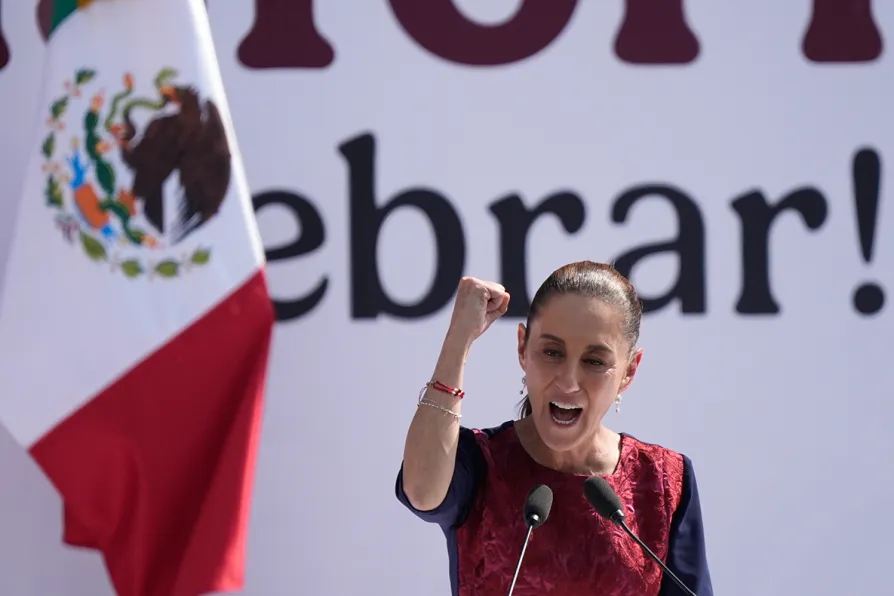 Mexican President Claudia Sheinbaum addresses supporters gathered in the Zocalo in Mexico City, December 6, 2025, to celebrate the seven years since President Andres Manuel Lopez Obrador electoral victory

DOUG NICHOLLS welcomes a turning point at this year’s Congress, where many motions call for a co-ordinated plan to revive British industry, a perspective outlined in his new book
HOPE VIRGO of campaign Dump the Scales warns MPs voting today they should be alert to the threat legalised assisted death poses to people with eating disorders
The Together Alliance is hosting two summits, North and South, to build power and plan action against the scourge of racism peddled by the right. DANIEL KEBEDE urges mass participation
The drift toward militarisation in Europe is not inevitable, left-wing and peace movements can preserve sovereignty and prevent war, says DÁIRE HUGHES MP
Whatever differences exist among international sympathisers of the Bolivarian revolution about its current trajectory, they should unite against the imperialist power that is the source of an enforced retreat, argues ROGER D HARRIS
Trade unions need to step up and force a turn in the policies of the labour movement to effectively confront the far-right threat, argues NICK WRIGHT





TEN days ago the news from Mexico was of violent right-wing protests and destabilisation attempts but the popular response led by President Claudia Sheinbaum has completely transformed the situation.
An investigation by the Morena party group in the Mexico City Assembly produced detailed evidence of the identity of several of those most prominent in the violent November 15 protest, and the direct responsibility of the right-wing mayors of two city boroughs for organising the protest.
Other attempts to stir up trouble continued for several days afterwards. Starting on November 24 lorry drivers and farmers mounted blockades of several key motorways, causing serious disruption, demanding better prices for corn and access to markets.
When the government — through Home Secretary Rosa Icela Rodriguez — pointed out that there had already been many meetings to resolve these issues and that dialogue was ongoing, the protesters changed their tune and said the main problem was insecurity caused by criminal assaults on commercial vehicles.
Such assaults, obviously a form of organised crime, had become a problem starting about three decades ago under the previous neoliberal governments, and while they have not disappeared they have been much reduced under former president Andres Manuel Lopez Obrador (Amlo) and now Sheinbaum.
So it is clear that these protests are opposition-inspired attempts to cause trouble and have almost no real basis. It was also quickly demonstrated that the transport companies involved in the blockades were a small minority and most companies in the sector were against the disruption they caused; similarly, the farmers (“peasant leaders”) involved in the protests were wealthy producers connected to right-wing politicians.
Further protests from similar privileged groups began around the same time, in this case against the government’s Water Law Reform which was being debated in Congress. Water in Mexico is in principle a public good regulated by the National Water Commission, Conagua, but municipalities, farmers and industrial enterprises receive concessions according to their needs.
Neoliberal governments had granted abusive concessions to powerful individuals and interests, and there was serious corruption in Conagua. Amlo took measures to combat this corruption and reassert public control of water extraction and distribution, but more still needed to be done, especially with severe droughts caused by climate change.
Under Sheinbaum a Water Law Reform Bill was introduced to further limit private water concessions and prioritise drinking water supplies over commercial interests. Recent protests against this, posing as defence of local people’s access to water, have been led by large farmers such as the LeBaron Mormon clan in Chihuahua, who have long hoarded water supplies in the area.
Such opportunist protests by privileged interests have only served to further discredit the right-wing PAN and PRI parties which are desperate (in league with the international far right) to undermine Mexico’s Fourth Transformation and the most popular president in the country’s history.
The end of November and the first week of December brought developments which demonstrated the remarkable strength and dynamism of the transformative process. The Water Reform Bill was passed with a large majority by Congress.
The Attorney-General (Fiscal General de la Republica, FGR) Alejandro Gertz Manero, a veteran public servant who has been much criticised but has been defended both by Amlo and Sheinbaum, resigned; whether or not he was incompetent or even corrupt as some allege, he is 86 years old and this alone may explain his departure.
What is beyond doubt is that his replacement, Ernestina Godoy, rapidly selected and approved by the Senate, is a very capable, principled and determined woman who will give a new impetus to the fight against crime and corruption; her appointment has been welcomed by all except the most conservative.
On the same day, December 3, the president used her press conference to host a large gathering of business leaders to announce an official agreement for gradual transition to a 40-hour work week (it is currently 48 hours, one of the few labour issues on which no progress had hitherto been made by the Transformation governments).
At the same press conference the president also announced agreement on a 13 per cent increase in the minimum wage from January 1 2026; with this the minimum wage, which had been frozen in real terms for 40 years before 2018, has been raised every year since Amlo took office, for a total of 145 per cent in purchasing power in seven years (about 250 per cent in nominal terms).
The peso is stable (in fact increasing against the dollar), investment both domestic and foreign is at a record high, and inflation is only 3.5 per cent pa.
All of this coincides with Donald Trump’s continued military threats against Venezuela and Latin America in general, and elections in Honduras on December 1 where Trump openly promoted an extreme right candidate and there are signs of massive fraud.
President Sheinbaum has been cautious to avoid interventionism in Honduras, but a few days before the election she received outgoing Honduran President Xiomara Castro whose Libre Party candidate Rixi Moncada was campaigning to continue progressive policies there.
When questioned about both Honduras and Venezuela, Sheinbaum insisted on Mexico’s values of self-determination, non-intervention and sovereignty of all nations.
On the domestic front the beginning of December marks seven years since Amlo’s inauguration and the start of the Fourth Transformation, and arrangements were made for a mass rally on Saturday December 6 to celebrate and show support for Claudia and the process of change.
The rally exceeded all expectations, from the early hours of December 6 huge crowds began to gather in the Zocalo and surrounding streets, estimates are that 600,000 people attended what was possibly the biggest gathering ever seen in the capital.
The atmosphere was of celebration, enthusiasm and festivity, a total contrast to the small and violent opposition demonstration three weeks earlier.
Sheinbaum’s speech was also historic, summarising the achievements of the previous seven years in welfare, democracy, rights for women, labour, indigenous peoples and Afro-Mexicans, justice, fighting crime and corruption, public investment in infrastructure and reclaiming resources including energy sovereignty.
She also insisted more clearly than ever before on the greatness of Mexico’s indigenous civilisations and its history of revolutionary struggle, including resistance to US and French invasions.
Finally she proclaimed the central role of the people in the Transformation, “with the people, everything; without the people, nothing,” and the revolution in popular consciousness which was the ultimate guarantee of success.
“Mexico is an example for the world, and we shall continue to make history.”
“We have established a good relationship with the US … on the basis of four clear principles: respect for sovereignty and territorial integrity; shared and differentiated responsibility; collaboration without subordination; and respect for national sovereignty … Mexico is a free, independent and sovereign country, we are no-one’s colony or protectorate.”
David Raby is a retired professor of Latin American history, a freelance journalist and co-ordinator of the UK Mexico Solidarity Forum. His book, Mexico In Transformation: From AMLO to Claudia, was published in 2025 by Praxis Press. He can be contacted at david.raby@mexicosolidarity.org.uk and on X @DLRaby.
