ROB WARZYNIAK wades knee deep through a pile of ‘dead canaries’ of Trumpist policies which exacerbated the horrors of US capitalism domestically


 Latest editorial

Selling choice: how neoliberal feminism normalises sexual exploitation
As Ash Regan’s Unbuyable Bill sparks debate in Scotland, the real issue remains unaddressed: a digitalised sex industry and a neoliberal economy that repackages exploitation as empowerment while leaving women’s material conditions unchanged, argues LAUREN HARPER
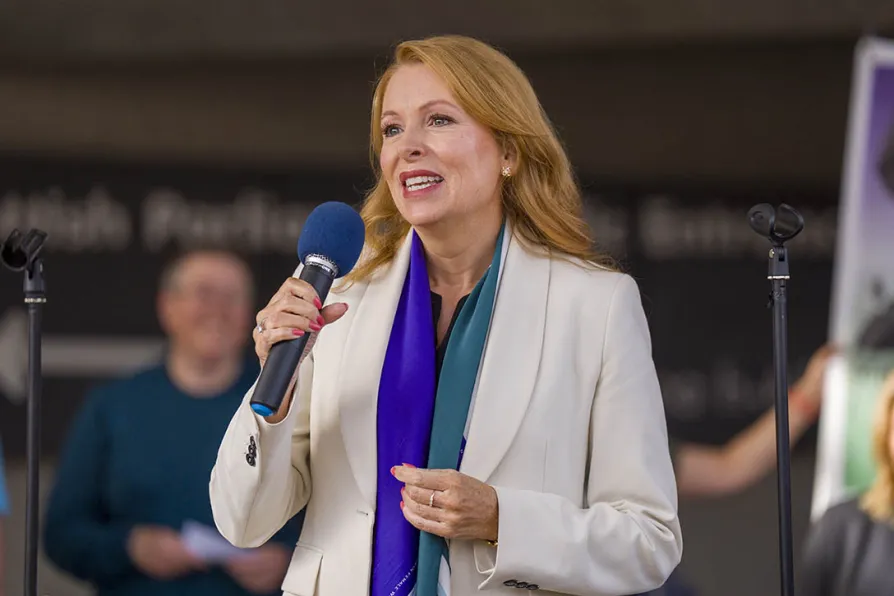 MSP Ash Regan has introduced a Bill to Scottish Parliament which aims to criminalise punters paying for sex in Scotland
Without evidence or Nato consultations Berlin’s answer to the Leipzig incident is a rupture of relations. SEVIM DAGDELEN examines why
FRANCISCO DOMINGUEZ introduces the background to a conference on defending Latin America’s sovereignty
The glacier collapse in Nepal is yet another warning that a warming planet is making Himalayan disasters more frequent and destructive – but the countries facing the greatest risks are often those least responsible, says LI YANG
Nick Blair is set to benefit from a hugely lucrative contract to ‘virtually’ train the British army for its next war. Like father, like son, writes SOLOMON HUGHES
Even when tragedy strikes, Western media cannot resist the opportunity to turn it into a sordid propaganda opportunity, as the Nepal-China border tragedy shows, writes CARLOS MARTINEZ
Trade unions should be at the heart of the anti-racist push for reparations for the historic legacy and continuing impact of slavery, writes ROGER McKENZIE





THERE is a concerning tendency among younger generations to describe themselves as “pro-sex work.” Far from a radical break with past feminist thinking, this position is best understood as the logical endpoint of what is known as “choice feminism”: the idea that any decision a woman makes is inherently feminist simply because a woman has made it.
Within this framework, structural power disappears. The material conditions under which choices are made — such as stagnant wages, collapsing public services and unaffordable housing — are rendered irrelevant.
What remains is a celebration of individual success stories. It is this strand of feminism that would see Marget Thatcher be called a “girlboss” despite it failing to challenge the economic system that constrains women’s lives. In a capitalist economy that depends on the precarity of women, “choice” is not so much a marker of freedom as it is a convenient alibi.
It is against this backdrop that Ash Regan’s Unbuyable Bill enters the political discourse. Now, I do not believe that Regan has undergone a sudden conversion to Marxist feminism, nor that she is seeking to uproot the economic system under which we live and transform women’s material conditions.
Nonetheless, the tabling of the Bill has already achieved something of value in that it has forced a conversation about the realities of “sex work” and how the cost of living and decades of neoliberal economic policies have forced an increasing number of women into prostitution and other forms of sex work.
The underlying principles of the Bill are entirely correct. No woman should be forced to endure sexual violation in order to survive. Yet the Bill is failing to engage with the contemporary reality.
Today, an increasing amount of sex work takes place online. For many women, digital platforms offer a degree of safety: the ability to screen clients, avoid police harassment and, if entirely online, a degree of control over their working conditions. It should not be necessary for women to sell sexual access to their bodies, but while this remains the reality, their safety matters.
Claims that the Unbuyable Bill would make sex work categorically more dangerous are therefore unconvincing, but so too is the idea that the legislation in its current form is going to meaningfully address the online sex industry.
That can only be achieved by taking on platforms such as OnlyFans which is perhaps the most infamous example of online sex work. The OnlyFans wave has seen sex work become agressively glamorised, with influencers flaunting large sums of money made through OnlyFans, as well as more traditional forms of sex work, the industry is presented as an easy route to financial stability.
What is rarely acknowledged is the vast majority of OnlyFans creators earn less than £150 a month, or that the top 1 per cent of creators make 33 per cent of the revenue and the top 10 per cent make 73 per cent of the revenue.
This distortion has consequences. Some young influencers have made substantial money by launching an OnlyFans the moment they turn 18. This content would have required planning, encouragment and creation before they were legally adults. This raises serious questions about grooming and the encouragement of sexual exploitation before legal adulthood.
Even for those who leave the industry, the digital footprint remains. Images circulate indefintely, with long-term implications for employment prospects, mental health and personal safety.
Costs such as this, or the emotional and physical harm are never a part of “empowerment” narratives by liberal choice feminists.
Defenders of decriminalisation often argue that all work under capitalism is exploitation. This is true, but it muddies the waters of the specific harms of the sex industry. Prostitution does not simply involve unsafe working conditions; it shapes social and cultural norms. It rests on and perpetuates the idea that men are entitled to purchase women’s bodies, an assumption that normalises sexual entitlement and, by extension, sexual violence.
Research consistently suggests that men who buy sex are more likely to commit acts of violence against women than those who do not. When sex is treated as a transaction in which a woman’s desires are irrelevant, it reinforces broader cultural ideas about a woman’s place.
The pro-sex work politics of younger generations must be understood as a symptom of the economic conditions of the country at large. With wages stagnating and unaffordable rents for those who do not wish to seek to change the system causing economic oppression at large, it is inevitable that sexual exploitation is repackaged as empowerment. Choice feminism and pro-sex work narratives allow for individual stories to be elevated while the structural violence against women perpetuated by capitalism is ignored.
Despite its failure to reckon with the current realities of sex work, Ash Regan’s Bill at least engages with the truth that no woman should be compelled by economic desperation to endure sexual violence in order to survive. Yet without tackling the digitalisation of the sex industry and the role of online platforms such as Only Fans it risks being symbolic in practice.
If we are to truly reduce harm, which I firmly believe all involved in this debate want to do, we must move the debate towards demanding a significant change in material conditions so that no woman’s body is treated as an income stream in times of desperation.

Similar stories

Comments from Matt Goodwin and Danny Kruger expose a reactionary vision in which falling birth rates are blamed on women, says JUDITH CAZORLA

Legal frameworks designed to safeguard women are too often weaponised against them, reinforcing male power and entrenching injustice. The FiLiA Ending MVAWG Team highlight some of the issues

The legacy of socialist feminists such as Alexandra Kollontai challenges us today to confront an uncomfortable truth: framing prostitution as empowerment lets the abusers of the Epstein class off the hook, warns HELEN O’CONNOR

AMANDA J QUICK warns about the ever-expanding influence of the sex industry – and the harm it unleashes on both the women involved and society collectively, especially the young