Cuban trade union federation CTC leader OSNAY MIGUEL COLINA speaks to Ben Chacko about life and work under a crippling US siege


 Latest editorial
Scotland’s parties must offer more than promises – they must offer real hope
If parties are serious about rebuilding trust, as the elections approach, they must embrace bold redistribution, invest in public services and put working people, not the wealthy few, at the heart of Scotland’s future, argues ROZ FOYER
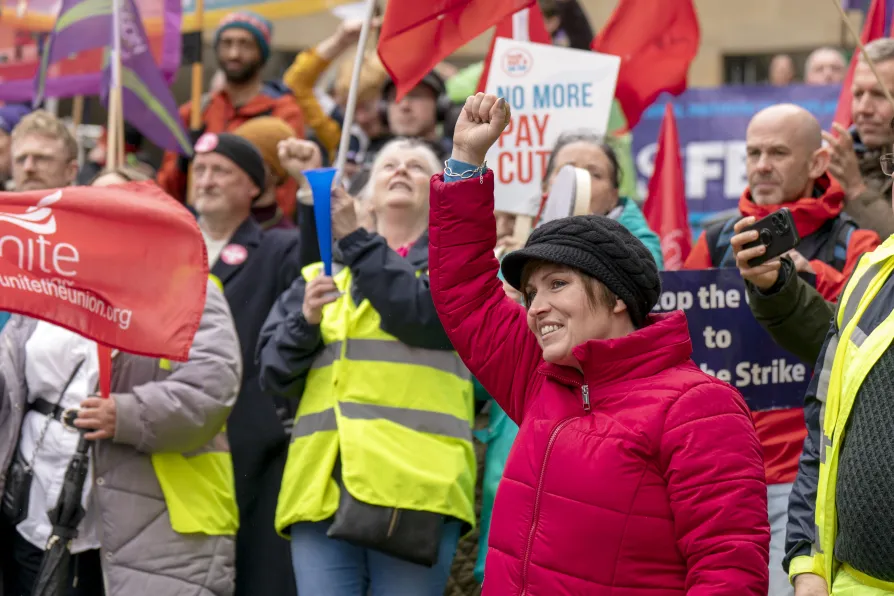 STUC General Secretary Roz Foyer speaks to lecturers and other university staff at a rally on Buchanan Street, Glasgow, September 19, 2023

A part of the British empire’s network of slavery, today the Caribbean island of Nevis faces a new form of exploitation in the form of crypto-colonialism, CLAUDIA WEBBE writes
A new book by Victoria Holmes illuminates the many hidden histories of the oppression experienced by Gypsy/Roma/Traveller community, writes ROGER McKENZIE
Even the oligarchs of the artificial intelligence industries are warning that their creations have the capacity for the ultimate destruction of the planet and its population. ANDREW MURRAY suggests that there might just be other solutions
The Labour government must deliver on its commitment to bring back privatised services into the public sector. This not only saves money but also creates accountability and generates wider social benefits, argues ANDY MCDONALD MP
Public ownership of Great British Railways has enormous potential to improve our railway network, but that can’t happen unless jobs, employee rights and union recognition is at the heart of the transition, argues MARYAM ESLAMDOUST
Challenges from the unscrupulous misuse of AI to steal actors’ voice and physical likenesses is being met with a firm union response, writes LYNDA ROOKE





THE election that, not too long ago, seemed like a distant date in the diary is rapidly now approaching.
Truth be told, parties have been on an election footing for quite some time. The long campaigns have begun; the doorknockers are racking up the steps and the party machines are putting the finishing touches on their manifestos.
Documents that, we hope, won’t just lie gathering dust after the vote on May 7.
One way to ensure that is for politicians to ditch the gimmicky soundbites and get back to basics. The people of our communities deserve much more than just another electoral cycle half-baked promises — they need hope.
Not managed decline. Not empty slogans. Real, transformative hope.
Does that sound vague? Perhaps. But let me explain.
Without hope, or even the credible offer of it, politicians risk condemning another generation of working people to decline, insecurity and despair.
This is not a challenge for one party alone. It is a challenge for every party that seeks to govern Scotland — the SNP, Labour, the Greens and others. Unless they are prepared to be unashamedly bold — to confront inequality directly and to reshape how wealth and power operate in our society — working people will continue to drift away from faith in democratic institutions and gravitate towards those who want to undermine those very same institutions.
What does boldness mean?
It must mean serious redistribution of wealth. It must mean backing an interventionist approach to Scotland’s national infrastructure — in offshore wind and green energy, in transport, in health, in housing and beyond. It means tackling the scourge of poverty with decent wages and trade unions at the centre of collective bargaining for all those in our class and communities. Without this scale of ambition, we cannot realistically expect people who feel abandoned by politics to suddenly believe again.
And we need our politicians to give us something to believe in.
Trust, once broken, is hard to rebuild. The latest, reprehensible and inglorious chapter of Peter Mandelson’s career — claims of cronyism and links to Jeffrey Epstein — and the resultant political fallout impacting on the Prime Minister, only deepen public cynicism.
It gives the not incorrect impression that there is barely a cigarette paper between Labour and the Tories in terms of the political boys’ club that operates at the elite level of our political class. It’s a perception — the valid perception — that political power remains too closely tied to wealth, privilege and influence.
It is therefore hardly surprising that politicians remain deeply unpopular when they are so often seen to be operating at the beck and call of the powerful and the profiteers, rather than standing firmly alongside the people they were elected to serve.
If political parties want to rebuild trust, they must start by offering something real: hope backed by material change.
That hope must come with a vision — a bold, unapologetic commitment to building a Scotland that works for everyone, not just the top 1 per cent.
For too long, governments of different colours have failed to fully use the radical potential of the Scottish Parliament’s powers — and time is rapidly running out. The Scottish Fiscal Commission has warned of a potential £2.6 billion gap in Scotland’s public finances by 2030.
At the same time, public services are stretched to breaking point, wages have stagnated for too many and inequality remains deeply embedded.
The STUC has set out tax proposals showing how Scotland could raise billions more annually from wealth taxes and changes to our income tax bands, which then fund our public services. Despite what those on the political right says, this isn’t about squeezing working families further but rather by asking those with the broadest shoulders to contribute fairly.
But proposals are only as useful as the political conviction needed to make them a reality.
This is about nurses, teachers and social care workers having the resources they need to do their jobs properly. It is about every child receiving the education they deserve. It is about refusing to allow poverty to dictate the life chances of another generation.
A different Scotland is possible: one where wealth and opportunity are shared, where workers’ rights are strengthened and where communities feel valued rather than forgotten.
A Scotland where trade unions are partners in building the future and where public services are treated not as costs to be contained, but as foundations of growth and economic prosperity.
That means meeting people’s real concerns, on housing, wages, care, education, not with slogans, but with action that makes a tangible difference to their lives.
It starts with redistribution. With ensuring that Scotland’s considerable wealth benefits everyone, not just those at the very top. It means using tax policy not only to raise revenue, but to build a fairer economy. It means funding services that support people when they need it most.
It means tackling the scandal of outsourcing in our public services whereby almost £2-3 billion per year gets extracted from our infrastructure and placed into private hands.
But it also means organising — building a movement based on solidarity, purpose and collective progress.
That is what all political parties must offer.
Imagine a government that genuinely puts workers first. One that strengthens collective bargaining, ends exploitative work and invests in green, unionised jobs. One that stops pretending trickle-down economics ever worked and instead builds prosperity from the ground up.
This is the future we must fight for. The far right will not be defeated by echoing cynicism or chasing reactionary votes. They will be defeated by offering people something better: a politics of decency, fairness and ambition. A Scotland that is confident, compassionate and collectively focused on the concerns of the working class, not the top 1 per cent.
Roz Foyer is general secretary of the STUC.
