A new generation of right-wing politicians have shifted from promoting deregulation to championing anti-migrant politics warns SOLOMON HUGHES


 Latest editorial

Scotland’s left is outmanoeuvred and outpaced
Fuelled by economic abandonment and a collapsing faith in politics, Farage’s party is transforming grievance into momentum north of the border, warns COLL McCAIL
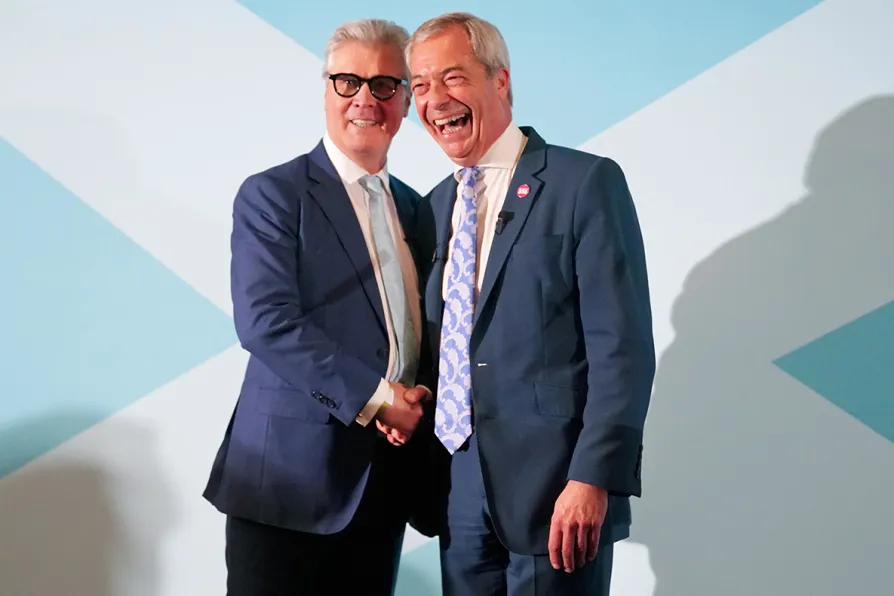 Reform UK leader Nigel Farage (right) with Lord Malcolm Offord, the latest Tory defector to join the far-right party during the rally in Falkirk, December 6, 2025
by the Greater Manchester Workers’ and Tenants’ Association
The US relationship with Israel has evolved into a strategic liability, argues RAMZY BAROUD
A champion motorcyclist, trade union organiser and communist, Clem Beckett went from Britain’s speedway tracks to the battlefields of Spain, where he gave his life resisting Franco’s forces at Jarama. GEOFF BOTTOMS pays tribute to this remarkable anti-fascist
The greatest threat to democracy may no longer come from political parties but from unelected tech oligarchs like Peter Thiel and his powerful Silicon Valley network, argues JOHN GREEN
Claiming to ease a fertiliser shortage, the Trump administration has suspended tariffs on Moroccan phosphate imports – deepening US support for the Morocco’s control over Sahrawi territory, writes LUKE ROTELLO





“MAN the barricades as we take on the political Establishment.”
Readers of this newspaper have heard these words before. They inspired the Paris Communards to storm the heavens in 1848, galvanised the Spanish masses to defend their republic in 1936, and brought thousands to the streets in the heady days of 1968.
To the sound of this historic battle cry, history has been made. Yet these words do not belong to the ideological descendants of Louise Michel, Dolores Ibarruri or Daniel Cohn-Bendit.
On Saturday December 6 this was how Thomas Kerr concluded his address to a 600-strong Reform UK rally in Scotland. His speech resonated far beyond the room.
Current polling predicts that Kerr and his colleagues will form the ranks of Holyrood’s official opposition after next May’s Scottish Parliament election. The former Tory councillor was joined by Nigel Farage at the MacDonald Inchyra hotel to unveil the party’s newest recruit: Baron Offord of Garvel.
Just over a mile from the Grangemouth oil refinery, a London stockbroker and an Edinburgh investment banker told a story of decline and deindustrialisation that spoke to the despair of Scots across the country — a fifth of whom, as one speaker pointed out, live below the poverty line.
The only barricades this narrative has helped to build have been erected outside the Cladhan Hotel, where 90 asylum-seekers have been housed since 2021. Just a short drive from where Farage reiterated his attack on Glaswegian children who speak English as a second language, hundreds of protesters gathered outside the accommodation once more.
The Forth Valley — much of which sits within the Scottish government’s “green” freeport zone — is a microcosm of the country at large. If Reform UK’s narrative is compelling in Scotland, that’s because it draws on many of the same themes as our own.
They tell the tale of a country condemned to collapse, governed by an aloof elite that forgot about places like Falkirk long ago. The conclusions of Kerr, Farage and Offord, however, are as insidious as they are insulting. To believe that the cabal of mediocre opportunists flocking to fill the party’s regional list spots next May are capable of anything but managing decline requires a level of delusion unique to Scotland’s political class.
But does that matter any more? With public trust in the political system at a record low and a historically unpopular Prime Minister in power, faith that change is possible — never mind attainable — is vanishingly thin on the ground. Alienation has taken its place. As the formation best placed to inflict a damaging electoral defeat on Britain’s duopoly, Reform UK stands to benefit.
While it is true to insist that “the enemy of the working class travels by private jet, not migrant dinghy,” it is no longer good enough — maybe sloganeering never was. Most Scots never see the inside of a private jet. They never meet a billionaire. But our fortunes and prospects are shaped by their decisions.
In Falkirk, hundreds of refinery workers lost their jobs in April 2025. Bus manufacturer Alexander Dennis only delayed closing its local yards following a 26-week Scottish government furlough scheme. On the other side of the Forth, the imminent closure of the Mossmorran ethylene plant has placed at least 400 jobs under immediate threat.
In each case, a foreign multinational — Ineos, the NFI Group, or ExxonMobil — has made a business decision to abandon Scotland’s east coast in pursuit of greater profits elsewhere. While governments evaded responsibility, the region was thrown into turmoil by economic forces beyond its control.
Denied the power to determine the fate of the places where they live and work, the residents of Falkirk and Fife are now the target of Reform UK and their empty promise to reindustrialise Scotland.
The area, one might think, provides fertile terrain to cultivate class-based political alternatives. But this task requires a vehicle — and it’s not going to be the Labour Party, whose latest brainwave is to construct an arms factory on the Grangemouth site.
Meanwhile, the ongoing intra-M25 faction fight at the top of the Your Party feels as far removed from the Forth Valley as one can imagine. Amid this disorganisation, our story is stolen and mutated by a political formation that claims the mantle of insurgency but depends on a growing coalition of Establishment forces. The scenes outside the Cladhan Hotel are the consequence.
This atmosphere of insurgency — of mobilising what Thomas Kerr calls “the silent majority” — is almost more intense in Scotland than south of the border. Farage has won national elections in England before. But when Ukip won 25 per cent of the vote in the English local elections of 2013, they were polling just above 1 per cent in Scotland.
How things have changed. Next May, Reform UK may well supplant both the Scottish Conservatives and Scottish Labour. A more detailed analysis of this sudden ascendance requires more space than this column affords.
What is certain, however, is that Scotland’s left has lost what little control of the political narrative it once possessed. Perhaps we grew too comfortable with an exceptionalist national story. In any case, progressives cannot hope to lay a finger on Reform UK without regaining a grip on what has been taken from us.
