Councillor SAM WHEELER says there’s a tangible shift in mood on the left in the city whose mayor has recently become PM — but there’s no room for complacency



Remembering the strike that shook Britain
Linking the General Strike 1926 to the struggles of workers today. General Strike 100 national co-ordinator HENRY FOWLER reflects on his recent visit to the Bristol Radical History Festival
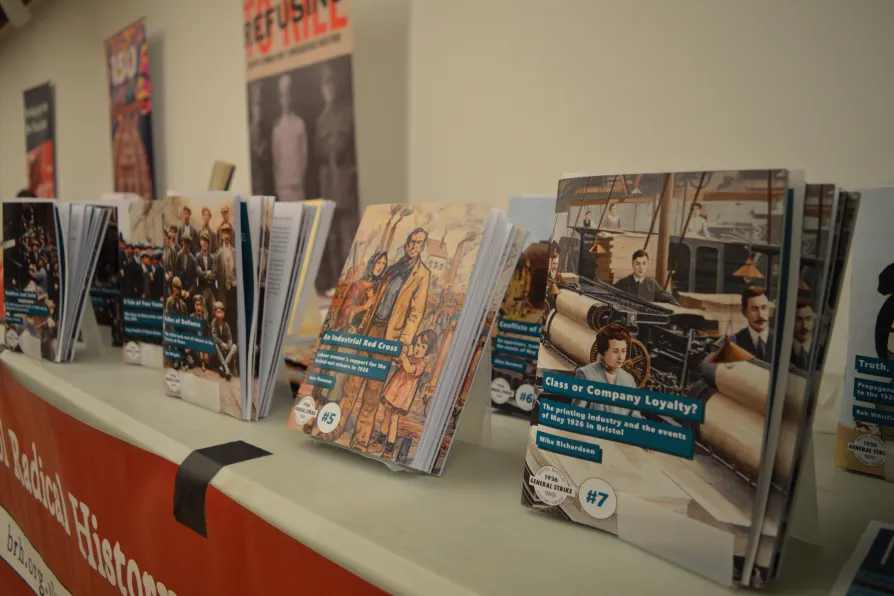
 EDUCATIONAL: An array of radical books on display at the festival
Communist Party leaders Alex Gordon and Lorraine Douglas deliver vital medicines in trip to besieged socialist island
TUC Cymru is playing a leading role in tackling far-right ideas in the workplace, says LAURA DOEL
A New Delhi press conference in which Sheikh Hasina and her son implied the new order in Bangladesh is a security threat to India has sparked fears she is planning a comeback. SIAM SAROWER JAMIL reports on the fallout
Two months of student unrest have forced out India’s education minister and rattled the BJP regime. Could this be the beginning of the end for Modi, asks Communist Party of India (Marxist) general secretary MA BABY
MAT COWARD says the heatwave is a testing time for gardeners — but he has some tips





THE Bristol Radical History Festival is an impressive two-day annual event held in Bristol. Drawing hundreds of attendees across both days, and hosted by General Strike 100 partners including the Bristol Radical History Group (BRHG), this year’s festival explored key themes such as propaganda, Welsh risings, utopias, and the 1926 General Strike.
Bringing together expert speakers from the Forest of Dean, Bristol, Stroud, Swindon, Bath, and Somerset, the free event — held at the M Shed on the harbourside — offered a powerful continuation of the region’s radical legacy.
The day opened with a rich and detailed account of the General Strike: its origins, course, and conclusion. Led by BRHG member Robert Whitfield, the session focused on Bristol’s local experience.
It also showcased the national GS100 partnership and its 63 partners, including our interactive map designed to help the public engage with this important centenary year.
Following this, Stuart Butler of Radical Stroud (another GS100 partner) joined Tony Condor in examining the Swindon Great Western Railway workers — “railway servants” in name only — highlighting their militancy during the strike.
They also shared stories of Gloucester dockworkers, whose actions combined resistance with a certain cheeky gallantry. These accounts are explored further in their new general strike pamphlet, part of a series of eight launched at the festival.
Throughout the afternoon, sessions turned to the crucial role of women during the strike and the subsequent miners’ lockout.
June Hannam, professor emerita and trustee of the Museum of Bath at Work (another General Strike 100 partner), explored the “Industrial Red Cross.”
She vividly described the organising efforts of Labour Party women such as Annie Towler and the others in the Women’s Co-operative Guild.
Women played a vital role in fundraising for miners’ families, innovating with merchandise like miners’ lamp pin badges and organising door-to-door collections — tactics still used in solidarity campaigns today.
Remarkably, women’s committees raised around a third of a million pounds during the dispute.
This contribution extended beyond material support. As Hannam emphasised, such organising elevated women’s role within the labour movement, demonstrating their central place in both political and industrial struggles.
Ian Wright followed with a talk on the miners’ lockout in the Forest of Dean, describing the use of “rough music” — a tactic of collective noise-making to protest against “scabs.”
Drawing on first-hand accounts, including that of local Forest Of Dean miner Alan Drew, Wright highlighted the active role of women: “If they thought you were going back to work they would come outside and batter pans and tins — hell of a row.”
The Gloucester journal on July 17 1926 summed it up, “Women were equally resolute for a fight to the finish and resentful of any action which threatens any break of men’s unity.”
Ian’s writing and research around mining in the Forest of Dean is impressive contribution to workers’ history.
Activist writer Dave Chapple then took the audience through the Somerset coalfields. With an engaging handout, he detailed the harsh working conditions miners endured and discussed his recent book, Resistance and Resilience: The 1926 General Strike and the Miners’ Lockout in the Somerset Coalfield.
He also highlighted the mass appeal of miners’ leader AJ Cook, who addressed crowds of up to 80,000. Alongside Cook, local leaders such as Mark Starr played a key role in delivering Marxist education through the National Council of Labour Colleges and the Plebs League — often to hundreds of miners after long shifts underground.
Starr later became educational director of the International Ladies Garment Workers Union in the United States.
As a long-time trades council activist, Dave celebrated in the crucial role of “councils of action” running towns and cities during the strike.
In Somerset, only goods signed off by James Tarrant were allowed in and out of the area, showing the power, potential and relevance of the trades council movement.
The day concluded with a panel reflecting on the strike’s lessons and legacy, featuring Chris Bowkett (BRHG), Sheila Caffrey (Bristol TUC/NEU), and Steve Mills (Unison). The discussion ended with a sense of urgency but also optimism: a shared belief that workers make history — and remain its driving force.
Alongside the talks, a vibrant exhibition space brought together a wide range of local and national organisations. With so much on offer, the collection of General Strike pamphlets — from Southwark to Gloucestershire — proved hard to resist, making for a heavier journey home.
The festival is highly recommended for future years; more information can be found via the BRHG website (www.brh.org.uk/site).
To explore the full partnership and plan your own visit, head to GeneralStrike100.com and find your nearest event.
