Councillor SAM WHEELER says there’s a tangible shift in mood on the left in the city whose mayor has recently become PM — but there’s no room for complacency



How the 1926 General Strike shaped trade union solidarity
Aslef general secretary DAVE CALFE looks at how rail workers and miners stood together against wage cuts 100 years ago – and why the legacy of collective action endures today
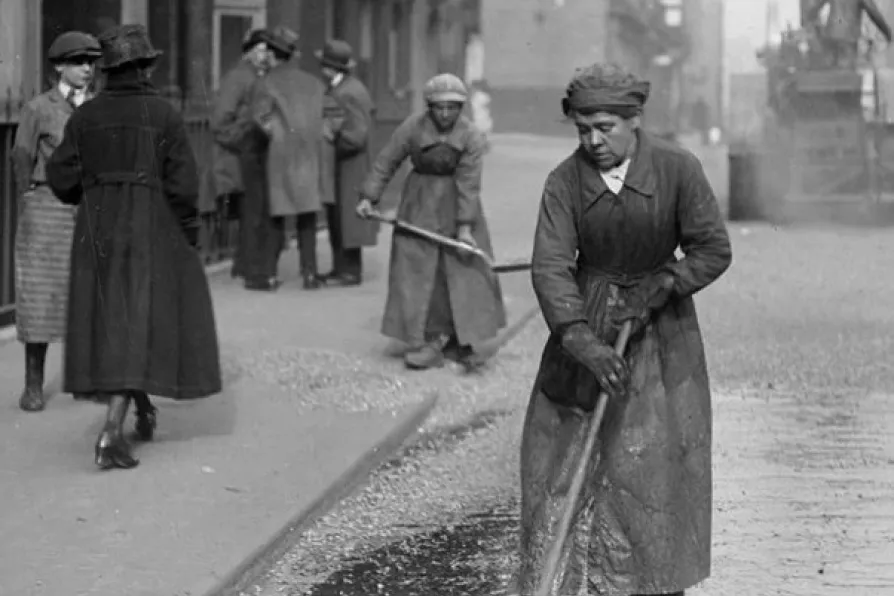
 Women tarring a street
Communist Party leaders Alex Gordon and Lorraine Douglas deliver vital medicines in trip to besieged socialist island
TUC Cymru is playing a leading role in tackling far-right ideas in the workplace, says LAURA DOEL
A New Delhi press conference in which Sheikh Hasina and her son implied the new order in Bangladesh is a security threat to India has sparked fears she is planning a comeback. SIAM SAROWER JAMIL reports on the fallout
Two months of student unrest have forced out India’s education minister and rattled the BJP regime. Could this be the beginning of the end for Modi, asks Communist Party of India (Marxist) general secretary MA BABY
MAT COWARD says the heatwave is a testing time for gardeners — but he has some tips





THE Locomotive Journal, Aslef’s monthly magazine, and (now) the world’s oldest continuously published trade union periodical, reported in June 1926: “The greatest strike in the history of Great Britain, and possibly the greatest the world has ever seen, has come and gone, starting on the morning of Tuesday May 4, and continuing as a General Strike until Wednesday May 12, it yet continued, so far as the railways were concerned, until Friday May 14, and its aftermath, unfortunately, is still with us.
“It is far too early for any but fools to attempt to apportion praise or blame, or to draw lessons from it to any great extent, and we propose to leave all that until some later date when we are able to view it in a truer perspective and a clearer atmosphere.”
That was, by one of my predecessors, a sober and sensible announcement. In contrast, with a whiff of gunpowder — and hyperbole — The Guardian ran this leader on Monday May 10 1926: “It is just a week since Civil War was declared in this country. It is not a war of arms; it is not yet even a war of tempers; it is a trial of strength.”
But it wasn’t a civil war; it was the first — and, so far, the only — general strike in this country, called by the Trades Union Congress to try to persuade the government to step in and act in the nation’s interest by preventing Britain’s mine owners from slashing the wages of 1,200,000 miners and forcing them to work on much poorer terms and conditions.
AJ Cook, general secretary of the Miners’ Federation of Great Britain, which became the National Union of Mineworkers, famously warned: “Not a penny off the pay, not a minute on the day,” which became a rallying cry for workers of the world.
And John Bromley, general secretary of Aslef from 1914 to 1936, a founder member of the TUC’s general council in 1921, and Labour MP for Barrow-in-Furness from 1924 to 1931, echoed Cook’s sentiment: “They want to make the miners work harder, and longer, for less. They’re not having it and neither are we.”
On Saturday May 1 the TUC approved plans to begin a national stoppage from midnight on Monday May 3.
Bromley, a powerful orator and formidable operator, said: “The time is for action, not speaking. I am proud that we shall be among the shock troops. We shall make the first blow.”
Some 1,700,000 workers answered the call and took sympathy action for nine days — from Tuesday May 4 to Wednesday May 12 — and members of Aslef, the train drivers and firemen on the footplate, played a key part in preventing the movement of people, goods, and raw materials around the country.
The Locomotive Journal reported that, of our membership which stood then at 60,000, fewer than 50 of our non-supervisory members failed to walk out: “What a response! What an exhibition of trade union solidarity, of loyalty, of sympathy with the bottom dog, and what a revelation to a government of cold-hearted representatives of capitalism, who never expected such a response to the call.”
Bromley dryly poured scorn on the “volunteers” — the scabs and blacklegs — who tried to break the strike: “While ‘gentlemen’ in plus fours, Oxford bags, rainbow socks, and fancy ties tried to be busy in driving a few motor buses about London, where they could show off, none of these gallant volunteers offered to go down the mines to do the miners’ work, or, indeed, to take on any of the dirty work of the world.
“There were none, for instance, scavenging, none in the London sewers, none undertaking construction work on lofty buildings. They carefully chose their work somewhere in comparative safety, and in the public eye, but all of it, so far as having any effect in carrying on the industries which were stopped, was about as useless as though they had been playing marbles.”
He added, more in sorrow now than anger: “Some few — a very few — endeavoured to drive railway engines, but the long list of accidents, fatal and otherwise, and of serious damage to engines and rolling stock, proves how unsuccessful they were.”
The magnitude of the stoppage so appalled the government that Sir Herbert Samuel, the chairman of the Royal Commission whose report into the mines lit the blue touchpaper for the dispute, was hurried home from Italy, and contacted the negotiating committee of the general council of the TUC.
The Locomotive Journal noted: “It is, of course, public property that both the government and Sir Herbert Samuel denied that he was acting on behalf of the government. Well, a blind man and a galloping horse may not have seen any connection, but all intelligent grown-up people will draw quite another conclusion.
“However, be that as it may, considerable progress was made. The miners’ representatives were brought in to meet Sir Herbert Samuel with the members of the general council’s negotiating committee, and finally it was agreed that the following correspondence should publicly take place and the memorandum attached be published.”
This included such provisions as “negotiations on the conditions of the coal industry should be resumed”; “the [government] subsidy being renewed”; “no revision of the previous wage rates”; “the preparation of a wage agreement on simpler lines than those hitherto followed [which should] not adversely affect in any way the wages of the lowest-paid men” and “the rapid construction of new houses to accommodate transferred workers.”
While the General Strike of 1926 was not the triumph for which those who walked out had hoped, neither was it the wholesale defeat that some detractors like to claim.
Workers in key industries at the heart of the British economy came together to protect their pay and the terms and conditions of their employment. Just as we do today. And the lessons our predecessors learned — about unity, solidarity, and loyalty — still resonate today. Which is why we were successful in our recent two-year national pay dispute with the passenger train companies.
Dave Calfe has been a train driver, and Aslef member, for 41 years. He joined the railway as a traction trainee in 1985 and drove passenger and freight trains for British Rail, Eurostar, Virgin West Coast, and Avanti West Coast. A member of Euston branch, he was branch secretary, company council rep, and then an executive committee member for 20 years, and EC president for the last seven years, before being elected GS. Dave was instrumental in the success of our recent Dignity for Drivers campaign, and was one of our negotiating team, with Mick Whelan and AGS Simon Weller, which successfully concluded the two-year national pay dispute, the longest industrial dispute in Aslef’s history, in 2024.
