
ROB WARZYNIAK wades knee deep through a pile of ‘dead canaries’ of Trumpist policies which exacerbated the horrors of US capitalism domestically


Peace is not a side issue — it’s a fight for our futures
Militarism and war cannot be separated from ‘bread and butter issues,’ argues MICAELA TRACEY-RAMOS — opposing them is central to trade unionism
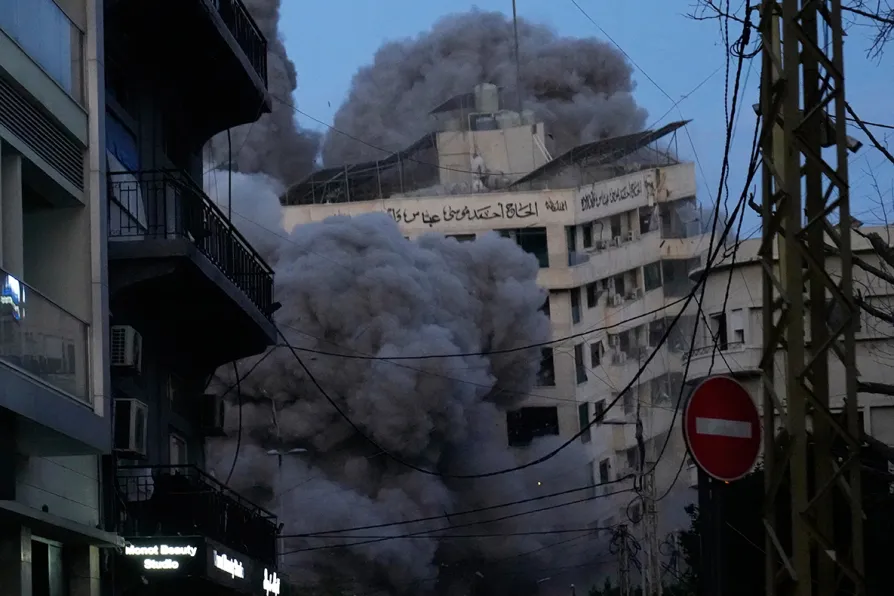
 A building collapses as smoke rises following an Israeli strike in central Beirut, Lebanon, March 18, 2026

Without evidence or Nato consultations Berlin’s answer to the Leipzig incident is a rupture of relations. SEVIM DAGDELEN examines why
FRANCISCO DOMINGUEZ introduces the background to a conference on defending Latin America’s sovereignty
The glacier collapse in Nepal is yet another warning that a warming planet is making Himalayan disasters more frequent and destructive – but the countries facing the greatest risks are often those least responsible, says LI YANG
Nick Blair is set to benefit from a hugely lucrative contract to ‘virtually’ train the British army for its next war. Like father, like son, writes SOLOMON HUGHES
Even when tragedy strikes, Western media cannot resist the opportunity to turn it into a sordid propaganda opportunity, as the Nepal-China border tragedy shows, writes CARLOS MARTINEZ
Trade unions should be at the heart of the anti-racist push for reparations for the historic legacy and continuing impact of slavery, writes ROGER McKENZIE





THE illegal US war in Iran has inflicted a horrific human cost on the people of Iran, including the murder of 160 Iranian schoolchildren.
Trump has made no secret that he wants to deliver regime change in Iran through bombs.
Besides the devastation to Iran, the economic impact is now becoming global, destabilising the world economy and risking increased poverty in Britain and across the world.
This week youth unemployment has been announced. It is at an all-time high, with many young people struggling to find a job in an economy gutted by underinvestment. In addition, public services are collapsing with chronic underfunding and interest rates are on the rise due to Trump’s war.
Yet last year the Labour government announced the Strategic Defence Review which was branded “Making Britain Safer: secure at home, strong abroad.”
This committed the government to increase military spending aiming to reach 2.5 per cent by 2027 with a view to increase to 3 per cent in the future. At the Munich Security Conference last month, Keir Starmer told world leaders: “To meet the wider threat, it’s clear that we are going to have to spend more, faster.”
Just this week, the government announced major cuts to the international aid budget in order to fund the ever increasing “need” for defence spending.
Despite entering government with a mandate for transformative change, Labour has doubled down on austerity — making it clear that instead of prioritising public services, welfare or international aid, the government is choosing to funnel billions into militarisation.
Trade unionists see the consequences of this every day: understaffed hospitals, overstretched councils, and communities left without essential support.
Against this backdrop, the government’s decision to ramp up defence spending is not just misguided — it is a political choice that diverts resources away from the people who need them most. Peace is and has always been a trade union issue.
What a “Nato first” Policy Really Means
In the government’s own words, “Britain is moving to a war-fighting readiness to deter threats and strengthen security in the Euro-Atlantic. As the UK steps up to take on more responsibility for European security we must have a ‘Nato first” defence policy and lead.”
But what does this ‘Nato first” policy mean?
Nato first means money lining the pockets of arms companies, not investment in youth, in public services or social infrastructure.
It means the infringement on our sovereignty as a country with the US using RAF bases to host weapons which are used to kill innocent people in Iran.
And it means continued complicity in the war and genocide against the Palestinian people as Britain’s involvement in EU and Nato’s military partnership is responsible for facilitating this.
Successive governments have tried to normalise war as inevitable. But it is not. Britain could choose diplomacy, co-operation, and peace building, choices that would genuinely enhance security at home and abroad.
Instead, the drive to expand arms production will lead to innocent people being killed in war around the world. Starmer may call Nato the “bedrock of our security,” but for our communities, this approach entrenches insecurity by draining resources from the services they rely on.
The Alternative Defence Review
There is an alternative to this. The Alternative Defence Review published by CND, with RMT, challenges the dominant war narrative, cultivated by our ruling class, the military-industrial complex, and the mainstream media and offers an alternative vision for peace, justice, and security.
It examines how militarisation has distorted national priorities, fuelled global instability, undermined international law, harmed the environment, and diverted investment from public services and social infrastructure.
It shows that increased military expenditure will be economically inefficient, environmentally destructive, and socially regressive, offering limited job creation while stifling a more sustainable and just economy.
It clearly shows us there is an economic alternative to this mainstream warmongering, one of peace, security and investment in our communities.
The Myth of Military Keynesianism
Supporters of increased defence spending often claim it will stimulate economic growth. But as the Alternative Defence Review shows the evidence tells a different story.
Military spending has a far smaller economic multiplier than investment in social infrastructure. Building bombs and tanks does not improve productivity, raise living standards, or generate sustainable economic activity as it does not expand the productive capacity of the economy.
By contrast, investment in public services — health, education, social care, green infrastructure — creates long-term prosperity and strengthens communities.
The idea that defence spending is “job rich” is a myth promoted by the arms industry itself. If the government truly wanted to create well paid, socially useful jobs, it would invest in the services that keep society functioning, not in weapons designed for destruction.
A fight for our futures
However, while the government ramps up the war drive, sadly for Keir Starmer, the British working class are fundamentally anti-war.
We mobilised against the genocide in Gaza at unprecedented rates and had tens of thousands on the streets against the illegal war in Iran. Overwhelmingly polls say that most people in this country don’t want Keir Starmer to drag us into another US war.
The peace movement within the trade union movement needs rebuilding. Debates about wealth taxes and public spending cannot ignore the vast sums being channelled into defence. Militarisation is not a side issue — it is central to the economic choices shaping our society.
As young trade unionists, this is not just a fight for better jobs and living standards, this is a fight for our futures. Our message must be clear: we oppose all drive to war and the expansion of arms production.
We demand an alternative rooted in peace, diplomacy, and investment in the working class. Britain’s young people need jobs, homes, and hope — not bombs, death and destruction.
We will fight for a world where all people can live in peace, human dignity and justice prevails. Instead of Nato first, instead of war first, how about the working class and the youth of Britain first?
Micaela Tracey-Ramos is on the Unison NEC and is vice-chair of the union’s international committee.
