
APURBA CHATTERJEE explains how British artists in India used the “picturesque” to reshape colonial landscapes and celebrate imperial power


Nuclear power? No thanks
MARTIN GRAHAM recommends a comprehensive demolition of the case for nuclear power
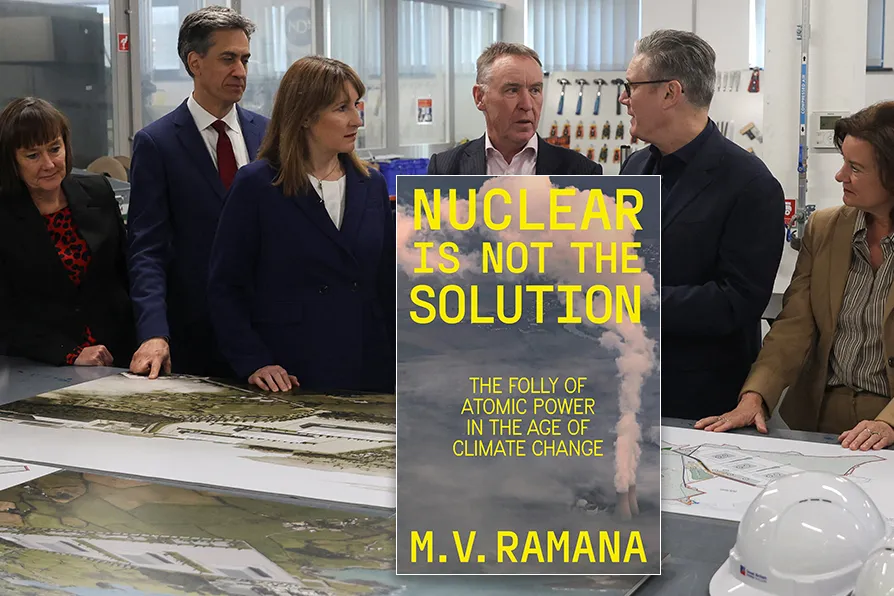
 CONNED: Jo Stevens, Ed Miliband, Rachel Reeves, Simon Bowen (Chair for Great British Energy - Nuclear) Keir Starmer and Eluned Morgan at the Wylfa plant in Wales where the UK's first small modular reactor will be built, November 13, 2025

PAUL DONOVAN welcomes a revival of Reginald Rose’s classic play that reminds us of the fundamental need for trials with juries
SIMON PARSONS applauds an exceptional performance of Wesker’s little-known play, by the same actor for whom it was written 45 years ago
ANDY HEDGECOCK and MARIA DUARTE review Late Fame, The Death of Robin Hood, Leviticus, and Gail Daughtry and the Celebrity Sex Pass
ANGUS REID recommends a uniquely accomplished documentary collage that contemplates our relation to the natural world
GORDON PARSONS enjoys Kant’s ‘mind-boggling’ theory of human reality: that we create the reality we experience





Nuclear is Not the Solution — The Folly of Atomic Power in the Age of Climate Change
MV Ramana, Verso, £14.99
IN the introduction to this book, Professor Ramana modestly describes himself as “someone trained in physics and an academic paid to research” but this understates his expertise and authority to write about, and comment on, nuclear power.
He is currently the Simons Chair in Disarmament, Global and Human Security at the University of British Columbia and its director of the Master of Public Policy and Global Affairs programme. In 2014 he shared the Leo Szilard Lectureship Award from the American Physical Society, which recognises outstanding accomplishments by physicists in promoting the use of physics for the benefit of society, particularly in areas like environmental issues, arms control and science policy.
Unlike many who expound on the subject, he understands nuclear power — how it works, its history, what are its shortcomings, and why it is promoted with such enthusiasm by commercial interests.
Proponents of nuclear power claim that it is simple, safe and cheap, and insist that all it needs is less regulation. Given past failures to deliver any of these, they are now promoting small modular reactors (SMRs) as the panacea, claiming that, while producing little radioactive waste, they can contribute to addressing the climate crisis when exported worldwide — something that can be done without risking of nuclear weapon proliferation.
Ramana effectively demolishes each of these claims in turn and, at a more fundamental level, recognises that it is globalised capitalism’s own unending search for profits through ever-increasing extraction, production and consumption that is the cause of global warming.
For Ramana, generating electricity by nuclear fission is neither simple nor safe. It’s an inherently hazardous process whereby controlled nuclear fission, using enriched uranium, itself mined at great ecological and human cost, is employed to convert water into steam to drive turbines to generate electricity. Unlike solar photovoltaics, which is a simple and safe process, it is not amenable to economies of scale or technological improvement.
The electricity generated is expensive. Whether reactors are large or small, the key question for the industry is finding someone to pay for it. The solution they have adopted is to persuade governments to regulate the electricity market to ensure that it is consumers and taxpayers who pay.
On safety, the accidents at Three Mile Island, Chernobyl and Fukushima stand as warnings of the risk of catastrophic failure. The nuclear industry provides stupefyingly low estimated probabilities for such accidents and understates their cost in terms of lives, health and clean-up.
Fortunately for the industry, political leaders appear happy to accept these specious estimates and the industry’s assertions that nuclear reactors are now immune from such accidents. One explanation is governments’ appetite for nuclear weapons; another is that the cost of managing nuclear waste will be borne by future generations, if they survive, and not current voters.
On the all-important question of whether nuclear reactors can help address global warming, Ramana is dismissive. The threat from climate change is urgent and, given the cost and the time needed to construct and commission nuclear reactors, the world has neither the financial resources nor the luxury of time to do so. Meanwhile, even a limited expansion of nuclear power would have severe ecological and environmental consequences.
Many potential readers of this book may already be persuaded of the need to oppose the expansion of nuclear power. I would nevertheless recommend this book to them as providing the information and arguments they need to persuade others. To those who have been seduced by the arguments of the nuclear industry and its lobbyists, I would challenge them to read this book and see if their faith in nuclear power survives.
