The Defence Universities Alliance is a bit to co-opt higher education into the wider drive to war — we should resist as earlier generations of scientists did, argue say ROX MIDDLETON, LIAM SHAW and MIRIAM GAUNTLETT of SCIENCE AND SOCIETY


 Latest editorial

Narcissism, nepotism and insatiable greed: Trump’s horrific new world order
Trump’s Venezuela “coup” along with his fake peace deals, including the latest in the Congo, are motivated by personal gain and self-aggrandisement, writes Linda Pentz Gunter
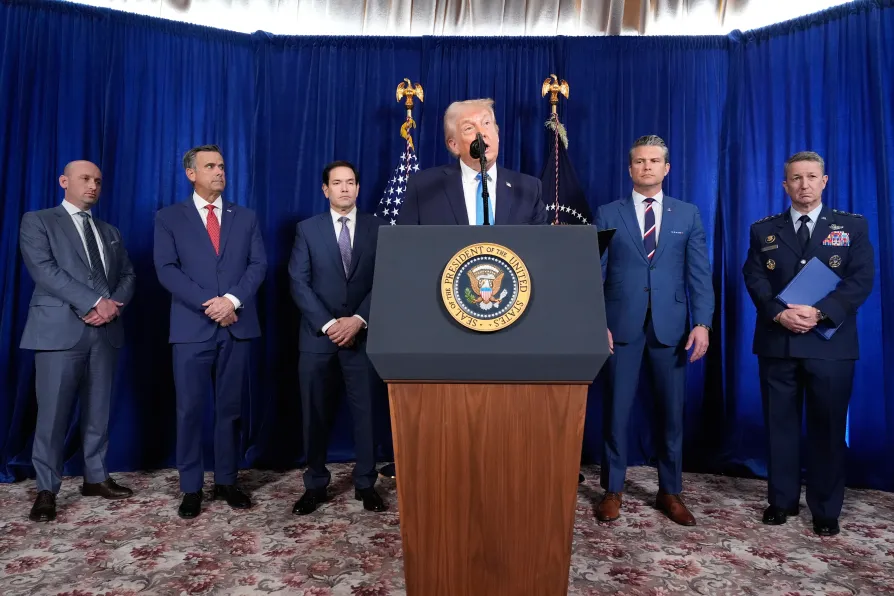 President Donald Trump speaks at his Mar-a-Lago club, January 3, 2026, in Palm Beach, Fla.
In the third of a four-part serialisation from her new book No to Nuclear, LINDA PENTZ GUNTER explains how the world had a chance to build an energy system around renewables more than 70 years ago — instead, it chose nuclear
In the fourth and final part of our serialisation from LINDA PENTZ GUNTER’S book No to Nuclear, she asks how anyone can see nuclear as value for money given its constantly ballooning costs
Elon Musk says AI will make work optional. The world of abundance he predicts actually spells the end of the capitalist system, argues FAWZI IBRAHIM
CARLOS MARTINEZ responds to liberal hawk Simon Tisdall’s evidence-free China-bashing and asks whose agenda it really serves
Indian students have fought for the right to education, schooling us all in the process. Comrades from the Students’ Federation of India (SFI) — UK comment on the resistance and its ripples here





NO READERS of these pages need reminding that US President Donald Trump does not broker genuine peace deals. Every decision Trump makes is centred around personal profit, delusional self-aggrandisement or both.
Venezuela has the largest oil reserve in the world, amounting to at least 303 billion barrels, mostly heavy crude. That is all that needs to be said about the motivation behind the recent US attack and abduction of that country’s president, Nicolas Maduro and his wife. Indeed, Trump already said it himself on Saturday.
“We’re going to have our very large United States oil companies — the biggest anywhere in the world — go in, spend billions of dollars, fix the badly broken infrastructure, the oil infrastructure,” Trump said at a press conference held at Mar-a-Lago.
“We’re going to run the country,” he said. “We can’t take a chance that somebody else takes over Venezuela.”
Controversial 2025 Nobel Peace Prize winner and Venezuelan opposition leader Maria Corina Machado, who had called for Maduro’s overthrow, must be disappointed. Trump, who revels in revenge and perhaps smarting at the Nobel win he thought he deserved, said at the press conference that Machado “doesn’t have the support or the respect within the country.”
Venezuela is not the only country currently in Trump’s crosshairs. He has also said he would attack Iran again if those currently protesting against the government there are killed. But a quick glance at the world’s oil reserves could yield a very different reason. Iran has the fourth largest at almost 158bn barrels, behind Venezuela, Saudi Arabia and Canada.
Gaza represents an attractive real estate proposition to the Trump family, along with some handy fossil fuel resources. Ukraine could be forced into submission in exchange for a minerals deal.
It comes as no surprise then that the peace deal Trump claims to have struck last month between the Democratic Republic of the Congo (DRC) and Rwanda, allegedly to end the genocide there, is just the latest US minerals grab. And another instance of craven nepotism.
Just as Trump son-in-law Jared Kushner’s greedy eyes have been focused on Gaza under the false guise of peace-brokering there, so the chief architect of the DRC-Rwanda Accord was the father-in-law of Trump’s daughter Tiffany, Lebanese-American businessman Massad Boulos.
“Everybody’s going to make a lot of money,” Trump announced revealingly when the Congo deal was consummated in Washington on December 4 by DRC president Felix Tshisekedi and Rwanda President Paul Kagame. It had first been signed on June 27 in Doha by the two countries’ foreign ministers.
But within days of the December signing, Tshisekedi was complaining that Rwanda, which has at least 7,000 troops in the DRC and backs the violent M23 militia there, had broken the peace agreement as rebels sought to grab more territory in the eastern part of the country.
“What took place in Washington [on] December 4 was less a peace deal than it was a minerals deal that will serve US strategic interests,” said Maurice Carney, executive director of the US-based Friends of the Congo. That’s because one of the clauses in the deal is a bilateral strategic partnership between the US and the DRC that effectively hands control of the Congo’s mineral supply to the White House.
The partnership establishes a Strategic Asset Reserve “that will guarantee a secure supply chain of critical minerals vital to US military or defence and the commercial sector,” said Carney. It will also give the US the first right of offer for Congolese mineral assets, even for those majority-owned by China, a key player in the region. In contrast, China cannot equally invest in minerals deals between the Congo and the US.
The deal sets up “a pipeline of strategic minerals to the United States,” Carney said. “Not only does it secure the US’s supply chain but it also counteracts China expanding its mining presence in the Congo.”
Known as the Doha and Washington Accords, the terms of the peace agreement have been decried by Congolese human rights activist and joint 2018 Nobel Peace Prize winner Denis Mukwege who said the deal was “driven primarily by foreign economic financial interests.”
Mukwege said the agreements, which were not approved by the Congolese people or its parliament, “provide the illusion of diplomatic progress but do nothing to change the daily reality of millions of Congolese people displaced, starving, and deprived of their most fundamental rights. No political agenda, national or geostrategic, can outweigh the right of the Congolese people to security, justice, and sovereignty.”
Mukwege has long championed the cause of Congolese women in particular who, along with their children, represent the majority of victims in the DRC, mostly due to rampant sexual violence.
A delegation of Congolese women leaders visited Washington last June to let members of Congress know they had not been consulted during the peace process and that the agreement was devoid of any elements of justice, accountability or an end to the impunity of the perpetrators of the genocide there.
As Mukwege pointed out, “As long as economic interests and mining deals prevail over human rights, security, and the dignity of the Congolese people, true peace will remain out of reach.”
The US International Development Finance Corporation has since announced two Letters of Intent that it says will “advance economic growth, strengthen supply chain resilience, and bolster mutual security and prosperity” for both the DRC and Rwanda.
In reality, they are designed to benefit the US security sector. Under Article II, the strategic partnership agreement states it will “promote secure, reliable, and mutually beneficial critical mineral flows for commercial and defence purposes between the United States of America and the Democratic Republic of the Congo.”
The details — and benefits to the US — become apparent under Article IX, which refers to the Sakania-Lobito Corridor project. “It serves as a key route for the transport and export of copper, cobalt, zinc, and other critical minerals, as well as other commercial goods, from the Democratic Republic of the Congo to the United States of America,” the document reads.
Forgotten in this fake peace deal are the at least six million Congolese now dead since the genocide began in 1996, although this figure has remained static for years and is likely now far higher. Especially forgotten are the countless women and children raped and murdered. More than 400 civilians have been killed in the ongoing violence in the Congo since December 4.
Meanwhile, and similar to Israel’s impunity in Gaza, the culpability of the Congo genocide’s perpetrators has been entirely overlooked.
Notably, M23, the murderous Rwanda-backed paramilitary group responsible for much of the violence, is mentioned just three times in the Washington and Doha Accords, including once in the glossary, as if they are a minor player.
In contrast, the accord “makes 43 references to the FDLR (the Democratic Forces for the Liberation of Rwanda), a militia of Rwandan refugees and children of refugees who fled into eastern DRC at the end of the Rwandan war and genocide in 1994,” according to the Black Agenda Report, which provides news and analysis from the black left.
“The so-called peace agreement’s representation of Rwanda’s actions as ‘defensive’ and its singular focus on the FDLR as a source of instability, represent a complete capitulation to Rwanda’s narrative,” the Report said.
It also represents a capitulation to the Trump narrative, another agenda that marches on with impunity.
The minerals prize of the Congo is matched only by the oil prize that is Venezuela.
Trump has said he is willing to wage “a second and much larger attack” if needed to secure those reserves.
This could lose Trump his “America First” base of voters who don’t want US troops embroiled in foreign wars, but Trump doesn’t care. They were pawns to get him elected. Now he is eyeing permanent power.
“We’re not afraid of boots on the ground,” Trump said at Saturday’s press conference on Venezuela. The disastrous history of US-orchestrated foreign regime changes should make the American people very afraid indeed.
Linda Pentz Gunter is a writer based in Takoma Park, Maryland. Her book, No to Nuclear: How Nuclear Power Destroys Lives, Derails Climate Progress And Provokes War, will be published by Pluto Press in March.
