Growing instability in the US economy and financial markets could have serious consequences worldwide because of the central role of the US dollar and financial system, argues MICHAEL BURKE


 Latest editorial

More than expression: why art matters for black liberation
Born from exclusion and resistance, black British art has carved out creative space to tell untold stories and challenge racism, says ROGER McKENZIE
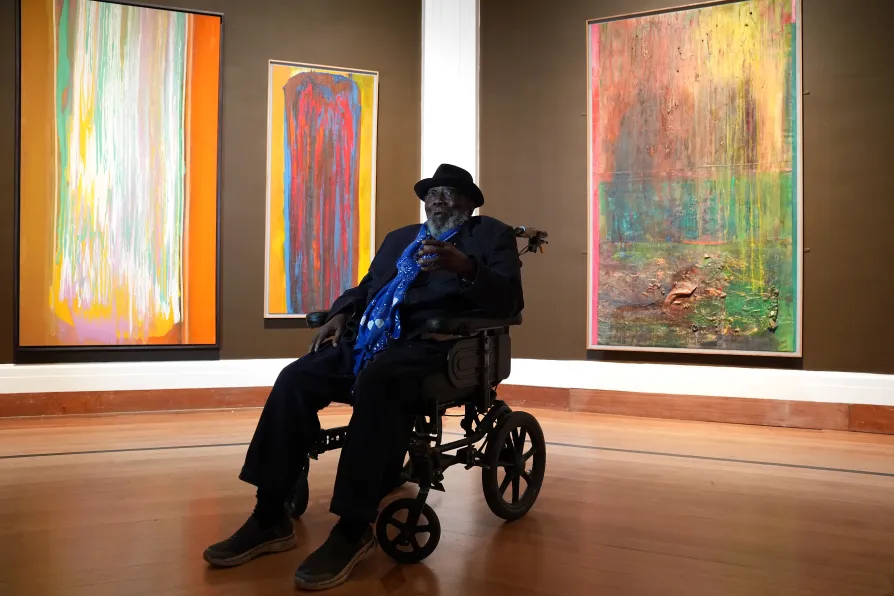 Artist Frank Bowling at the launch of his new exhibition Seeking the Sublime, at the Fitzwilliam Museum in Cambridge, March 25, 2026
Despite Andy Burnham’s declaration defending the continued partition of the island, all major international and internal trends are converging to make Irish reunification inevitable
The left needs a bold energy vision – because if it fails to provide one, others will shape the future in their own interests, argues ALAN SIMPSON
From Margate to Deal, mining memories are being kept alive. National co-ordinator for General Strike 100, HENRY FOWLER continued his nationwide tour of partner organisations in the Garden of England
Humans are part of the ‘animal kingdom’ – and of nature in general – but also distinct from it and labour (work) is part of what makes us unique, declared Engels. His insights 150 years ago into how our species came to be and how we differ from the rest of nature, are as important today as they were then, says the MARX MEMORIAL LIBRARY
Boxes of books, family photos and heirlooms, labour movement anniversaries, along with nostalgic memories of glorious childhood days on the Ayrshire coast still leave room for a wistful MATT KERR to hope for a better future





CULTURE is a critical part of our weaponry for black liberation and to build a revolution. Having spent last week at the Cultures in Resistance gathering at Wortley Hall near Sheffield, I am even more convinced that this is the case.
When I was growing up during the 1970s and ’80s the arts were something I always felt were not for the likes of me. They were just, I believed, something for the well-to-do. Something to be talked about by the chattering classes and to be done to me rather than with and never by me.
In any case, much of the art that I did see, either at school or on the television, never remotely talked to my experience of being a British-born black of African-Caribbean heritage bred in the Black Country of the West Midlands.
I was a child of the Windrush generation but with very limited awareness of my cultural heritage beyond the obvious Jamaican ones we kept up at our family home.
On the music side, it was only really when I started to hear the music of people such as dub poet Linton Kwesi Johnson and reggae band Steel Pulse that I began to hear my experiences reflected rather than that of Trench Town in Kingston, Jamaica, or something from black America.
The fact that black people have been in Britain since Roman times and have faced our own home-grown brand of racism, influenced but distinct from the colonies, makes it even more disturbing that we were rarely depicted in the arts in anything more than a demeaning way.
The lack of positive images does not, of course, mean that we had no identity. Instead it meant we developed a more rebellious and resistance-orientated identity to enable us to collectively and individually cope with the harassment of being constantly stopped and searched by the police and the daily acts of racism that became all too commonplace part of our existence.
Black communities, whether of African or Asian descent, forged a new culture and developed our own new modes of expression. New art, new music and even new ways of communicating with each other.
But our new black culture was often appropriated from us. Many people with no direct experience of our developing culture made millions off the backs of emerging artists who themselves often struggled to make ends meet.
But from the rampant racism of Thatcherite Britain of the early 1980s sprung a new black arts movement.
In fact, just up the road from Walsall, in Wolverhampton, a group of students formed a collective called the BLK Art Group.
That this birth of what turned out to be the new Black Arts Movement (Bam) should come in Wolverhampton is, for me, unsurprising. During the late 1970s I remember being chased late one night through the subways of the town centre by thugs wearing white pillow cases in their own home-grown version of the racist Klu Klux Klan.
There had to be a reaction to increasingly common events such as this and art was just one of them.
Members of the BLK Art Group included the likes of Eddie Chambers, Donald Rodney, Claudette Johnson, Marlene Smith and Keith Piper.
As young black artists, they wanted to tell “our story” in their art.
They worked in many different mediums and aesthetic traditions but it wasn’t enough for the group to just create art, it also had to be seen — and, importantly, be seen by other black people.
They organised exhibitions for many people who were not often used to attending such things. But the first was Black Art An’ Done held in 1981 at Wolverhampton Art Gallery.
It was probably the first time the term “black art” had been used in a British art context. All during a time of a massive rise in racism that saw black uprisings across the country.
In 1982, the collective organised the First National Convention of Black Art “to discuss the form, functioning and future of black art.”
Established black artists like Frank Bowling, as well as art students like Lubaina Himid and Sonia Boyce came together on October 28 1982 for what I am sure would have been often feisty discussions on key issues for black artists.
The convention was the beginning of the Bam but the group itself had split by 1984. However, this was not before it had laid the groundwork for what was clearly now a fully fledged Bam that transformed the cultural landscape of Britain for black and white people.
That is not to say that all of the art was specifically anti-racist, or that black art can only be about race. There were, not surprisingly, many differences in opinion at the time about what the movement was and what its concerns should be.
Contrary to what some may believe, not all black people think the same. That was as reflected in the arts as it was anywhere else.
But regardless of what would have been “robust” exchanges of views it was important to demonstrate that black, whether art or anything else, was “something” rather than nothing.
Lubaina Himid once said: “Fancy having got to 1986 and managing to prove that you exist.”
The Bam not only proved that black artists exist, but that their work was often on a par if not miles ahead of some of the works produced by some white artists that were being celebrated and, importantly, rewarded financially.
The success of the Bam paved the way for generations that followed. Without these black British-based pioneer artists, as in so many other fields, the ability of others to come through and pave their own way for the next generations would have been so much more difficult.
Steve McQueen and Yinka Shonibare should be seen as the artistic successors of the Bam. In their work, we still see that commitment to telling the untold stories of black Britain and of spotlighting black experience.
The questions that arise for me now, after having spent a week at the Cultures in Resistance gathering, is how can we use art to bring about both black liberation and revolutionary change.
I leave that as an open question for debate. But I do so from the viewpoint that art is essential to both linked endeavours of liberation and revolution.
I also do so from the position that our endeavours must be done from a position of joy rather than the dour-faced perspective that so often pervades the left.
I am reminded of a quote from the great Indian writer and activist Arundhati Roy, who I have often cited in my writings.
Roy said: “Our strategy should be not only to confront empire, but to lay siege to it. To deprive it of oxygen. To shame it. To mock it. With our art, our music, our literature, our stubbornness, our joy, our brilliance, our sheer relentlessness — and our ability to tell our own stories. Stories that are different from the ones we’re being brainwashed to believe.
“The corporate revolution will collapse if we refuse to buy what they are selling — their ideas, their version of history, their wars, their weapons, their notion of inevitability.”
