


Court strikes down Palestine Action ban as government slammed for its promise to fight the decision in appeals
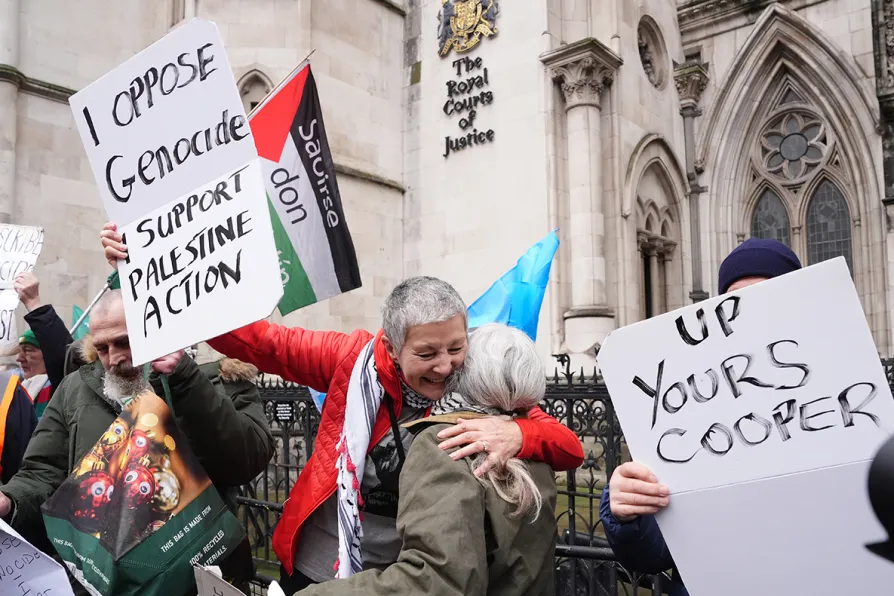
 Protesters celebrate outside the High Court, central London, after it rules in favour of Palestine Action's co-founder Huda Ammori's challenge over the ban of the organisation as a terror group, February 13, 2026






JUDGES struck down the ban on Palestine Action as unlawful today in a landmark judicial review celebrated as a “monumental victory” by activists.
Defend Our Juries (DOJ) said the historic ruling came after Britain’s “largest sustained civil disobedience campaign” to Lift The Ban.
The ruling for the judicial review, brought by Palestine Action co-founder Huda Ammori, marks the first time in British history a group proscribed under terror legislation has been successfully challenged in the courts.
Ms Ammori said the ban would “forever be remembered as one of the most extreme attacks on free speech in recent British history.”
“This is a monumental victory both for our fundamental freedoms here in Britain and in the struggle for freedom for the Palestinian people,” she added.
In a 46-page ruling, Dame Victoria Sharp, sitting with Mr Justice Swift and Mrs Justice Steyn, said: “We are satisfied that the decision to proscribe Palestine Action was disproportionate.
“At its core, Palestine Action is an organisation that promotes its political cause through criminality and encouragement of criminality.
“A very small number of its actions have amounted to terrorist action.”
The Communist Party said the High Court “delivered a terminal blow to the British state’s attempt to criminalise the moral conscience of a generation.”
Friday’s decision is a “vindication” for Palestine campaigners, the party said, branding it a “humiliating defeat for successive UK governments that prioritised arms industry profits and an alliance with the apartheid state of Israel over the lives of Palestinian people.”
They called for Yvette Cooper, who was home secretary at the time of the ban and is now Foreign Secretary, to resign.
Home Secretary Shabana Mahmood insisted the government would “fight this judgment in the Court of Appeal.”
“The government’s proscription followed a rigorous process, endorsed by Parliament,” she claimed.
Labour MP for Hayes and Harlington John McDonnell immediately hit back, writing on social media: “So we have a Home Secretary that is going to ‘fight’ the judiciary.
“This is hardly the language of someone holding one of the highest offices of state.
“You can disagree with court decisions but you don’t have to use the language usually reserved for the fringes of the right.”
He added: “We must uphold our centuries-old tradition of the right to protest.”
Following the review decision, the Metropolitan Police published said officers would not enforce the ban on expressing support for Palestine Action for the time being.
But earlier that day, Met police stationed at the DOJ protest outside the Royal Courts of Justice filmed the demonstrators holding placards defying the ban.
Dozens of activists held signs reading “I oppose genocide. I support Palestine Action,” as the ruling was delivered at the central London court.
Cops stood ready to arrest anyone taking part in this act of civil disobedience, planned before anyone knew the result of the judicial review.
But the Met later confirmed that videos taken of protesters were part of their effort to “continue to identify offences” for “enforcement at a later date, rather than making arrests at the time,” so if the Court of Appeal upholds the ban people can be retrospectively persecuted.
Palestine Action still technically remains proscribed until the end of any appeals process.
Among the DOJ protesters, retired social worker Dru Long told the Star she was “absolutely ecstatic” when she heard the decision.
She said: “Justice is being served. We’ve got to hang on to it. Because they may try and overturn [the review].”
Ms Long joined the protest having already been arrested multiple times on charges related to support for Palestine Action.
She said: “I’m a retired social worker. I consider this part of my work to speak up for the children of Gaza who are being murdered.”
The judicial review ran from November 25 to December 2. It heard witness statements including from Irish author Sally Rooney, human rights groups Liberty and Amnesty International.
Ms Ammori was represented by Raza Husain KC, who argued the ban was an “ill-considered, discriminatory, due process-lacking, authoritarian abuse of statutory power.”
He added it “is alien to the basic tradition of common law and the European Convention on Human Rights.”
United Nations Special Rapporteur Ben Saul, also in court, said the ban was an indication Britain was “out of step with comparable liberal democracies” and “sets a precedent” for the government to crack down on other protest movements.
Jenny Mason, co-chair of the Jewish Voice for Liberation campaign group, told the High Court the government’s decision to proscribe Palestine Action served to “privilege Israeli arms groups.”
She added: “There are dangers from the common misconception, fed too often by politicians and the media that Jews wholeheartedly support Israel.
“We say ‘not in my name’ to highlight that the decision to proscribe [Palestine Action], the decision to continue to send arms and the decision to continue to defend Israel’s current actions are decisions that are not supported by us.”
The ruling was welcomed by DOJ, after the group led the disobedience campaign against the proscription, which they say resulted in 2,787 people being arrested for showing support for the group since July last year.
“Thousands of people of conscience saw that branding protest as terrorism was a move straight out of the dictator’s playbook,” a DOJ spokesperson said.
“Together we took action at great personal risk — inspired by each other’s courage. We helped make this proscription unenforceable by saying ‘we do not comply’.
“When presented with the full evidence — as they were in the Filton 6 case — ordinary people don’t agree with the government that damaging weapons that would be used in a genocide is a crime, let alone terrorism.”
DOJ demanded a meeting with the Home Secretary and Met Police Commissioner Mark Rowley following the ruling.
They added that there is “no longer any reason for Palestine Action-linked prisoners, including those who went on hunger strike, to be held in prison without trial on unsubstantiated ‘terror’ charges.
“They should be released immediately.”
Amnesty International UK’s law and human rights director, Tom Southerden, welcomed the result.
He said it sends “a clear message: the government cannot simply reach for sweeping counter‑terrorism powers to silence critics or suppress dissent.”
Former Labour leader Jeremy Corbyn called it “an enormous victory for the Palestinian solidarity movement, for civil liberties and for our common humanity.”
“The real crime,” he added, “is the government’s complicity in genocide — and we will not rest until we have justice for the Palestinian people.”
Stop the War Coalition’s Lindsey German joined calls for heads to roll, saying Mr Rowley and Ms Cooper should step down.
“Now the CPS must drop all the charges against those wrongly arrested and imprisoned without trial for peacefully protesting a genocide,” she said.
“That includes the charges against four of the leaders of the Palestine movement, Chris Nineham, Ben Jamal, Alex Kenny and Sophie Bolt.”
