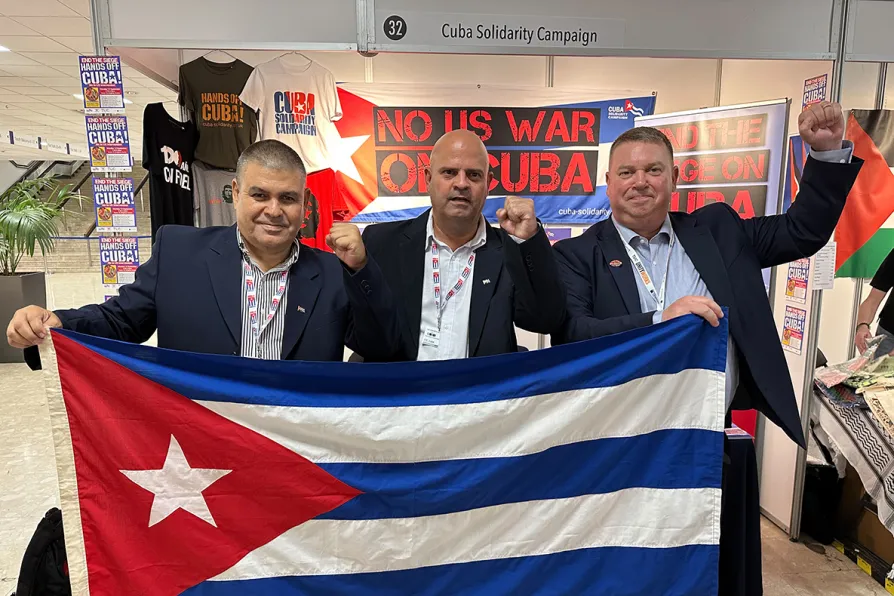
Cuban trade union federation CTC leader OSNAY MIGUEL COLINA speaks to Ben Chacko about life and work under a crippling US siege


 Latest editorial
Mexico acts decisively against narco criminality
DAVID RABY explains the background of the recent upheavals in Mexico
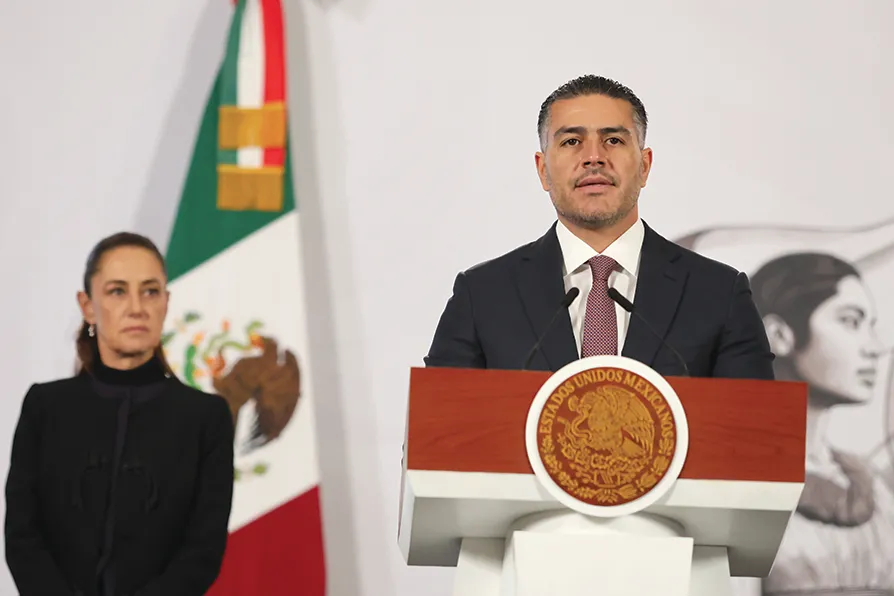 President Claudia Sheinbaum looks on during her daily, morning news conference, as Mexican Security and Citizen Protection Minister Omar Garcia Harfuch delivers a briefing
A part of the British empire’s network of slavery, today the Caribbean island of Nevis faces a new form of exploitation in the form of crypto-colonialism, CLAUDIA WEBBE writes
A new book by Victoria Holmes illuminates the many hidden histories of the oppression experienced by Gypsy/Roma/Traveller community, writes ROGER McKENZIE
Even the oligarchs of the artificial intelligence industries are warning that their creations have the capacity for the ultimate destruction of the planet and its population. ANDREW MURRAY suggests that there might just be other solutions
The Labour government must deliver on its commitment to bring back privatised services into the public sector. This not only saves money but also creates accountability and generates wider social benefits, argues ANDY MCDONALD MP
Public ownership of Great British Railways has enormous potential to improve our railway network, but that can’t happen unless jobs, employee rights and union recognition is at the heart of the transition, argues MARYAM ESLAMDOUST
Challenges from the unscrupulous misuse of AI to steal actors’ voice and physical likenesses is being met with a firm union response, writes LYNDA ROOKE





MANY observers will have been taken by surprise by the explosion of criminal violence in Mexico beginning on February 22 with the capture of “el Mencho,” boss of the notorious CJNG (Cartel Jalisco Nueva Generacion) network.
Over the past 16 months President Claudia Sheinbaum and her security team headed by Public Security Secretary Omar Garcia Harfuch had achieved remarkable success in fighting crime by a combination of welfare programmes, investigation, intelligence and restrained use of force, reducing homicides by 42 per cent, but cartel violence was far from eliminated.
The operation against the cartel
As explained by the president in her morning press conference on February 22, along with Defence Secretary General Ricardo Trevilla Trejo and Garcia Harfuch, the spectacular violence was a direct response to a carefully planned operation by the Mexican armed forces, with intelligence assistance (but no more) from the US, to capture the CJNG boss and his immediate entourage.
Long and careful investigation by Mexican military intelligence, tracking a female partner of El Mencho, had located him in the remote municipality of Tapalpa, in the central-western Jalisco state.
On the night of February 21 Mexican special forces surrounded the area and moved in with helicopter support; they were met with intense gunfire by the cartel boss and his personal guards.
In the confrontation several criminals were killed and some soldiers were also killed and others wounded. El Mencho, his immediate deputy and another criminal were wounded and captured, and later died while being flown out of the area.
Other gun battles in neighbouring areas led to the deaths of at least eight soldiers and 25 National Guard personnel, three members of the military, a civilian security guard, a member of the Jalisco Attorney’s office and a woman; 30 presumed criminals were killed.
In the following 24 hours cartel members and associates caused mayhem in many parts of Jalisco, Michoacan, Nayarit, Guerrero, Tamaulipas, Oaxaca, Veracruz and other states, blockading roads, seizing and burning cars and buses and attacking buildings of the public Welfare Bank and pharmacies.
Greater Guadalajara — capital of Jalisco and the country’s second city — and the tourist resort of Puerto Vallarta were seriously affected.
However, on orders from the president, an operational command co-ordinated action in all affected states; there was unanimous support from all state governors and public agencies. Numerous fake reports exaggerating the news of violence were generated by social media linked to criminals or simply sensationalist, and were swiftly denounced by the authorities.
False reports of participation by US armed agents were denied by the Mexican authorities and indeed by US ambassador Ronald Johnson, who publicly praised the valour and efficiency of the Mexican troops.
However, as was pointed out by the Mexican Defence Secretary, 80 per cent of cartel weapons come from the US, and others drew attention to US demand for narcotics, money laundering and failure to tackle criminal gangs and social problems north of the border.
Attempts at destabilisation
It is also well known that US agencies like the CIA and DEA have repeatedly used criminal drug networks to infiltrate and destabilise progressive governments in Latin America, and despite his fine public statements, Johnson is known to have a CIA background.
Moreover, there is much evidence to suggest that attempts at destabilisation began well before the Mexican decision to launch this operation against the most powerful cartel of all.
There are many reasons why the US would want to undermine President Sheinbaum and the Fourth Transformation (a sweeping political and social project inaugurated in 2018 by former Mexican President Andres Manuel Lopez Obrador), not least because of Mexico’s heroic stand in support of Cuba.
As I explained in these pages on November 27 (Destabilisation fails in Mexico) and December 9 (Sheinbaum turns the tide), provocative right-wing demonstrations and the mysterious murder of a populist mayor in Michoacan state were used to try to discredit the government.
Investigation pointed to right-wing politicians advocating US intervention, and in Michoacan, probable ties to the CJNG cartel, as responsible.
Firm responses by Sheinbaum’s government and greatly increased welfare and security policies coupled with dialogue in a special “Plan Michoacan” neutralised these provocations, and on December 6 a huge popular rally demonstrated mass support for the president.
But renewed unrest emerged in mid-February when an official in the Education Ministry responsible for the popular free school textbooks programme was dismissed in an arbitrary manner. Marx Arriaga, a respected left-wing intellectual, was suddenly told of his dismissal with a bizarre intervention including three police officers. He refused to leave and accused the Education Minister Mario Delgado of arbitrary intervention to impose neoliberal ideas.
It was then revealed that despite all Arriaga’s good work, he had failed to include references to women in the history textbook, and these were inserted by a co-worker, Noemi Juarez. Delgado defended himself in an interview and was backed by the president. A few days later Arriaga received his formal notice, and left.
The worst part of this strange episode is that many left-wing supporters of Arriaga claimed to be Obradoristas, loyal to former President Amlo, while attacking Sheinbaum and her government.
This is something Amlo would never approve of, and he gave no hint of support for such divisionism. Sheinbaum calmed the waters by thanking Arriaga for his good work and reaffirming that all should unite despite differences.
It seems obvious that the sudden emergence of supposed Obradoristas opposing a president who is totally committed to continuing and advancing Amlo’s Fourth Transformation was another manoeuvre aimed at destabilisation.
This sorry episode was quickly followed by the operation against the CJNG cartel, and everyone closed ranks behind the president and the defence of the country against criminal violence.
More support for young people
Despite an intense and alarming 36 hours or so of violent confrontation and disorder, Sheinbaum and the Fourth Transformation have emerged with more prestige than ever.
By February 24 life had returned almost completely to normal. Support for the president was greater than ever, and those who fear renewed serious violence by the cartel may not be correct.
As General Trevilla pointed out, the strategy of dealing with the root causes of crime by welfare and assistance is beginning to work: the cartels are finding it more difficult to recruit young people.
Sheinbaum showed immediately that she understands this: on February 24 she announced a whole raft of new programmes for young people, with access to education, culture, sports and community integration through tequio collective work initiatives.
Collectively these programmes will be called “Young People Transforming Mexico;” they will benefit over 300,000 youngsters this year and many more as time goes on.
David Raby is a retired professor of Latin American history, a freelance journalist and co-ordinator of the UK Mexico Solidarity Forum. His book, Mexico In Transformation: From AMLO to Claudia, was published in 2025 by Praxis Press. He can be contacted at david.raby@mexicosolidarity.org.uk and on X @DLRaby.

Similar stories
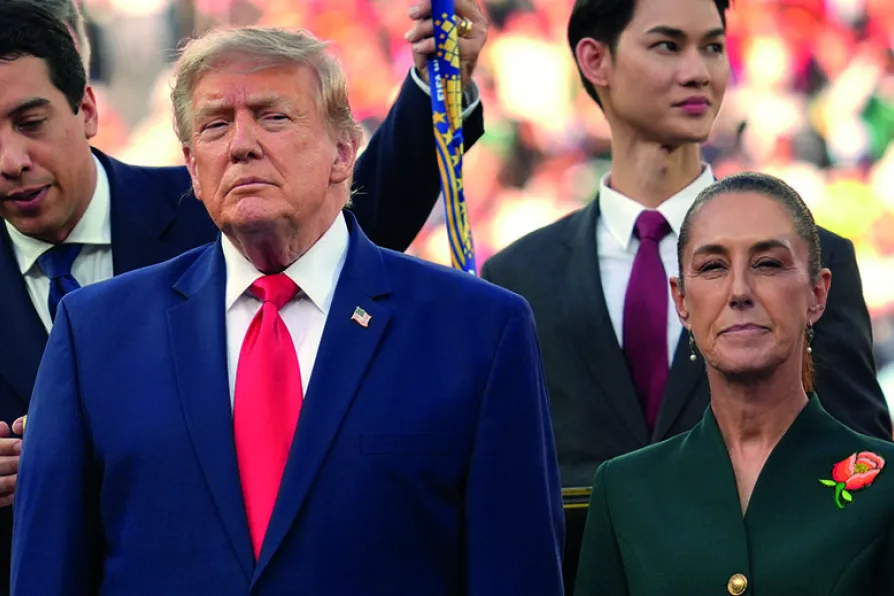
The Claudia Sheinbaum government is no pushover and is holding firm despite US abuses of the relationship, says DAVID RABY
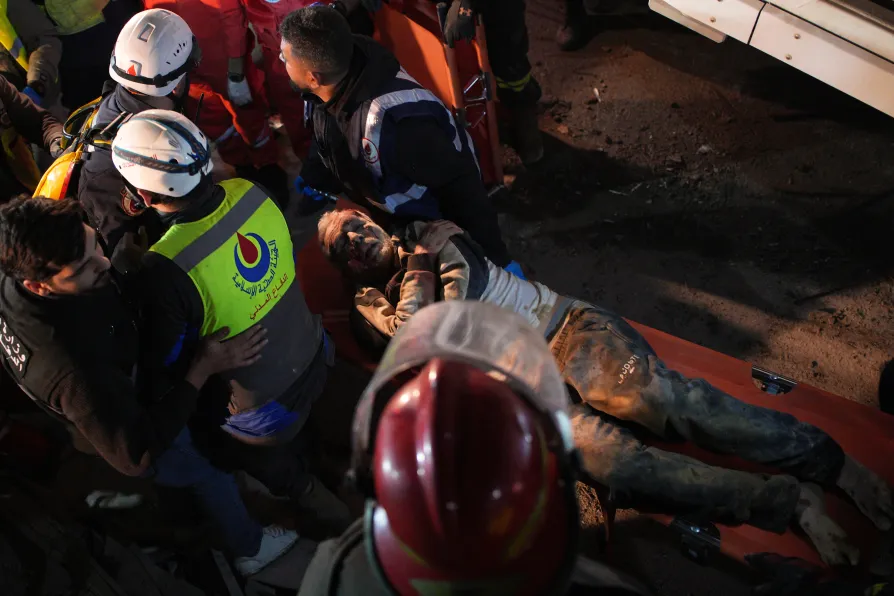

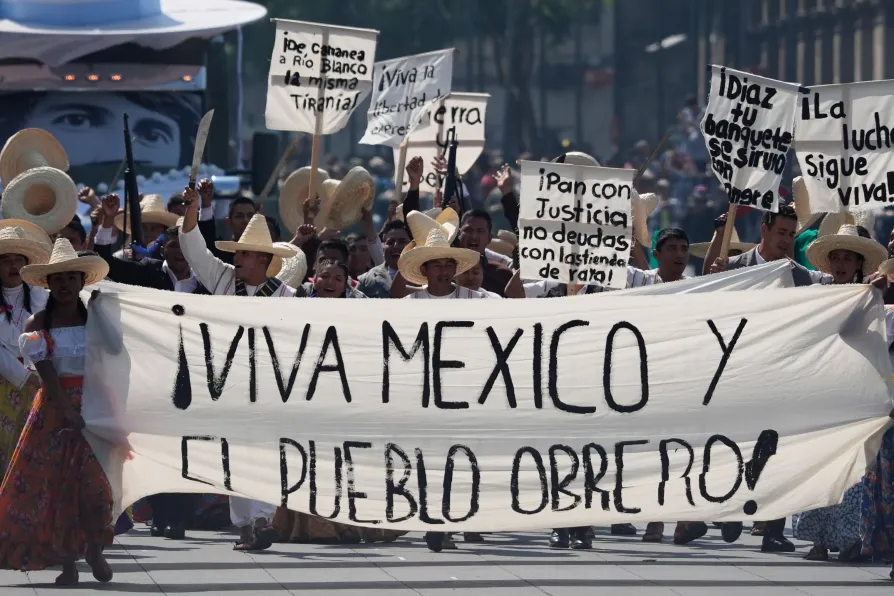
A November 15 protest in Mexico – driven by a right-wing social-media operation – has been miscast as a mass uprising against President Sheinbaum. In reality, the march was small, elite-backed and part of a wider attempt to sow unrest, argues DAVID RABY