
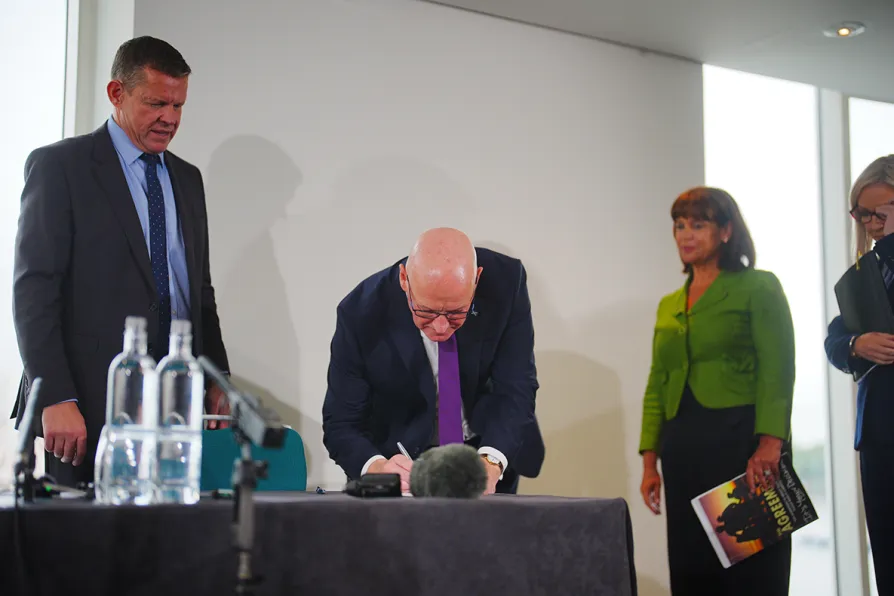
The UK Prime Minister may have the regal touch in northern England, but he’s been wrong-footed on the constitutional challenges posed by the Celtic Alliance of first ministers from Scotland, Wales and Northern Ireland, argues KENNY MacASKILL

Marxism is as relevant today as it ever was
Studying the works of Karl Marx is a necessity if we are to fully comprehend the crises that surround us, says MATT WILLGRESS ahead of a Marx Matters event this weekend
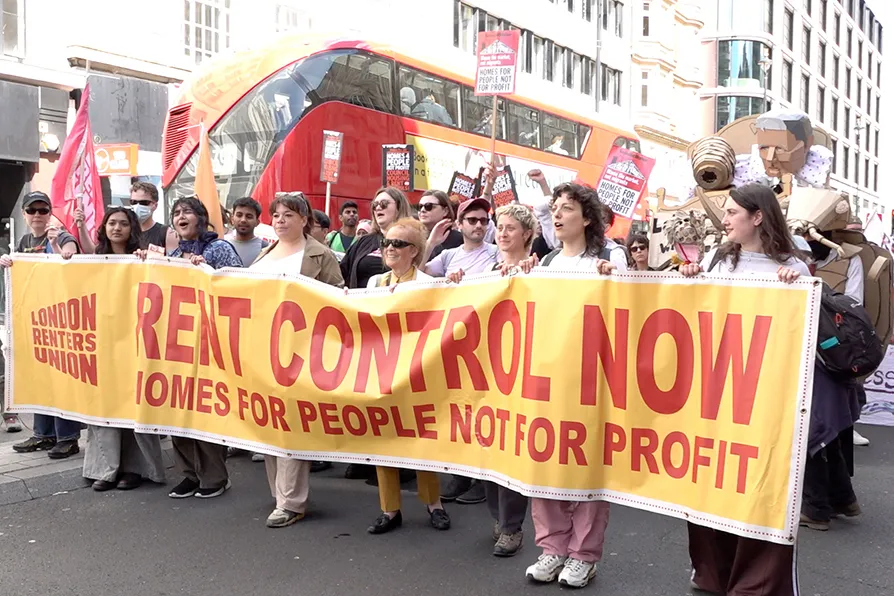
 NEED BEFORE GREED: National Housing Demo in central London, on April 18, against unaffordable housing, demanding better council housing and rent controls
NEIRLAY ANDRADE, a member of the Communist Party of Venezuela’s political committee, outlines her party’s position on the crisis facing the country
A look at Taylor Wimpey’s accounts shows why Labour’s market-led housing strategy won’t deliver more, cheaper homes, as promised, says SOLOMON HUGHES
DAVID HORSLEY remembers the remarkable life and death of US black revolutionary George Jackson, whose politically passionate prison letters were published as Soledad Brother
Cuban trade union federation CTC leader OSNAY MIGUEL COLINA speaks to Ben Chacko about life and work under a crippling US siege
A part of the British empire’s network of slavery, today the Caribbean island of Nevis faces a new form of exploitation in the form of crypto-colonialism, CLAUDIA WEBBE writes
Challenges from the unscrupulous misuse of AI to steal actors’ voice and physical likenesses is being met with a firm union response, writes LYNDA ROOKE





IF YOU can bear to turn on the TV news for just a few minutes, you see that without a doubt we are in the midst of global economic, social, political, military and climate crises that are on a scale unprecedented in their severity and depth in many of our lifetimes.
Yet what you’ll also notice is how few commentators or voices — even ones opposing reactionary policies such as Donald Trump’s war on Iran — on these news programmes give a reason behind these crises beyond blaming immediate individuals or policies.
The idea of systemic crises is rarely visited on the media or indeed in Parliament – yet if we as activists are to transform the world, we have to seek to grasp and explain the systemic roots of these crises.
And to do this, we need to return to the ideas and methods of the founders of the labour movement, most notably Marx and Engels.
And when we dive deeper into Marx, you find not only ideas that are still relevant, but also a method of analysing, which can help us get to grips with the world at this time of multiple — and seemingly permanent — global crises.
In terms of the economic crisis, Marx once wrote that “capital is dead labour, which, vampire-like, lives only by sucking living labour, and lives the more, the more labour it sucks.” This rings truer than ever in 2026, both here in Britain and across the world.
Here, our high streets have never recovered from the 2008 financial crash and both commentators and government politicians seem relieved unemployment is “only” at 4.9 per cent. Yet massive profits for the mega-corps keep being siphoned off.
Global poverty and inequality levels show how barbaric capitalism is in the 21st century — around nine million people die from hunger-related causes every year, according to SAPA.
This means that some 25,000 people, including over 10,000 children, die daily from malnutrition and related illnesses (child hunger causes around 3.1 million children to die annually). Or to put it another way, a person dies every four seconds.
The UN identifies the key underlying factors driving increasing global hunger as “conflict, climate change and economic instability.” And we can identify all these as being caused by the very nature of capitalism itself, and its current protracted crisis.
This crisis has reached such a point that there won’t be a habitable planet if capitalism continues in its current form. In the era of “Trump 2.0” by enabling a massive increase in fossil fuel extraction in the US and elsewhere, much of the capitalist class has shown it will literally wage war on the planet itself in order to seek short-term profit.
And — as Trump’s murderous interventions in Venezuela and Iran illustrate so starkly — war is also all about the search for profits, at any cost. As Lenin said: “War is a ‘terrible’ thing? Yes. But it is a terribly profitable thing.”
Understanding capitalism is therefore not only essential to understanding the cyclical economic crises but also environmental catastrophe and the era of permanent war we live in.
But there is hope as resistance coalesces. The mass movements in support of Palestine show how millions have not only had enough of war and misery but are making the link between the wars and the crisis-ridden economic system that propels them.
At climate justice marches placards are carried demanding: “System change not climate change.”
Polling also indicates that people perceive negatively an economic system that puts corporate greed before public need with a change of attitudes to capitalism itself.
In late 2024, only about 30 per cent of Britons viewed capitalism positively, compared to 44-45 per cent holding an unfavourable view. Anti-capitalist feelings are particularly strong among younger generations, with a 2021 report finding that 67 per cent of young people aged 16 to 34 want to live under a socialist economic system.
And if we look at support for specific socialist policies, clear majorities favour public ownership including 83 per cent for water and 77 per cent for energy.
It is therefore more than feasible that a mass anti-capitalist mood, and movements organised by the left based around it, can emerge here in the next period.
But — and this is a massive but — the left needs to be explicitly talking the language of anti-capitalism, anti-imperialism and socialism if it is to harness these moods and forge movements based on militant and collective action.
As well as this, a key lesson of the years of Jeremy Corbyn as Labour leader and since must be that steeping ourselves in a real understanding of socialist ideas is not a nice “add-on” to the equally essential work of organising in the streets, workplaces and communities. It must be central to what we do.
How can we beat back against the ideological warfare of capitalism, if we don’t collectively grasp the nature of class rule today ourselves? As Marx himself said: “To be radical is to grasp things by the root.”
To this end, the series of events organised under the banner of Marx Matters — following on from 2024’s Lenin 100 series — have reached far more people than the small band of volunteers behind it could have imagined. Over 2,500 different people have pre-registered for events to date, with a packed agenda still to come, and YouTube viewers are in the 10,000s and counting.
Interaction from participants throughout has confirmed they are not “armchair revolutionaries,” but people engaged in struggle — with Palestine campaigners attending alongside others fighting in trade unions; different political parties and none; liberation and equality struggles; local and community initiatives for a better world, and much more besides.
Join us with Vijay Prashad on the first Sunday in May for the next event on “Marx and the Poorer Nations Struggle for Liberation” — and then in further illuminating examples of socialist political education in the months ahead.
The Marx Matters series takes place on the first Sunday of every month. The next session is on Sunday May 3 at 3pm with Vijay Prashad on Marx and the Poorer Nations’ Struggle for Liberation. Register at bit.ly/marxliberation.
Buy tickets for the whole season at https://bit.ly/MarxMattersTickets and follow at https://x.com/MarxMatters25.
