
RITA DI SANTO contemplates two films about journalism that opened this year’s festival


Macbeth in Ireland
JENNY FARRELL recommends an earthy production, driven by two magnificent performances
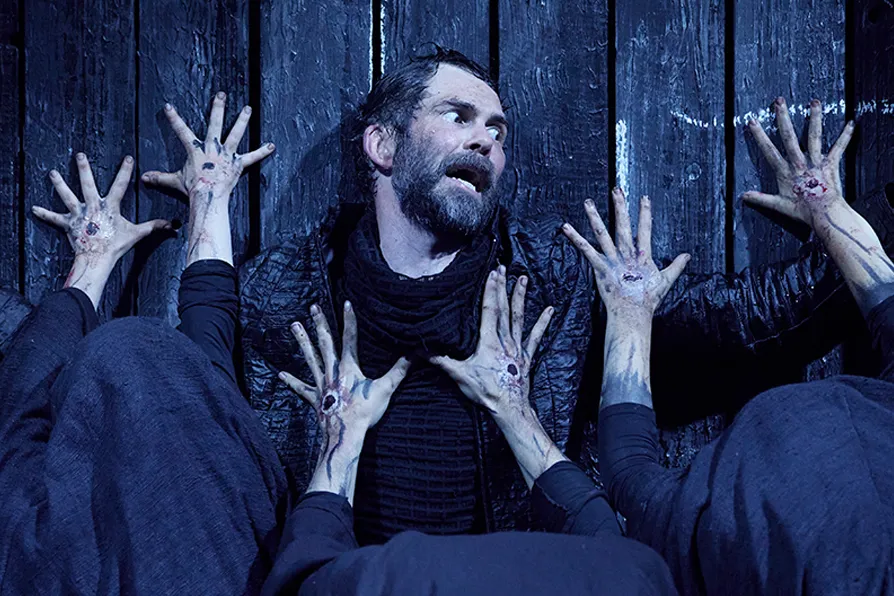
 BREATHTAKING FORCE: Marty Rea as Macbeth [Pic: Ros Kavanagh]
GEOFF BOTTOMS applauds a world-class production King Lear that pits late feudalism against a rising bourgeoisie
MARY CONWAY keeps up with the sheer pace of a drama about the terrible gap between sanitised reporting and real-life turmoil of race and gender
New releases from Brian Fallon, Antony Szmierek and Hollow Hand
APURBA CHATTERJEE explains how British artists in India used the “picturesque” to reshape colonial landscapes and celebrate imperial power
PAUL DONOVAN welcomes a revival of Reginald Rose’s classic play that reminds us of the fundamental need for trials with juries





Macbeth, Druid Theatre, Galway, Ireland
★★★★☆
THE peat floor of Francis O’Connor’s set still smells of damp earth as the witches hiss their prophecies. This is the world of Druid Theatre Company’s Macbeth, directed by co-founder Garry Hynes — a production that is by turns magnificent, frustrating and ultimately worth your time.
Briefly stated, Macbeth is the last of Shakespeare’s great tragedies to explore the conflict between humanist ideals and emergent Machiavellian realpolitik as it manifested itself in the Renaissance. What distinguishes Macbeth from Hamlet, Othello and Lear is that here the conflict between the capacity for humanity and that for barbarism takes place not between opposing characters but in one character, Macbeth, echoed by his beloved partner Lady Macbeth.
The main job for any production is to communicate this theme and allow the audience to recognise what the play has to do with our times. Druid’s production achieves this.
The menacing world of the Macbeths is ably created on stage by designer Francis O’Connor. The set is spare: a peat floor, dark, wood-panelled walls with hidden doors opening onto the stage and a barrel fulfilling various purposes. The audience are seated on three sides, placing some spectators in close proximity to the carnage.
Colin Grenfell’s lighting — strong LED bands above, candlelit moments below — and Conor Linehan’s music create an atmosphere of shadowy forces and omens. The dark-clad witches, faces covered, are effective and blur the line between natural and supernatural.
At the heart of this production are two magnificent performances. Marty Rea’s Macbeth captures the character’s descent from conflicted thane into ruthless tyrant with breathtaking force. His performance is energetic, inventive and fully convincing. He uses the entire stage in his appearances, deploying a wide physical and emotional range.
The legendary Mary Mullen is cast in the role of Lady Macbeth. Here, however, the decision to give her this role must be questioned. Given the considerable age difference between Mullen and Rea, viewers are left wondering whether the director intends to introduce an Oedipal dynamic into the relationship, with Lady Macbeth appearing less as a partner than as a quasi-maternal figure. Shakespeare’s next tragedy was Coriolanus, with an intense mother-son relationship central to that play’s statement. However, in this production, it is not a convincing choice, as it disrupts the sense of mutuality at the core of the Macbeths’ relationship.
The porter scene and the role of Macduff’s young son are handled with care and conviction — the truths they speak register clearly and are not dismissed as mere comic distraction, as can happen in lesser productions. Liam Heslin as Macduff delivers an able performance. However, the work of some others among the eleven-strong cast is less convincing. Several actors unfortunately exhibit a distracting habit of visibly “switching off” after delivering their lines, freezing on stage rather than sustaining character and a continuous physical life on stage.
Despite these reservations, the overall message of Shakespeare’s play comes across with clarity. This is to be greatly welcomed. In fact, in an age when, for example, German Regietheater productions often bury the text beneath an imposed directorial concept, leaving audiences wondering what the play is actually about, Druid’s Macbeth is worth a great deal.
The themes of tyranny, the speed with which humanity falls away to Machiavellian inhumanity and greed for power, the necessity of challenging violence and injustice — all emerge powerfully from Hynes’s vision.
Macbeth runs in Belfast until April 19. Box office: www.druid.ie.
