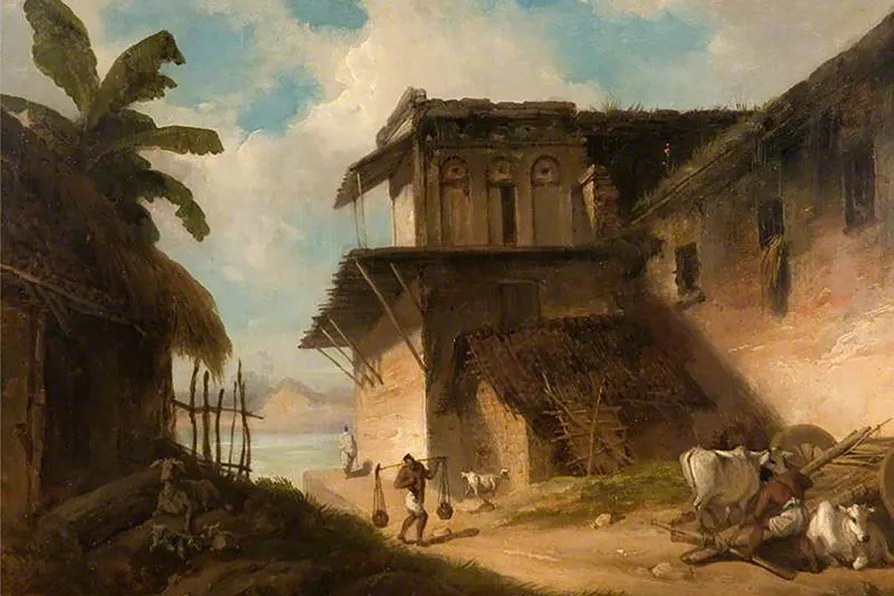
APURBA CHATTERJEE explains how British artists in India used the “picturesque” to reshape colonial landscapes and celebrate imperial power


 Latest editorial

Letters from Latin America with Leo Boix: May 5, 2026
LEO BOIX reviews a novel where shadows deceive and mortality looms, and a poetry collection that refuses to dim

PAUL DONOVAN welcomes a revival of Reginald Rose’s classic play that reminds us of the fundamental need for trials with juries
SIMON PARSONS applauds an exceptional performance of Wesker’s little-known play, by the same actor for whom it was written 45 years ago
ANDY HEDGECOCK and MARIA DUARTE review Late Fame, The Death of Robin Hood, Leviticus, and Gail Daughtry and the Celebrity Sex Pass
ANGUS REID recommends a uniquely accomplished documentary collage that contemplates our relation to the natural world
GORDON PARSONS enjoys Kant’s ‘mind-boggling’ theory of human reality: that we create the reality we experience





THE Roman poet-philosopher Lucretius, in De Rerum Natura, offers one of the earliest — and strangest — accounts of perception.
Everything, he insists, is made of atoms and void, including appearances themselves. Objects are constantly shedding wafer-thin films of matter — simulacra — that drift through the air and strike our eyes.
To see, then, is not merely to look, but to be struck: vision as contact, not contemplation. Mirrors bounce these films back at us; dreams recombine them into improbable pageants. Reality, for Lucretius, is already a kind of theatre.
What better way to begin Mexican-American Chloe Aridjis’s The Shadow of the Object (Chatto & Windus, £16.99), a novel that seems to take Lucretius at his word and run gleefully with it. This is a book about images that refuse to sit still, about the quiet magic of projection, and about the ways in which seeing is never innocent.
Aridjis has long been drawn to the uncanny edges of perception, and here she turns her attention to the magic lantern, an early image projector whose ghostly slides prefigure cinema, photography and perhaps even memory itself.
The novel opens with Flora, a jewel polisher living in London, returning to Mexico City to visit her parents. Shortly after arriving, she is bitten by the family dog — Diogenes, or Diego, depending on who is speaking — and ends up in hospital.
It is there, in a suitably liminal state of convalescence, that she meets Wilhelmina, a German collector of magic lanterns and optical devices. Wilhelmina, part scholar, part conjuror, draws Flora into a world of glowing images, mechanical marvels and emotional afterimages that refuse to fade.
“I lifted the lantern out of its box… A glowing circle of light was cast, a hungry circle waiting to see what sorts of beings might come to fill the vacancy,” Flora tells us. The sentence could stand as a manifesto for the novel itself.
Aridjis writes with a meticulous, almost jeweller-like precision — unsurprising, given her protagonist’s profession — but there is always a shimmer of something just beyond reach. London’s canals glint with suggestion; cats appear and vanish with conspiratorial timing; objects seem to carry memories like latent fingerprints.
The magic lantern becomes both device and metaphor: a machine for projection, certainly, but also for transformation. Images slide, distort, double.
Love, too, is refracted: never quite direct, always mediated by memory, language, or longing.
Aridjis is particularly sharp on literature’s own sleight of hand: its ability to cast shadows that feel more substantial than the objects that produced them.
The result is a novel that is elegant, elusive and quietly hypnotic — a cabinet of curiosities in prose form. A must-read, and one that rewards lingering in its half-light.
If Aridjis gives us images that flicker on the wall, US author Alexis Almeida, in Caetano (Ugly Duckling Presse, £16), offers something closer to the afterimage: the residue that lingers when the light has gone.
This debut full-length collection is preoccupied with the small negotiations of everyday life — time, labour and intimacy, but renders them with a clarity that feels almost otherworldly.
“There is the question of what we do together./ How will we make enough time./ How will we carry all the bags./ Who will keep the door open.” The lines are simple, even domestic, yet charged with a quiet urgency.
Almeida’s gift lies in precision. Each poem feels carefully tuned, its language exact without ever becoming brittle. Scenes unfold with a logic that is just slightly off-kilter, as though reality has been nudged a few degrees to the side.
There is, at times, a distinctly Lynchian atmosphere — rooms within rooms, signals half-caught, meanings that hum rather than declare themselves.
In the title poem, the speaker searches for her grandfather: “I found a room/ inside another/ room… a sound/ vaguely there, like an/ ancient transmission.” It is an image that could have come straight from Lucretius: something real, and yet not quite graspable, arriving from elsewhere.
Both books, in their different ways, are fascinated by what hovers between object and image. Aridjis builds a luminous apparatus of projection, where shadows take on a life of their own; Almeida pares things back to the moment after, when meaning flickers and threatens to dissolve.
Together, they remind us that seeing is never straightforward. That every image, whether cast on a wall or held in a line of verse, carries with it a trace of illusion.
Or, to put it in Lucretian terms: we are always, in one way or another, being touched by ghosts.
