
The US administration is endangering lives by reversing environmental protection laws, CHAUNCEY K ROBINSON argues

Lessons from the fall of the GDR
Western accounts portray the Stasi as an agent of repression, but behind the stereotype, many East German security officers saw themselves as defenders of an anti-fascist socialist project under constant attack from the West, argues NICK WRIGHT
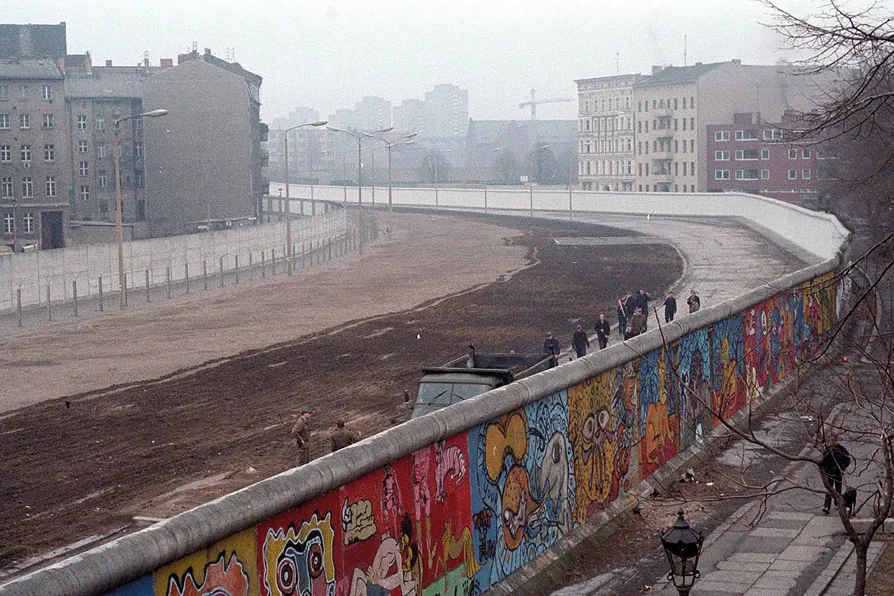
 COLD WAR: The Berlin Wall in 1986. Photo: Thierry Noir/Creative Commons
It’s time to stop retreating and go on the offensive to promote working-class interests, argues DOUG NICHOLLS
Marco Rubio wants to defeat socialism in Nicaragua, not restore ‘democracy,’ writes JOHN PERRY
Believe it or not, there was a time when the US government built beautiful homes for working‑class Americans to deal with a housing shortage, writes ERAN BEN-JOSEPH
DIANE ABBOTT provides an analysis of the reasons for EU and British voters’ dramatic swing to the right
Train drivers’ union Aslef general secretary DAVE CALFE speaks to Ben Chacko about his hopes that Burnham’s devolution agenda will include the importance of the railway





A BRIEF but interesting discussion arose a while back in this paper’s correspondence columns about the role of the Ministry of State Security (MfS) in the German Democratic Republic.
One view was that while life in GDR could not be conflated with the Stasi one could not exist without the other and that the socialist state could never have survived without the efforts of the comrades working with the MfS.
Another view was presented which hinted to the possibility that these efforts may have contributed to the failure of the socialist state to survive. A partial analysis of the complex development and tragic demise of the first anti-fascist state on German soil must necessarily be incomplete. But nevertheless we can make a start in looking at who these terrible people were.
In the reconstituted capitalist German state the official and quasi-official framing of the question is best summed up (by the Deutschland Museum) that: “Aware that East Germany’s repressive political system lacked popular support, the Politburo of the ruling Socialist Unity Party (SED) established a new secret police force on 24 January 1950 to combat dissent. Modelled on Stalin’s secret service, the Ministry for State Security (Stasi) was tasked with protecting socialism from its domestic and foreign enemies and preventing East Germans from voting with their feet and leaving for the West.
“The Stasi combined the role of a secret police and intelligence service in a single organisation and soon expanded to become a comprehensive instrument of surveillance and repression. By 1989, some 90,000 people worked for the Stasi full-time, assisted by 189,000 informants.”
This account by the victors in the clash between working class and bourgeois power can be challenged.
It took more than a decade before the inner German border was closed and it is certainly true that many Germans, especially those most closely associated with the Nazi regime, went west, along with people reuniting families, economic migrants and almost anyone uncomfortable with the new dispensation. Rarely reported is the fact that over 300,000 people went east, including Angela Merkel’s Lutheran pastor father.
To transpose this unusual situation to post-war Britain, we can easily imagine — from among our family and workmates — those who mind find life more congenial across an internal border where capitalist relations of production remained.
Among the earliest Germans to go west was Wehrmacht Major General Reinhard Gehlen, head of the Nazi intelligence organisation in eastern Europe and the Soviet Union who, even before the surrender, had placed his outfit at the service of the US.
He was given sanctuary by what became the CIA and resumed his work in Pullach in Bavaria before becoming head of the Bundesnachrichtendienst, the West German federal intelligence organisation.
As the US National Security Archives record, Gehlen “…employed numerous former Nazis and known war criminals.” Among them was Adolf Eichmann’s deputy Alois Brunner, who sent more than 100,000 Jews to ghettos or internment camps.
The first director of the GDR’s MfS was Spanish civil war veteran and former commander of the International Brigades, Wilhelm Zaisser. Earlier, in Weimar Germany, he had been dismissed from his teaching job after a spell as a military leader of the Ruhr workers’ militia in the German Revolution of 1921.
The first cohort of state security functionaries were almost exclusively Spanish civil war veterans, returning exiles and former political prisoners released from Nazi prisons and camps. In the years immediately after the defeat of Nazi Germany, and conscious of the population’s exposure to Nazi indoctrination and even complicity in war crimes, the Stasi recruited almost exclusively from young people without a compromised past.
The MfS — “the sword and shield of the working-class party” took an uncompromising approach to domestic intelligence and recruited more than 100,000 so called Inoffizielle Mitarbeiter, in what might be described as a scaled-up working-class “neighbourhood watch,” but with added class politics.
This naturally included people who were politically loyal to the socialist state, socialists, communists, trade unionists and anti-fascists. But conscious of the constant efforts by Western intelligence agencies, the MfS also recruited people from former Nazi structures and family networks to monitor opposition groups or people collaborating with Western intelligence organisations, particularly in Berlin where spooks were thick on the ground.
The security apparatus included an MfS military formation, the Felix Dzerzhinsky Regiment named after the Polish aristocrat who Lenin had appointed to head the Soviet Cheka or All-Russian Extraordinary Commission for Combating Counter-Revolution and Sabotage.
A 210,000 strong Kampfgruppe der Arbeiterclass was made up of armed factory groups of politically engaged workers. These were among the 8,000 people who, in 1960, built the Berlin Wall. Just eight defected to the West during its construction.
To transpose this unusual situation to post-war Britain, we can easily imagine from among our family and workmates who might sign up in a people’s police, a factory militia or an army pledged to defend working-class power.
For people in the West, a counterintuitive feature of this episode is that the construction of the wall appeared as a surprise to Western intelligence organisations and such was their lack of human intelligence in the socialist bloc that they had even less advance warning of its dismantling. The joke has it that the CIA watched the dissolution of actually existing socialism on CNN.
One of the most successful agencies of the MfS was the Hauptverwaltung Aufklarung, its foreign intelligence division headed by the MfS deputy director Markus Wolf. This specialised in the penetration of Nato and Western intelligence organisation directed at the socialist states and in providing support for anti-imperialist forces in Latin America, Africa and the Arab world.
My experience of comrades who I assumed or knew to be working under the direction of the MfS and of those I met after the end of the GDR is that they were both highly motivated and politically astute.
This may be why the dissolution of the German socialist state was largely violence-free.
The comrades of the MfS knew better than most that without the security guarantee that Mikhail Gorbachov threw away the balance of forces had changed and that an autarchic socialist German island was impossible in a capitalist Europe.
After the fall hundreds of thousands, perhaps millions of GDR functionaries — teachers, civil servants, local government officers, police, diplomats, enterprise managers, military and MfS staff — were sacked and West Germany’s infamous anti-communist berusfsverbot or employment ban was extended to the territory of the former GDR.
Following the last congress of the SED successor party, the Partei der Demokratische Socialismus, now divided into Der Linke and Budnis Sarah Wagenknecht, I spent several days in old Berlin haunts with a former MfS officer — now driving a cab for a living.
He gave me a valuable lesson in revolutionary realism. I can still hear his voice in my head when he said: “This is no time for self-pity. We lost a battle in the class war and we are paying the price. The important thing is to understand that the state is always the instrument of the ruling class and that every state creates the machinery to defend its class character. A working class state that does not defend itself is not worthy of the title.”
Burnham and the crisis of Labour’s working-class politics
AS WE consider the prospects of Andy Burnham in the battle to lead what remains of the Labour Party, we are forced to make a survey of the party’s history from its original aim of becoming the parliamentary representative of the working class to its present position as, on balance, the preferred party of the ruling class.
Our rulers really don’t want a Faragiste regime and if compelled to contrive a Tory/Reform UK coalition would prefer more of a balance in the respective weights of these two unreliable guarantors of capitalist stability. In contrast the present parliamentary contingent of Labour MPs was shaped with the intention that it should guard the sanctity of the bond markets above all other considerations.
Comrade Burnham is compelled, of necessity, to talk about representing the working-class interest but not even the most optimistic observer thinks he envisages a fundamental shift in the balance of wealth and power. The last time I sat in a room with him as he was gently interrogated by education professionals the furthest he was prepared to go was to declare a preference for the comprehensive principle in the delivery of public services.
This modest goal, if implemented, would entail a some reordering of British society but not a fundamental change.
As socialism — seen as the actual exercise of state power in the interest of the working class — seems a remote dream we are more than a generation away from the real-life experience of working-class power on our continent.
