
Washington’s inability to subjugate Iran is an example of how it is trying to preserve a regional order that no longer exists, argues RAMZY BAROUD


Left? Right? Anti-semitic? Not anti-semitic?
JULIA BARD looks at the persistence of anti-semitism on the political right – and its troubling emergence on parts of the left, too
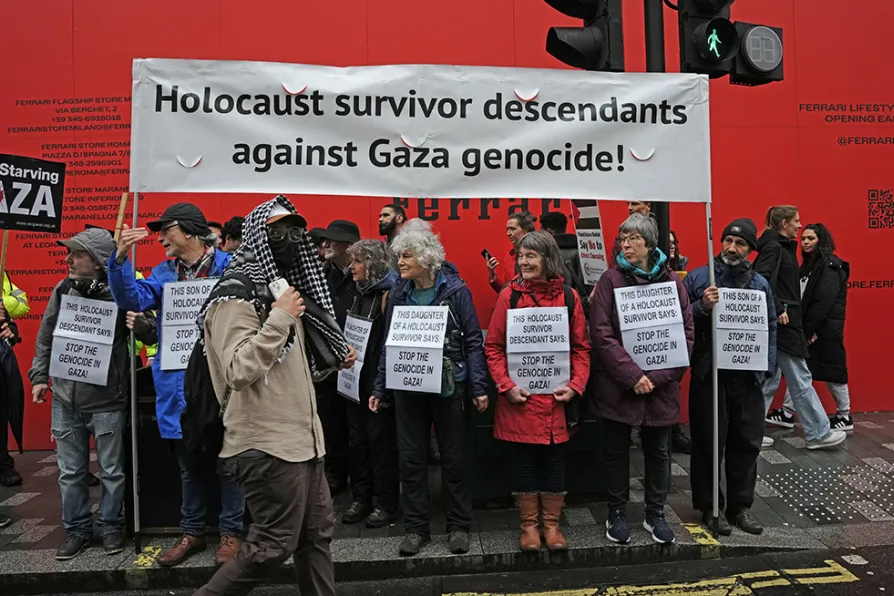
 Holocaust survivor descendants on a demonstration in solidarity with Palestine last month

US financial instability is exposing the limits of a dollar-dominated global economy — and giving the Global South a historic chance to build an alternative, says MURAD QURESHI
DOUG NICHOLLS says the parasitic finance markets must be challenged or another British government could be toppled
The late country singer’s Imagination Library has put hundreds of millions of books into children’s hands. We should build on that legacy by defending the libraries at the heart of our communities, says BRENDA AITCHISON
Deprivation is a fundamental factor in criminal behaviour that must be addressed but, KENNY MacASKILL argues, there needs to a major rethink in sentencing to tackle overcrowding
MML director MEIRIAN JUMP outlines the recently refreshed library’s busy autumn schedule that ranges from book sales, archival exploration, community work with online education and the ever popular site tours
TONY BURKE surveys the shifting political landscape and the challenges Labour needs to address if it is to prevail in the 2028 federal elections





Put your phones away. The quiz is about to start. Round one: I will give you seven quotes and you need to decide whether they come from the left or the right.
1. “It’s not a belief … that organised Jewry has a massively disproportionate hold on the mass media; it’s a fact.”
2. “This is Britain. We are occupied.”
3. “My father told me the Jewish lobby is the most influential lobby.”
4. “Free Britain from Jewish supremacy.”
5. “They are calling us inferior goys but if we say that word, they attack us. This is Jewish supremacy.”
6. “Pax Judaica, the new Jewish supremacist empire succeeding and usurping US hegemony.”
7. “In order to give the goyim no time to think and take note, their minds must be diverted towards industry and trade. Thus, all the nations will be swallowed up in the pursuit of gain and in the race for it will not take note of their common foe.”
Traditionally, the far right has been the main repository of anti-semitic ideas (conspiracy theories, Holocaust denial, racial stereotypes) and practice (discrimination, abuse, physical attacks), and the challenge to those ideas has come primarily from the left.
Over the last 10 years, though, the political establishment has used anti-semitism to try to discredit the left and supporters of the Palestinians by aggressively imposing as orthodoxy the concept of “new antisemitism.” This claims that the chief threat to Jews comes from the left, usually dressed up as opposition to zionism.
The main mechanism for reconfiguring our understanding of anti-Jewish racism was a determined campaign to establish the flawed, bitterly contested IHRA Working Definition of Anti-semitism as a single acceptable interpretation and give it quasi-legal weight.
The battle to prevent it being forced on institutions generated millions of words, tweets, reels, memes and recriminations among socialists about how to understand and respond to what quickly came to be called the weaponisation of anti-semitism.
Some of the debate was erudite, but much of it was shallow and defensive, drifting into oversimplification and conspiracy theories. In the resulting cacophony, David Feldman, director of the Birkbeck Institute for the Study of Anti-semitism, said: “When it comes to anti-semitism many of us literally don’t know what we’re talking about and are happy to admit it. And as for the rest of us who think we do know what anti-semitism is, we are congenitally unable to agree among ourselves.”
The one thing we thought we could depend on was the far right’s consistent hatred of Jews. But some of them are — or appear to be — making an exception for particular Jews.
There are still the old-time fascists who attribute all the problems of the world to the murky machinations of all Jews everywhere. But others, both in Europe and the United States, are so drawn to the ultra-nationalism and anti-Muslim racism of Netanyahu, the violence of the settlers, the living example of an apartheid state in Israel, that they are prepared to make an exception for far-right zionists.
More than an exception: they are keen to join them in their murderous Islamophobia.
Tommy Robinson is one of these. He has recently done the rounds of Poland, where he was welcomed by his far-right anti-semitic friends, and from which he returned to launch his campaign to rescue Christianity from the Muslims.
He also received an invitation to Israel the day after the attack on Yom Kippur on Heaton Park Synagogue in Manchester, to be embraced by far-right Jews as a courageous fighter against Islam.
This isn’t unprecedented. There are historical — and more respectable — examples of people who supported nationalist Jews while expressing hatred and mistrust of internationalist Jews.
Lord Balfour was not only the author of the “declaration of sympathy with Jewish zionist aspirations” promising to facilitate the establishment “in Palestine a national home for the Jewish people,” he was also a white supremacist and an anti-semite who, in 1905, as prime minister, brought in the Aliens Act.
This was the first peacetime legislation restricting immigration into Great Britain, the foundation of all subsequent anti-immigration law, and it was aimed at preventing the entry into Britain of Jews escaping discrimination and persecution in the tsarist Russian empire.
Even the International Churchill Society, whose mission is “honouring the memory, preserving the legacy of Winston Churchill,” acknowledges that he believed the Bolsheviks were an illegitimate minority consisting mostly of Jews ruling over the “real” Russian majority, referring to them as “the tyrannic Government of these Jew Commissars” and “adherents of this sinister confederacy.” But that didn’t inhibit him from enthusiastically supporting the creation of a Jewish home in the Holy Land which, fortuitously, aligned with British imperial interests in the Middle East.
Every form of racism has its own features, and what characterises anti-semitism is the belief that Jews have a sinister influence over other people: that they are underhand; not what they appear to be; convincing fakes, conspiring to achieve power, especially through control of the media. Blaming a single, shadowy culprit for inequality, poverty, conflict and powerlessness has a magnetic pull.
An overarching conspiracy theory, shared across the far right, is the Great Replacement Theory. This fantasy of white supremacists bundles all their racism into a hierarchical system, with Jews at the top, encouraging migration to replace white people with non-Europeans, especially Muslims, and bring down European civilisation.
The Great Replacement Theory is a feature of Donald Trump’s National Security Strategy, which claims that “it is more than plausible that within a few decades at the latest, certain Nato members will become majority non-European.”
Trump also backed the violent, far-right demonstration in Charlottesville in 2017, which left many people injured and a civil rights campaigner dead, and where white supremacists carrying placards with the words “The Goyim Know” and “the Jewish media is going down” chanted: “You will not replace us!”, “Jews will not replace us!” Trump defended the white nationalists, saying they included “some very fine people,” just as he eulogised Charlie Kirk, who, amongst a deluge of fascist rhetoric said: “Jewish donors have been the Number 1 funding mechanism of radical, open border, neoliberal, quasi-Marxist policies … This is a beast created by secular Jews, and now it’s coming for Jews.”
Neither has Nigel Farage been coy about his hostility to Jews, referring to the Jewish “lobby” and “globalists” — code for the “international Jewish conspiracy.” He has called George Soros “the biggest danger to the entire Western world,” who “wants to break down the fundamental values of our society.” The Guardian has reported that earlier in his career, “Farage discussed supposed plots by bankers to create a global government, citing Goldman Sachs, the Bilderberg group and the financier George Soros as threats to democracy.”
In the current political turmoil, some of the right’s conspiracy theories are seeping into the left, especially on social media. When people don’t have to look into the faces of actual Jews, they seem quite comfortable making unverifiable claims of fakery, secret scheming, behind-the-scenes lobbying, corrupting political processes and buying loyalty.
The names Goldman Sachs and Rothschild crop up in socialist discussions about wealth, power and influence much more often than the Duke of Westminster, James Dyson or Richard Branson. But these deep-seated stereotypes of Jews are not confined to the rich; they are also being used within the left.
There are some extreme examples of Palestine supporters and socialists swallowing whole the claim by Israel and the zionist establishment that “Jew” is synonymous with “zionist” and therefore “the Jews” are a valid target.
At least one prominent campaigner for the Palestinians quotes hard-line fascists like former British National Party leader, Nick Griffin, and Holocaust denier, Nick Fuentes, and, like others, is more comfortable challenging “Jews” than “zionists.”
Zack Polanski has been targeted by Reform UK, who, not entirely unexpectedly, published an anti-semitic AI image of him that would have fitted nicely into Der Sturmer. Some of the language used about him is reminiscent of the attacks on Michael Howard, who, according to Ann Widdecombe (now Christian Reform UK campaigner), had “something of the night about him.”
Unfortunately, though, this is not confined to the far right. Facebook is full of socialists who, rather than addressing his politics, think they’ve nailed him by saying he’s a zionist stooge, a fake, is suspiciously popular with the media and, to top it all, was a hypnotist! Didn’t he change his name? That just proves what a shape-shifter he is. (I’d better not mention my cousin, my uncle, and most married women and pop stars!)
Conspiracy theories are not new on the left, and as well as coming from an increasingly right-wing mainstream ideology, they have often come from a more apparently progressive direction such as elements of the yoga/wellness/New Age movements that have their roots in fascist ideology. That’s a topic for another article but indicates how critical we need to be of the ideas themselves, and not assume we can trust their source.
The frustration of all this is that the misuse of anti-semitism as a weapon against the left and as a means to corral Jews into a zionist fold is becoming less effective.
A recent Jewish Policy Research report shows a sharp polarisation in the Jewish community, with falling support for mainstream political parties and growing support for both the Greens and (less so) for Reform. The leftward shift is striking among younger people, nearly half of whom now define themselves as non- or anti-zionist. It is now highly contentious to claim that support for Israel is fundamental to Jewish identity.
This should leave us with a clear political direction: to challenge the increasingly explicit anti-semitism from the right; to intercept the slide into conspiracy theories on the left; to give people within and beyond the Jewish community confidence to challenge both Israel’s genocidal actions and ideology and anti-semitism; to recognise the common interests of all minorities; and to act together to challenge all racism, including Islamophobia.
Here are the answers to the quiz.
1. Far right. 2. Left. 3. Far right 4. Left. 5. Left 6. Left 7. Far right.
