

 Latest editorial

Corbyn tables Commons Bill requiring Parliament's approval before allowing foreign militaries to use British bases
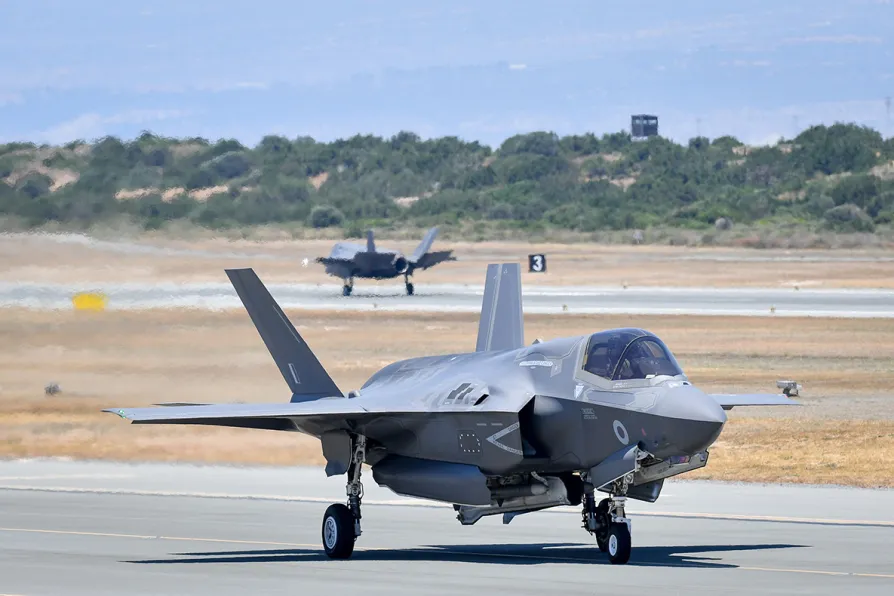 An F-35 arriving back at RAF Akrotiri in Cyprus, June 2019






LEFT MPs moved today to block Britain from being dragged deeper into the escalating attack against Iran.
Former Labour leader Jeremy Corbyn tabled a Commons Bill to require MPs’ approval before allowing foreign militaries to use British military bases.
The move comes as not only are US forces using the bases to pursue their illegal aggression, but British military forces are increasingly becoming directly involved in the conflict.
Mr Corbyn’s Military Action (Parliamentary Approval) Bill is co-sponsored by Labour, Green and Independent Alliance MPs and a response to PM Sir Keir Starmer’s agreement to allow US use of the bases.
While it has scant chance of becoming law, it signals growing disquiet in Labour’s ranks and beyond about Britain getting bogged down in supporting US President Donald Trump’s attack.
It would “require parliamentary approval for the deployment of UK armed forces and military equipment for armed conflict” and “require parliamentary approval for the granting of permission by ministers for use of UK military bases and equipment by other nations for armed conflict.”
Its co-sponsors are new Green MP Hannah Spencer and her colleague Ellie Chowns, Adnan Hussein and Ayoub Khan from the Independent Alliance and Labour’s Bell Ribeiro-Addy, Brian Leishman, John McDonnell, Richard Burgon, Apsana Begum, Kim Johnson, as well as suspended Labour MP Diane Abbott.
Sir Keir is under growing pressure from Mr Trump to fall in line as British governments usually do, forcing the premier to assert in the Commons that the “special relationship” did not “depend on hanging on to President Trump’s latest word.”
He has come under daily attack from the volatile US president, who is smarting from the government’s reluctance to be more enthusiastic and co-operative with the Iran war. He most recently jibed that the Prime Minister was “no Winston Churchill.”
Sir Keir reiterated to MPs that “what I was not prepared to do on Saturday was for the UK to join a war unless I was satisfied there was a lawful basis and a viable, thought through plan,” he says. “That remains my position.”
However, he was also keen to list the numerous military actions Britain is now taking in the region in support of the war, suggesting the US president may be getting his way in any case.
“British jets are shooting down drones and missiles to protect American lives in the Middle East on our joint bases. That is the special relationship in action,” he said.
“Sharing intelligence every day to keep our people safe. That is the special relationship in action. Hanging on to President Trump’s latest words is not the special relationship in action,” the Prime Minister added.
He also treated MPs to a lengthy recitation of radar systems, ground-based air defence, counter-drone systems and F35 jets which have been deployed to the Middle East.
In addition, anti-drone helicopters are on their way to Cyprus, while HMS Dragon will shortly embark from Portsmouth to add to the British firepower already engaged.
Government policy came under attack from multiple directions today. Liberal Democrat leader Sir Ed Davey warned that Trump’s “illegal war” on Iran could cost each British household £500 a year.
He said the war has “brought more chaos” across the Middle East and “increased the threat to national security” in Britain.
Your Party MP Zarah Sultana urged the creation of “a 2003-scale anti-war mobilisation demanding an end to the UK’s involvement in this illegal war, an end to punitive sanctions, and the removal of US troops from UK bases. Wages, not weapons. Welfare, not warfare,” she wrote on X.
Tory leader Kemi Badenoch, on the other hand, demanded fuller British engagement in the war, a position supported by very few of the public, and slammed Sir Keir for purportedly prioritising welfare over the military.
She also denounced Labour MPs as a “sea of orcs and goons,” suggesting that she has been turning to Tolkien and his Lord of the Rings for guidance during the crisis.
The premier retorted that he was spending more and faster on arms than the Tories ever did in office.
The government is also facing mounting economic pressure arising from the war, which threatens to blow apart Chancellor Rachel Reeves boastful claims that all was now well in this week’s Spring Statement.
There are fears the rift with the mercurial Trump could upend the much-trumpeted trade deals which were signed by Sir Keir but have yet to implemented by Washington.
A Downing Street spokesman blandly assured journalists that “we already have an agreement with the US and discussions, as you’d expect, continue on multiple levels between the two countries.”
And the Resolution Foundation think tank warned that disruption to energy supplies as a result of the conflict could wipe out any projected rise in living standards.
According to its calculations following Ms Reeves’s statement this week, living standards for average working-age households are projected to grow by £300 over the next year, a rise of 0.9 per cent.
But this increase in could be reversed by rising oil and gas prices as the war in the Gulf threatens supplies.
Britain’s reliance on gas from the Middle East makes it exceptionally vulnerable to any disruption in the Straits of Hormuz, which Iran has declared blockaded as a result of the US -Israeli action.
The foundation’s research director James Smith said the government should consider developing a social tariff to protect low-income households from the looming energy shock rather than a universal protection package.
Ms Reeves held crisis talks with giant energy monopolies to find ways to minimise the disruption and impact on household bills today.
