TUC president and POA leader STEVE GILLAN speaks to Ben Chacko on the eve of Congress 2026


 Latest editorial
Iran – reform becoming radicalised
As discussions continue between the US and Iran over the Islamic Republic’s nuclear enrichment programme, the suppression of internal dissent by the theocratic dictatorship grows. STEVE BISHOP reports.
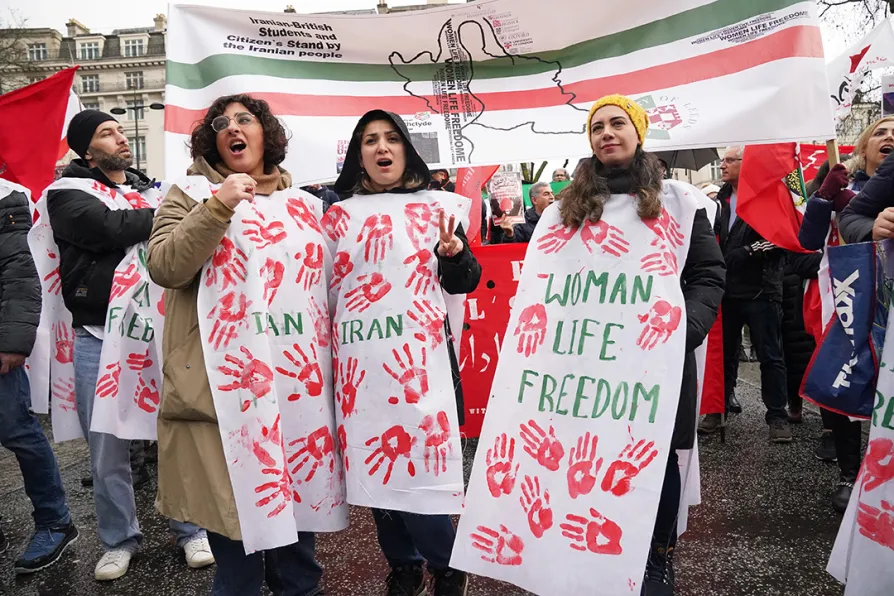 Protesters gather at Marble Arch in London before they march to Trafalgar Square to protest against the Islamic Republic in Iran following the death of Mahsa Amini, 2023

DOUG NICHOLLS welcomes a turning point at this year’s Congress, where many motions call for a co-ordinated plan to revive British industry, a perspective outlined in his new book
HOPE VIRGO of campaign Dump the Scales warns MPs voting today they should be alert to the threat legalised assisted death poses to people with eating disorders
The Together Alliance is hosting two summits, North and South, to build power and plan action against the scourge of racism peddled by the right. DANIEL KEBEDE urges mass participation
The drift toward militarisation in Europe is not inevitable, left-wing and peace movements can preserve sovereignty and prevent war, says DÁIRE HUGHES MP
Whatever differences exist among international sympathisers of the Bolivarian revolution about its current trajectory, they should unite against the imperialist power that is the source of an enforced retreat, argues ROGER D HARRIS
Trade unions need to step up and force a turn in the policies of the labour movement to effectively confront the far-right threat, argues NICK WRIGHT





IT IS hard to believe that the leadership of the Islamic Republic of Iran do not take the threats issued by US President Donald Trump seriously.
After the unprovoked attack on Iran by Israel in June 2025, followed by the US bombing of Iran’s nuclear facilities, it should be clear that the actions of the US are a real danger to the Iranian people.
However, it is not the Iranian people which are the primary concern of the theocratic leadership, or the military circle of the Islamic Revolutionary Guards Corps (IRGC) which protects them.
Both the theocracy and the military in Iran are mired in corruption, presiding over a failing state, which they sustain in order to protect their own interests rather than those of the people of Iran.
The moribund theocracy refuses to shoulder any blame for the state of the Iranian economy or the increasing poverty of the population.
International sanctions, outside forces, Mossad agents are, in their view, all to blame for the fomenting of unrest and its causes, which have led to mass protests and outbreaks of anti-regime slogans over recent months.
If the Iranian leadership is to be believed they do not bear any responsibility for the current crisis, hoping to hide behind a fig leaf of anti-imperialist rhetoric by placing the blame for all things on the US and Israel.
That there is truth in the belligerence of the US and Israel towards Iran gives the pleas of the Iranian leaders a veneer of plausibility but it is no more than a surface sheen.
The religious zealotry which drives the fundamentalists in the current Israeli government is simply the other side of the coin from the religious zealotry which has been characteristic of the Iranian regime for the past 47 years.
Israel’s desire for dominance in the Middle East is backed by the might of the US. Iran’s attempts to dominate the region have been through the creation of the so called Axis of Resistance, a series of funded proxies in Hamas in Gaza, Hezbollah in Lebanon and the Houthis in Yemen, sustained in order to spread the Iranian regime’s particular brand of political Islam.
That the objectives of these groups include the establishment of a Palestinian state is more an indication of their political opportunism than any deeply felt anti-imperialism, based on an antipathy towards Israel and its fundamentalist tendencies towards greater territorial expansion in the region.
On the international front, discussions continue between the US and Iran regarding its nuclear enrichment and ballistic missile programmes. In recent days however, the Islamic Republic has launched a new wave of arrests targeting prominent figures of the Reform Front and domestic critics, charging them with “establishing subversive mechanisms.”
Arrests include those of Javad Imam, the spokesperson for the Reform Front, and Hossein Karroubi, the son of Mehdi Karroubi, a dissident cleric and leader of the Green Movement.
This is a pattern of behaviour which goes back over 40 years as the Islamic Republic has resorted to the arrest, imprisonment, torture and execution of political opponents, trade union activists, women’s rights campaigners and academics who have voiced opposition to the regime and its policies.
With reference to the recent protests against the regime, in January of this year, the judiciary in Iran justified recent arrests on the basis that members of a “circle” consisting of “extremist elements” took action to “incite the country’s domestic atmosphere” and were “acting to destroy national cohesion by levelling accusations and publishing false positions against the country.”
The arrests come at a time when the Reform Front, which previously viewed the existing regime as one which could be reformed, has moved to a more radical position, recognising that the regime as it stands is beyond reform.
Ardeshir Amir-Arjomand, a legal expert and adviser to Mir-Hossein Mousavi, one of the leaders of the Green Movement, views the arrests as a result of the existing regime’s fear that an internal opposition in Iran could grow and demonstrate popular support which would undermine the Islamic Republic, stating: “Khamenei has a clear red line: a prominent, independent national opposition must not be allowed to form within the country. An independent opposition that simultaneously opposes foreign military strikes, recommends non-violent solutions, and maintains a clear stance against authoritarianism is completely unacceptable to Khamenei.”
The fear of a growing opposition to the sectarianism of the Islamic Republic was the driving force behind the mass imprisonment, torture, execution and exile of opposition activists in the 1980s, including Iran’s communists and other left-wing opponents of the regime.
While the Reform Front does not by any means represent a revolutionary alternative to the existing regime, its growing radicalism is seen as a threat by the ruling theocracy.
Amir-Arjomand, in a recent interview with Euronews summarises the position as he sees it: “I believe the regime fears domestic movements more than anything else and has exerted every effort in recent years to discredit them and alienate them from their popular base.
“While I do not wish to overlook their own shortcomings, the regime has certainly made a concerted effort to ensure they remain disconnected from the public and to silence their voices as quickly as possible.
“The regime can no longer trust this segment of Iran’s political society, believing they will no longer act in alignment with its interests.”
It is clear from the actions of the regime and the assessment of those close to the Iranian opposition that any limited tolerance of reform, which the Iranian regime may have had, is rapidly disappearing.
The lack of trust which the Iranian leadership has in its own people is evident in the number of deaths and arrests immediately following the protests in January. The recent arrests suggest that the regime is not letting up in its suppression of opposition.
The rhetoric of Donald Trump, in relation to coming to the rescue of protesters, is clearly regarded as hollow in this regard. Although further strikes on Iran’s nuclear capability have not been signalled by Washington in the short term, they cannot be ruled out depending upon the outcome of talks.
The Iranian people once again they find themselves between a rock and a hard place, hesitant to sustain protest on the streets, for fear of shooting and arrest, but with no desire to rely upon external intervention to bring about regime change.
It is a situation which cannot be sustained indefinitely and one which must be resolved by the Iranian people, in the interests of the Iranian people in their desire for peace, democracy and social justice.
Steve Bishop is on the executive of the Committee for the Defence of the Iranian People’s Rights.
