JAMES WALSH is moved by a provocative and original take on the relationship between ecology and architecture, and a plea to work with, not against, the materials and minerals of our world


 Latest editorial

A history of the slave rebellion
BRENT CUTLER welcomes a book stands as a testimony to those who fought against the evil institution of slavery
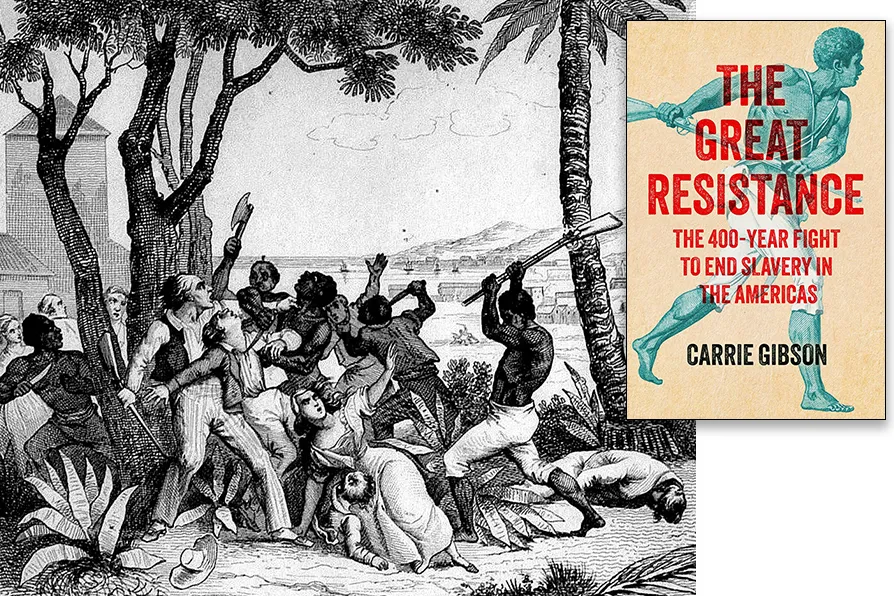 The 1791 slave rebellion in Saint-Domingue which sparked the Haitian Revolution: Burning of the Plaine du Cap, August 22 1791, [Pic: Martinet et Masson/CC]

An immersive, participatory display by a queer Australian Aboriginal performer, and a rebellious unravelling of traditional Scottish dance
EWAN CAMERON witnesses a political farce that lacks a clear message
EWAN CAMERON picks out two fascinating music shows, fusing the Korean, and the Celtic, with the modern
BENJAMIN POTHIER suggests that Palaeolithic cave paintings in Spain point to the ceremonial use of hallucinogenic flora
The bard confirms that the right has a humour bypass, and replays the English Revolution on period instruments





The Great Resistance – The 400-Year Fight to End Slavery in The Americas
Carrie Gibson, Basic Books, £9.99
THE 16th century saw the opening up of the Americas and the establishment of Transatlantic Trade Routes. The trade in sugar, cotton and tobacco was central to the development of capitalism and with it the industrial revolution; central to this process was the trade in human capital — the slave trade and the institution of slavery.
In her book The Great Resistance – The 400-Year Fight to end Slavery in The Americas, Carrie Gibson gives a detailed account of resistance to this evil institution. The author pieces together a myriad of small texts and in so doing constructs the 400-year history of slavery in the Americas. The book begins in the late 1400s and ends in 1888 with the abolition of slavery in Brazil.
The Transatlantic slave trade was initiated by Spain and Portugal and later involved Britain, France and to a lesser extent the Netherlands, Denmark and Sweden. Resistance to slavery took many forms; including suicide, where kidnapped Africans jumped overboard fearing they would be victims of cannibalism on arrival in the Americas. Rebellions took place almost as soon as the slave trade began; with accounts of rebellions as early as 1520. Successful revolts resulted in the establishment of communities outside the direct control of the colonial power.
Gibson also cities an example of a representative from the Kingdom of Kongo making a deputation to the Pope, requesting abolition. Meanwhile, there are also examples of resistance taking the form of guerilla warfare. Slave revolts took place wherever slavery existed and were more widespread than many of us may have previously been aware.
The book goes into considerable detail as to how the major events of late 18th century contributed to the ending of slavery. The America War of Independence saw both sides offering freedom to people of colour who fought on either side. Slavery was not abolished in the United States until 1865; however a number of northern states did abolish it soon after independence.
The French Revolution, with its emphasis of The Rights of Man, influenced the successful revolt in San Dominique (Haiti); it was the first state to abolish slavery in the Caribbean. This was not the result of actions of well-meaning white folk, but the result of the actions of slaves themselves that ended slavery, a theme that the author stresses throughout the book.
Gibson downplays the role of the Royal Navy’s African Squadron in ending the slave trade (abolished in 1807). Gibson points out that most of the captives liberated were not returned to Africa and mostly ended up in the Americas as indentured labourers. She also points out that the African Squadron was more the means of extending Britain’s imperial interests in Africa than actually helping Africans.
On a more surprising note, the author is highly critical of Simon Bolivar, a hero of the Latin American Left, whose attitude to People of Colour was at best ambiguous.
The 19th century saw the gradual abolition of slavery across the Americas. It did not result in prosperity for the formerly enslaved people; after all it was their former “owners” who received compensation. They still suffered from the ravages of colonialism, segregation and racism, problems that are for the most part went unresolved.
The book stands as a testimony to those who fought against the evil institution of slavery.
