
The UK Prime Minister may have the regal touch in northern England, but he’s been wrong-footed on the constitutional challenges posed by the Celtic Alliance of first ministers from Scotland, Wales and Northern Ireland, argues KENNY MacASKILL

A historic advance for workers – and the fight to make it count
The Employment Rights Act 2025 marks the biggest expansion of workplace protections in a generation. But with key reforms delayed and crucial details still to be decided, unions must remain vigilant to ensure this landmark law fulfils its transformative promise, says ANDY McDONALD MP
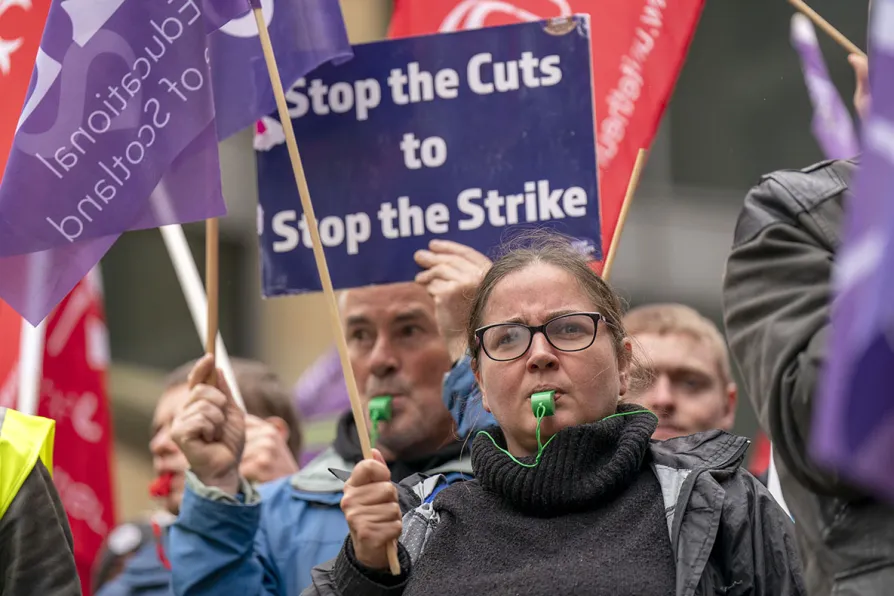
 Lecturers and other university staff take part in a rally on Buchanan Street, Glasgow, September 19, 2023
NEIRLAY ANDRADE, a member of the Communist Party of Venezuela’s political committee, outlines her party’s position on the crisis facing the country
A look at Taylor Wimpey’s accounts shows why Labour’s market-led housing strategy won’t deliver more, cheaper homes, as promised, says SOLOMON HUGHES
DAVID HORSLEY remembers the remarkable life and death of US black revolutionary George Jackson, whose politically passionate prison letters were published as Soledad Brother
Cuban trade union federation CTC leader OSNAY MIGUEL COLINA speaks to Ben Chacko about life and work under a crippling US siege
A part of the British empire’s network of slavery, today the Caribbean island of Nevis faces a new form of exploitation in the form of crypto-colonialism, CLAUDIA WEBBE writes
Challenges from the unscrupulous misuse of AI to steal actors’ voice and physical likenesses is being met with a firm union response, writes LYNDA ROOKE





THE Employment Rights Act 2025 has now passed into law, marking the most significant advance in workers’ rights in a generation. For decades, trade unions and campaigners have argued for reforms that protect workers from precarious conditions, arbitrary dismissal, and exploitative practices. This Act delivers on many of those promises and represents a historic step toward the vision set out in Labour’s 2021 New Deal for Working People.
Among its landmark measures, the Act guarantees protections around hours of work, creates powers to challenge unfair fire and rehire practices, and establishes day-one rights in several key areas.
It also strengthens trade union access to workplaces, initiates the possibility of e-balloting for industrial action, and lays the groundwork for collective bargaining in the social care sector. For the first time in decades, workers in some of the most vulnerable parts of the economy are being given tools to assert their rights and challenge exploitative practices.
However, the road to this moment has not been smooth.
Throughout the passage of the Bill, the employer lobby actively sought to water down the legislation. Whether through the Confederation of British Industry (CBI), the Federation of Small Businesses (FSB), or other employer bodies, many organisations pushed for carve-outs, longer qualifying periods, and narrower enforcement provisions. While ministers ultimately resisted wholesale dilution, the process demonstrated the ongoing tension between workers’ interests and entrenched business groups.
Another complication arose from the front-bench reorganisation during the Bill’s passage. Angela Rayner, who had been the responsible Secretary of State, and Justin Madders, the Minister of State overseeing the Bill, were both removed from their roles.
While Kate Dearden, who had been closely involved in establishing the New Deal for Working People, remains part of the team, the frequency of reshuffles caused by wider political pressures risks disrupting the continuity and relationships necessary to embed the best possible upgrade in employment rights.
Maintaining strong, consistent leadership within government is essential to ensure that the Act’s transformative potential is realised.
Critically, much of the detail of the Act will be determined through secondary legislation. That means the passage of the law is not the final step — trade unions and their parliamentary allies must remain vigilant to ensure these protections are implemented robustly.
Current consultations on trade union access to workplaces and on establishing social care collective bargaining institutions are pivotal moments where advocacy will shape how the Act operates in practice.
Even as we celebrate this historic achievement, it is important to acknowledge the measures still delayed or absent. Key proposals from Labour’s 2021 New Deal, such as moving toward a single worker status, extending blacklisting protections, broadening health and safety safeguards, reviewing Transfer of Undertakings (Protection of Employment) requirements, and ensuring public procurement actively raises employment standards, remain unfinished.
Additionally, there is no commitment to reform public-sector pay review processes to create a meaningful form of collective bargaining. These gaps leave substantial work for future campaigns.
A number of bold measures that remain unmet — full bans on “fire and rehire” with injunction powers for unions, the abolition of zero-hours contracts, single worker status with universal rights, the removal of restrictions on industrial action, and a proper minimum wage of £15 with uprating — have been advocated through the proposed Employment Rights Bill No 2 by Strike Map, the Campaign for Trade Union Freedom, the Institute of Employment Rights, the General Federation of Trade Unions, and other organisations. These proposals signal that the push for a truly transformative agenda is alive and growing.
The history of reform in Britain demonstrates the importance of sustained campaigning. Early compromises, such as the reduction of day-one unfair dismissal protections to six months’ qualifying service, illustrate the pressure unions face from both government negotiation and employer lobbying.
As a party and a movement, we had framed day-one rights as a moral imperative: no worker should live in fear of dismissal from the first day of employment. Yet, in practice, the government yielded under pressure from the House of Lords and business interests, leaving new employees vulnerable for nearly half a year before gaining full legal protection.
Critics may argue that these concessions were necessary to balance business concerns, but the reality is stark: under the current framework, workers who meet all expectations can still be dismissed arbitrarily, with minimal recourse. This is not an abstract scenario; it is the lived experience of countless workers today.
Moreover, employer groups continue to use consultations on secondary legislation as a platform to shape protections, highlighting the necessity of active engagement from unions and campaigners.
Despite these challenges, the passage of the Employment Rights Act 2025 is a moment to celebrate. It enshrines some of the most significant workers’ protections in decades and initiates reforms that could reshape employment practices across the country. Yet celebration must be paired with vigilance.
The union movement must ensure that secondary legislation strengthens, rather than undermines, the law’s intent. At the same time, support for a second, more ambitious Employment Rights Bill remains essential to complete the agenda begun in 2021.
The Act represents progress, but it is also a reminder that labour rights are not delivered once and for all — they are won, defended and expanded through persistent campaigning. This is a historic step, but it is not the final one. Working people, unions and advocates must continue to push for a world where decent work is not a privilege, but a guaranteed right.
Andy McDonald is Labour MP for Middlesbrough and Thornaby East.
