
The US administration is endangering lives by reversing environmental protection laws, CHAUNCEY K ROBINSON argues

Grit, greed and a government on thin ice
Behind the cute names of Scotland’s road gritters lies a workforce underpaid and overlooked – a fitting reflection of a Budget that protected profits, bungled its rollout and offered hardly a glimmer of hope, writes MATT KERR
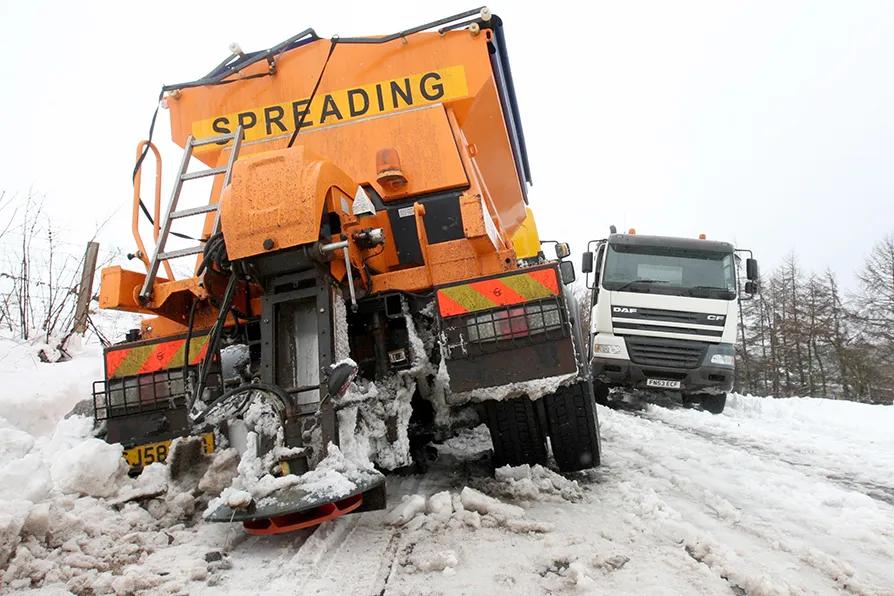
 THANKLESS JOB: A Stirling council gritting lorry gets stuck in the snow near Carronbridge, central Scotland
It’s time to stop retreating and go on the offensive to promote working-class interests, argues DOUG NICHOLLS
Marco Rubio wants to defeat socialism in Nicaragua, not restore ‘democracy,’ writes JOHN PERRY
Believe it or not, there was a time when the US government built beautiful homes for working‑class Americans to deal with a housing shortage, writes ERAN BEN-JOSEPH
DIANE ABBOTT provides an analysis of the reasons for EU and British voters’ dramatic swing to the right
Train drivers’ union Aslef general secretary DAVE CALFE speaks to Ben Chacko about his hopes that Burnham’s devolution agenda will include the importance of the railway





IT’S HARD to tell if it’s 5am or 5pm. The place may be hanging low with darkness, but sound travels crystal-clear in a frost.
There’s a distant rumble. I wonder if Dr Snow and Betty White-out are back out on the road, spreading their secret formula of grit and molasses up and down the M8?
If you are sad enough, you can pop on the web to watch they and dozens of their pun-tastic colleagues criss-cross the country to keep the trunk roads open. At some point this became a thing.
The act of giving something a name isn’t to be sneezed at, it matters. It demonstrates power and ownership, while the name itself projects who the owners want to be.
In this case, it speaks of private companies who have spent decades fleecing us all, craving to be clutched so tightly to the collective bosom that it becomes impossible to see their face.
Most of Scotland’s trunk roads are maintained by the rather cuddly-sounding operations Amey and BEAR. Amey managed to eke out a £127 million pre-tax profit in 2024, while BEAR Scotland had to content itself with just £3.7m.
BEAR’s managing director Iain Murray noted last year that “comical names” for the gritters “help to raise spirits and humanise the important work that our team delivers around the clock throughout the winter season.”
Humanising work is however a world away from humanising the workers who keep the lifeline routes of the Highlands open. When Murray made that statement, the highest grade worker performing that task was paid £13.25 an hour, and the lowest £12 an hour.
The idea of “raising the spirits” in the months that followed amounted to the offer of just 75p-an-hour more for the lowest paid, who had to threaten strike action to win recognition of their union, Unite, or something approaching a decent pay rise.
If wages are truly supposed to reflect things like skill, responsibility, and risk, we have it all very, very, wrong indeed. If the chief executive of one of these outfits stayed at home tomorrow, the roads would still be gritted by workers earning the kind of money they wouldn’t get out of bed for.
I would humanise the jobs of the senior management that infest these enterprises if only I actually could understand what value they add to anything, other than their own bank balances.
Contracting in function and size for years, governments have opted to become referee rather than player. Nobbled in the dressing-room before bounding onto the pitch, everyone wins but the people packed into the freezing terraces, who endure draw after draw and have to content themselves with the odd firework and a man in a chicken suit for entertainment at half-time.
There was no such reward in the Budget speech, but perhaps a medal should be struck for those of us who endured its entirety. It was only 10 days ago, but it feels like much more; events and all that.
The last couple of months have seen an unprecedented war on Budget precedent. Tragically, this was not to signal an irreversible redistribution of power and wealth to working people, but a remarkably inept effort to manage expectations already so low that a medical, rather than a management, intervention may have been more appropriate.
Emergency breakfast speeches and leaks warned of the dire state of the country’s finances leavened with the usual “broadest shoulders” guff.
I’ve always found that analogy hilarious. It hints at the wealthy carrying a heavy burden for the rest of us, conjuring up pictures of them with baskets full of coal on their backs so the rest of us may have a warm hearth and home.
If only.
Others carry that burden to their bank, not in baskets, but by the lorryload.
If the wealthy do have broad shoulders it must be through some sort of genetic mutation, because it certainly isn’t through hard work.
As if the leaks, speeches and briefings were not enough, the Office for Budget Responsibility (OBR) managed to publish its assessment of the Budget two hours early. A minor crisis ensued, and it cost the head his job.
Rachel Reeves has forgotten one of the golden rules of politics though: never let a good crisis go to waste. The Chancellor had the perfect excuse to abolish the OBR handed to her on a silver platter. This nonsense organisation was created by George Osborne to provide a fig leaf for his economic illiteracy, to bake in — as if such a thing were needed at this point — the market-slave consensus in the Treasury.
The orthodoxy it maintains has cost hundreds of thousands of lives, ruined countless more, decimated services underpinning a remotely civilised society and hobbled the economy. Still, Osborne got his little moment mimicking Gordon Brown’s decision to grant the Bank of England operational independence.
It’s a remarkable thing that both Osborne and Brown, so different in personality, both chose as their first acts in No 11 to hand yet more power to the bureaucracy; power that was not theirs to give away.
Chancellors now wait on the Bank of England to dictate to them how much money circulates in our economy, what rates businesses and householders will pay on the debt successive governments have encouraged them to run up, and live in fear of a slap on the wrists from the OBR for prioritising need over capital.
Nonetheless, the Budget wasn’t entirely a loss. The freeze on rail fares was the right thing to do and will have a material impact on thousands. At the same time the Chancellor announced the end of the green fuel levy, which, she claimed, will cut household bills by £150.
Two measures that should put money in people’s pockets, but the differing methodologies are worth considering. The (almost) state-owned railways’ running costs are not falling, but will carry the cost of a freeze in fares, while privately owned and highly profitable energy companies will bear none of the burden of cutting fuel bills.
Funny that.
Reeves proudly told us that such measures would help cut inflation, but in doing so let the cat out of the bag. Governments are not powerless in the face of inflation; to leave the population at the whims of the market and the profiters who rig it is a political choice.
It is obvious to the voting public that energy should be returned to public hands, but if the government won’t step in to take control, then at the very least it can regulate the prices downward; a move that would boost the economy, cut inflation and, more importantly, keep people alive this winter.
It has the power to do so, not in 10 years time as renewables expand, but here and now. If the energy giants don’t like it, let them form a line to hand back the keys.
Returning to convention, the Chancellor littered her speech with references to colleagues’ lobbying, giving them their moment in the sun, as she weaved on and on to the shuddering anti-climax of the plan to scrap the two child cap.
Like those people who cry at funerals when they realise one day they will be in the box, there were in those moments hints of real emotion as Reeves described her disgust at the cap and the attendant “rape clause” she propped up for the last year.
Hundreds of thousands of children will be saved from the humiliation of poverty by this act, and for all my grumpiness, I’ll take that.
We can hope that this taste of the power to act snowballs into something more transformative.
Let’s not leave it to hope though; but instead turn the voices heard now as a distant rumble on Downing Street into a crystal clear call for control.
The world is ours, don’t forget it.
Matt Kerr is Morning Star Scotland reporter.

Similar stories
TUC calls for tax increase on bank profits to pay for social tariff to cut household bills
Burnham urged to raise taxes on banks after Barclays reveals 30% rise in pre-tax profits
New PM slashes fuel bills and culls Starmer deadwood, but peace activists warn that placing John Healey as new Chancellor shows ‘beyond doubt that the military industrial complex is in charge of Burnham’s economic policy’