ROB WARZYNIAK wades knee deep through a pile of ‘dead canaries’ of Trumpist policies which exacerbated the horrors of US capitalism domestically


 Latest editorial

From Gaza to Lebanon: Israel’s new doctrine of total destruction
Behind the smoke clouds over Beirut lies a radical vision of a “Greater Israel.” The tactics from Gaza are now being deployed to depopulate south Lebanon, clearing the way for a permanent occupation and the reshaping of the Middle East, says MARC VANDEPITTE
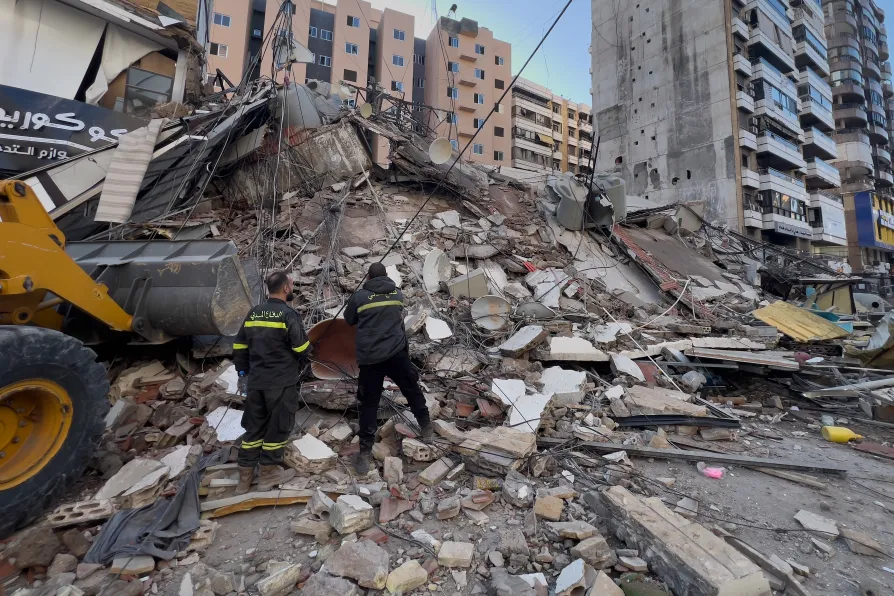 Civil defense workers check a destroyed building that was hit by an Israeli airstrike in Dahiyeh, Beirut's southern suburbs, Lebanon, March 24, 2026

Without evidence or Nato consultations Berlin’s answer to the Leipzig incident is a rupture of relations. SEVIM DAGDELEN examines why
FRANCISCO DOMINGUEZ introduces the background to a conference on defending Latin America’s sovereignty
The glacier collapse in Nepal is yet another warning that a warming planet is making Himalayan disasters more frequent and destructive – but the countries facing the greatest risks are often those least responsible, says LI YANG
Nick Blair is set to benefit from a hugely lucrative contract to ‘virtually’ train the British army for its next war. Like father, like son, writes SOLOMON HUGHES
Even when tragedy strikes, Western media cannot resist the opportunity to turn it into a sordid propaganda opportunity, as the Nepal-China border tragedy shows, writes CARLOS MARTINEZ
Trade unions should be at the heart of the anti-racist push for reparations for the historic legacy and continuing impact of slavery, writes ROGER McKENZIE





SINCE the beginning of March 2026, Israel has been conducting a large-scale military campaign in Lebanon under the name Operation Roaring Lion, which began as a response to rocket fire by Hezbollah. The operation includes intensive aerial bombardments of Beirut and south Lebanon, supplemented by a ground offensive that, since March 16, has escalated into a broader invasion in the border region.
The far-right Israeli minister Bezalel Smotrich recently made no bones about it: the southern suburbs of Beirut will soon resemble the devastated Khan Younis in Gaza. This statement marks a shift from the old “Dahiya doctrine” to a new, even more destructive “Gaza doctrine.”
Gazification
Whereas under the Dahiya doctrine disproportionate force was used to deter opponents, the current objective in Lebanon appears to be the complete destruction of social infrastructure, as was applied in Gaza.
The so-called “Gazification” of Lebanon is based on the idea that an entire nation is responsible for the actions of its resistance groups. “It’s an entire nation out there that is responsible,” said Israeli President Isaac Herzog on October 12 2023, regarding the Hamas attack a few days earlier.
This did not only apply to Gaza, but also to Lebanon. “What we are doing in Gaza we know how to do in Beirut,” said then-minister of defence Yoav Gallant a month later. “The ones who will pay the price are first of all the citizens of Lebanon.”
And today they are paying that price. For the entire population south of the Litani River, Israel has issued mass evacuation orders, later extending them to villages north of the river and neighbourhoods in south Beirut. Millions of people are thus being forced to relocate.
Analysts and human rights organisations describe this as the application of the Gaza doctrine to Lebanon: mass forced evacuations, heavy bombardments, the use of controversial weapons such as white phosphorus, and the preparation of an “ethnically cleansed” border zone.
By targeting critical infrastructure such as power plants and water systems, Israel is making entire areas de facto uninhabitable. In south Lebanon, even cement factories and brick workshops are being targeted. For the fleeing inhabitants, there is then no way back to their villages and homes.
Israeli media and political statements indicate that the aim is to create a buffer zone in south Lebanon, whereby an area along the border is structurally depopulated and brought under the control of the Israeli army. This strongly resembles what has happened in the Gaza Strip.
Opposition leader Yair Lapid stated that Israel should create a completely depopulated and flattened zone in southern Lebanon, explicitly compared to the yellow line in Gaza, where Israel “cut the enclave in two” — on the one hand, a coastal strip to which Palestinians have been driven; on the other, an occupied zone where systematic demolition takes place and anyone who crosses is shot at.
Aid workers in the line of fire
The human toll of this doctrine is very high and is characterised by a shocking impunity for attacks on medical personnel. In just two weeks, 32 aid workers in Lebanon have been killed by Israeli bombardments.
Hospitals are heavily shelled under the pretext that militants are present, but this is a gross violation of international humanitarian law that protects medical care.
Meinie Nicolai, former director of Doctors Without Borders Belgium, says that targeting medical personnel by the Israeli army is nothing new. This was already clearly visible in Gaza, where more than 1,700 healthcare workers were killed. This is now repeating itself on Lebanese soil.
According to her, it is very painful that despite UN resolutions, which oblige the protection of medical care in wartime, the international response is lacking.
“The impunity of these kinds of attacks is alarming and should be high on the agenda. Unfortunately, that is not the case.”
Zionist dream of ‘Greater Israel’
Behind the military operations lies an ideology that explicitly focuses on territorial expansion beyond the current borders of the state of Israel. Within the Israeli government and right-wing nationalist circles, the ambition of “Greater Israel” is reviving.
The ideology of “Greater Israel” (Eretz Yisrael Hashlemah) strives for the expansion of Israeli sovereignty over the entire territory between the Jordan River and the Mediterranean Sea (“from the river to the sea”), based on religious and historical claims from the Bible.
In more extreme forms, this concept also includes parts of surrounding countries, such as Lebanon, Syria and Jordan, whereby the establishment of Jewish settlements in these areas is considered a moral and national duty.
Around the same time as the fall of the Syrian government in December 2024, Israel invaded Syria and is holding a zone of that country under occupation. Today, Tel Aviv is using the current conflict to do the same in Lebanon.
During recent pauses in fighting, reports have already surfaced of Israeli settlers entering southern Lebanon and calling for the construction of new colonies. This territorial hunger explains why Israel does not stop at eliminating military targets but opts for total depopulation. The zionist doctrine, after all, requires land without the original population.
This expansion drive is rooted in a belief in military dominance as the only way forward. For the ideologues of “Greater Israel,” the current war in Lebanon is a golden opportunity to definitively reshape the map of the Middle East in order to realise the old colonial dream.
Divided society under fire
Meanwhile, Lebanese society is deeply divided on how to respond to this invasion. For the pro-resistance camp, consisting of Hezbollah and the Shi’ite movement Amal, this is a defensive war against an aggressor that would attack Lebanon regardless. This camp sees Hezbollah as the only force that can still protect sovereignty against zionist expansionism in the region.
Opposing this is a camp that places the blame for the current misery specifically on Hezbollah. These groups, including the government and Christian parties such as the Phalange, advocate for diplomacy and the disarmament of Hezbollah. They hope that an Israeli victory will break Hezbollah’s hegemony. Some even go so far as to openly debate peace with the occupier.
By primarily targeting Hezbollah and causing widespread destruction, Israel is increasing the polarisation between both camps. This division paralyses the state at a moment when unity is most crucial to effectively counter the planned ground invasion.
Colonial agenda
Many Lebanese fear that Israel’s ultimate goal is not the elimination of Hezbollah, but a permanent occupation. Israeli President Isaac Herzog has described the current war (against Lebanon and Iran) as part of a broader attempt to redefine the political order in the region.
At the beginning of the genocidal attack against Gaza, Prime Minister Benjamin Netanyahu said that it will “change the Middle East.” The destruction in Gaza can be seen as a dress rehearsal for what is now happening in Lebanon: the complete elimination of any form of organised local resistance.
In this operation, Tel Aviv once again receives backing from Washington. The special US envoy Thomas Barrack, who officially mediates between Washington, Beirut, and Israel, places the pressure entirely on the Lebanese government to disarm Hezbollah, without criticising Israeli aggression. This gives Israel a free hand.
In this scenario, Lebanon is heading toward a situation that strongly resembles the West Bank or Gaza: a fragmented territory under external tutelage. The destruction of social cohesion and physical infrastructure is the main weapon for this.
While the world looks on, the future of a sovereign Lebanon is being systematically shot away by an army that no longer recognises any red lines. Just as during the genocide in Gaza, a strong international response fails to materialise and Western governments once again choose to passively look on.
