Growing instability in the US economy and financial markets could have serious consequences worldwide because of the central role of the US dollar and financial system, argues MICHAEL BURKE


 Latest editorial

The forgotten force behind Britain’s Marxist historians
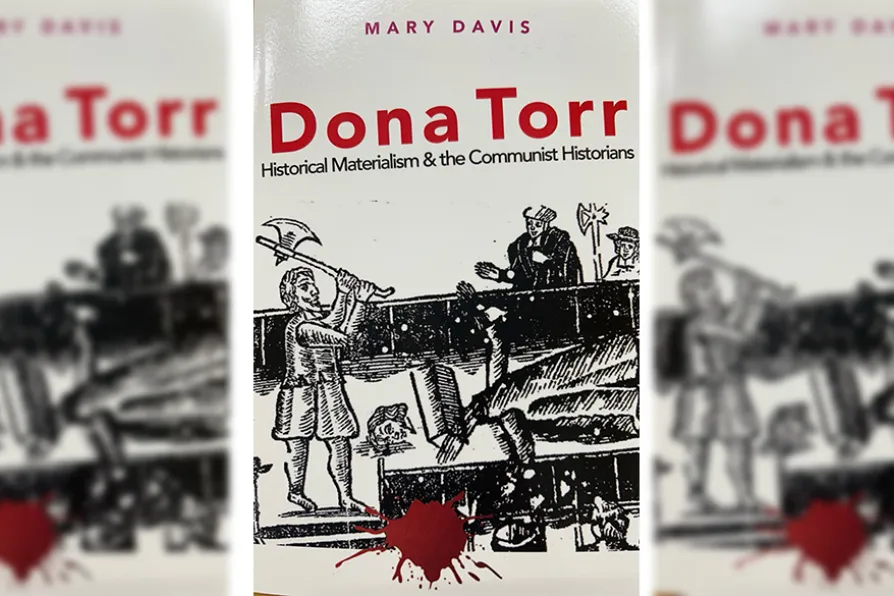
JAMES CROSSLEY enjoys a new book uncovering the life and legacy of Dona Torr, whose intellectual leadership shaped a generation of Communist historians

Despite Andy Burnham’s declaration defending the continued partition of the island, all major international and internal trends are converging to make Irish reunification inevitable
The left needs a bold energy vision – because if it fails to provide one, others will shape the future in their own interests, argues ALAN SIMPSON
From Margate to Deal, mining memories are being kept alive. National co-ordinator for General Strike 100, HENRY FOWLER continued his nationwide tour of partner organisations in the Garden of England
Humans are part of the ‘animal kingdom’ – and of nature in general – but also distinct from it and labour (work) is part of what makes us unique, declared Engels. His insights 150 years ago into how our species came to be and how we differ from the rest of nature, are as important today as they were then, says the MARX MEMORIAL LIBRARY
Boxes of books, family photos and heirlooms, labour movement anniversaries, along with nostalgic memories of glorious childhood days on the Ayrshire coast still leave room for a wistful MATT KERR to hope for a better future





Dona Torr: Historical Materialism and the Communist Historians
by Mary Davis
Glasgow: Praxis Press, 2026
SOME of the greatest historians of the 20th century belonged to the Communist Party Historians’ Group in the years 1946-56.
Founded to develop the work of AL Morton and Maurice Dobb, the group boasted luminaries such as Eric Hobsbawm, EP Thompson, Christopher Hill, John Saville and Rodney Hilton.
Few today have heard of the name Dona Torr. Yet, despite her lack of fame, Torr was among the most important and influential figures in the Historians’ Group.
A foundation member of the Communist Party of Great Britain (CPGB), Torr was a translator and editor of major Marxist writers, including Marx and Engels themselves. She was also a translator at the Fifth Congress of the Communist International in Moscow, 1924.
Torr was an active historian, dedicated to understanding the transformation from feudalism to capitalism. Towards the end of her life, she published the first volume of a detailed but accessible biography of the trade unionist Tom Mann.
Torr commanded great respect as a historian, mentor and organiser, both within the Historians’ Group and across the wider CPGB. Such was her reputation that, on her 70th birthday, she received essays in her honour, featuring contributions from Hill, Hobsbawm, Saville, SF Mason, Ronald Meek, Henry Collins, Daphne Simon and Victor Kiernan.
What AL Morton wrote of Torr in 1954 represented a widely held view among her peers: “There is no-one living in England to whom Marxist historical studies owe more, not only for her own admirable writings, but even more, perhaps, because of the never-stinted help and encouragement she has lavished on others. There is scarcely one of us working in this field who is not greatly in her debt.”
Yet, since her death in 1957, the memory of Torr soon faded while several of her younger contemporaries went on to greater acclaim.
Mary Davis is the first person (as far as I am aware) to study the Torr archive since it was recently uncovered in the Marx Memorial Library.
In Dona Torr: Historical Materialism and the Communist Historians, Davis not only reestablishes Torr’s rightful place as a leading Marxist historian but convincingly shows that she was even more influential than some of us once thought.
From Davis’s work, we can now see the extent to which Torr was a driving force behind the argument that the English Revolution was a bourgeois revolution, comparable to the French Revolution. By 1940, this was a heated debate in Communist circles.
Torr, along with Hill, was able to defeat Jurgen Kuczynski’s claim that England was already a capitalist society by the 17th century and the civil war was a bourgeois war against resurgent counter-revolutionary tendencies.
Torr’s area of specialism was the 19th century. Davis offers a behind-the-scenes look at Torr’s interest in Marx’s writings on China and developments in British industry. She shows Torr grappling with the issue of how revolutionary Chartism was undermined by the Labour aristocracy. Yet there is surprisingly little on the 19th century in the Torr archive. However, as Davis points out, we get detailed treatment in Torr’s biography of Mann. For Torr, Mann inherited a developing radical tradition moving towards socialism, and his new unionism represented a reawakening of revolutionary class consciousness.
Torr’s role in the debates over the English Revolution and the development of the British labour movement was essential in laying the foundations for the work of the Communist Party Historians’ Group. We learn from Davis just how much Torr’s fellow historians turned to her and were inspired by her, perhaps none more so than EP Thompson, with whom she corresponded regularly.
Thompson later published the acclaimed The Making of the English Working Class (1963), and thanks to Davis’s efforts, we see how the aspiring historian was remarkably indebted to Torr.
We also learn how Torr debated with leading CPGB intellectuals such as Rajani Palme Dutt and was consulted by Dobb, Willie Gallagher, and Harry Pollitt, no less. We find out more about her 70th birthday celebrations and the reception organised for her by the executive committee of the CPGB.
In addition to the historians, attendees included Pollitt, Jack Cohen, Andrew Rothstein, and Robin Page Arnot, such was the respect for her in the CPGB.
Lately, there has been a renewed interest in individual historians of the Communist Party Historians’ Group. Torr is as deserving as any of her esteemed colleagues of such a high-quality biographical treatment. And they would have been the first to agree. But Dona Torr: Historical Materialism and the Communist Historians is not just a fine tribute to an unfairly forgotten pioneering historian and organiser; it is a significant contribution to research on the British Marxist historians.
Anyone interested in the Historians’ Group and anyone undertaking serious research on them will have to read and engage seriously with Davis’s book.
As Torr placed Mann in the context of the history of class struggle, Davis likewise places Torr in the context of the 20th century struggle for socialism. This means that Davis’s book is essential reading for anyone involved or interested in the labour movement and Marxist thinking.
This book is also clearly written and thankfully lacking in academic jargon. Complicated debates over the transition from feudalism to capitalism are presented in an accessible manner. And so, Davis’s book further functions as an ideal guide to historical materialism generally, a subject that can otherwise be daunting for the uninitiated. Torr would have approved.
James Crossley is a professor of religion and history and author of AL Morton and the Radical Tradition (2025).
Dona Torr, Historical Materialism & the Communist Historians, by Professor Mary Davis, is being launched at the Marx Memorial Library, Clerkenwell Green, London on Saturday April 25 at 3pm. For details and bookings go to www.marx-memorial-library.org.uk events. To buy a copy visit www.marx-memorial-library.org.uk/shop.
