


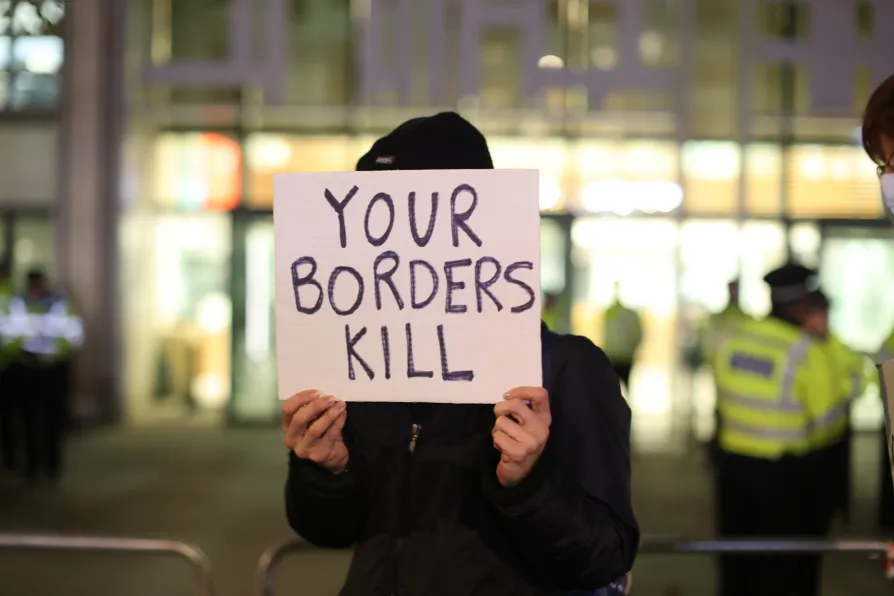
 People take part in a protest outside the Home Office in Westminster, London, demanding an end to deaths in the Channel, November 25, 2021

‘Ah the irony:’ Aamer Anwar says he doubts Reform has handed over the names of the far-right thugs who went on the rampage in Glasgow last weekend to the Police





AN INQUIRY’S damning findings over the deadliest Channel crossing on record must be a “watershed moment” to end the dehumanisation of refugees, charities warned today.
The Cranston inquiry, published today, concluded some of the 30 people who died when an overcrowded inflatable boat capsized overnight on November 23 and 24, 2021, could have been saved.
Just two survivors were eventually found in French waters almost 12 hours after the first distress calls.
The independent probe found “systemic failures, missed opportunities” and “chronic staff shortages” in Britain’s maritime response, which directly contributed to the failure to rescue those on board.
Led by Sir Ross Cranston, the inquiry identified 27 men, women and children among the dead, with four people still missing, and said “some of those deaths were avoidable.”
Sir Ross said small boat crossings “must end,” adding: “Apart from other reasons, it is imperative to prevent further loss of life.”
The report found the dinghy was “unsuitable” and overcrowded, that a nearby French Navy vessel failed to respond to a mayday call, and that the British coastguard made “a number of flawed decisions” which led to the search being ended early.
It also highlighted a “widely held belief” within the Coastguard that callers from small boats “exaggerated their level of distress.”
The inquiry concluded that if the search had continued some lives would have been saved, adding that staff were placed in an “intolerable position” by long-standing shortages, representing a “significant, systemic failure on the part of government.”
Refugee charity Care4Calais chief executive officer Steve Smith said: “For too long, consecutive governments have dehumanised refugees — and Cranston is confirmation that it has needlessly cost lives.
“This must be a watershed moment. If the government heeds the findings of Cranston, it will create safe routes for refugees to claim asylum.
“Overnight, it will put an end to deaths in the Channel and save lives.”
A PCS union spokesperson said that for its members who gave evidence, “revisiting the events of that night has been harrowing” and the report “confirms the chronic understaffing they have been raising concerns about for years.”
They added: “PCS has long pushed for safer, workable alternatives, including our Safe and Secure Routes proposal, which looks at a Ukrainian‑style visa system that could help prevent future tragedies and undermine smuggling gangs.”
The Maritime and Coastguard Agency and the government said they would carefully consider the report’s findings.
- Additional online —
One of the victims was believed to have died just half an hour before rescue, the inquiry had heard earlier.
In hearings over four weeks in March last year, the inquiry was told how the boat left the French coast shortly after 10pm on November 23 and around three hours into the journey, it became “swamped.”
The inquiry’s counsel, Rory Phillips KC, detailed multiple distress calls made from the boat to authorities, but the incident was mistakenly marked as resolved and “no-one came to their rescue.”
Several calls were made by 16-year-old Kurdish boy Mubin Rizghar Hussein, who is known to have died that night alongside his mother and two sisters.
One of the two survivors of the tragedy gave evidence during the hearings, Issa Mohamed Omar, who described how he kept moving to survive the cold water.
“In the morning, I would say around 10 people were still alive,” he said.
“It’s a harrowing experience and I just don’t want to remember.
“All night I was holding to what remained of the boat, in the morning I could hear people screaming, it’s something I cannot forget.”
Cold water expert Professor Michael Tipton concluded that while some of those on board may have drowned immediately, it is likely most victims died over a 24-hour period, the report said.
During inquiry hearings last year, many families of the dead and missing paid tribute to their loved ones throughout proceedings.
Rasul Farkha Hussein said he hopes the inquiry will find his missing son, Pshtiwan Rasul and that he is certain he is alive somewhere.
“He was in cold water surrounded by dead people for so long it may be the case that he has lost his mind and does not know that he should call his parents,” he said.
“If someone finds him and he contacts us, our lives would be saved and filled with joy.”
Lead solicitor representing the families, Maria Thomas of Duncan Lewis, said the findings that more lives would have been saved were “consistent with the beliefs of the families and survivors.”
She said: “It must not be overlooked that without this inquiry, the families would have forever remained in the dark as to what happened during their loved ones’ final hours.
“The survivor’s evidence would never have been made public. The extent of the systemic failures within HMCG would never have been known.
“The government of the day was quite prepared to characterise the tragedy as an event for which the French were wholly responsible, which we now know is not the case.”
