
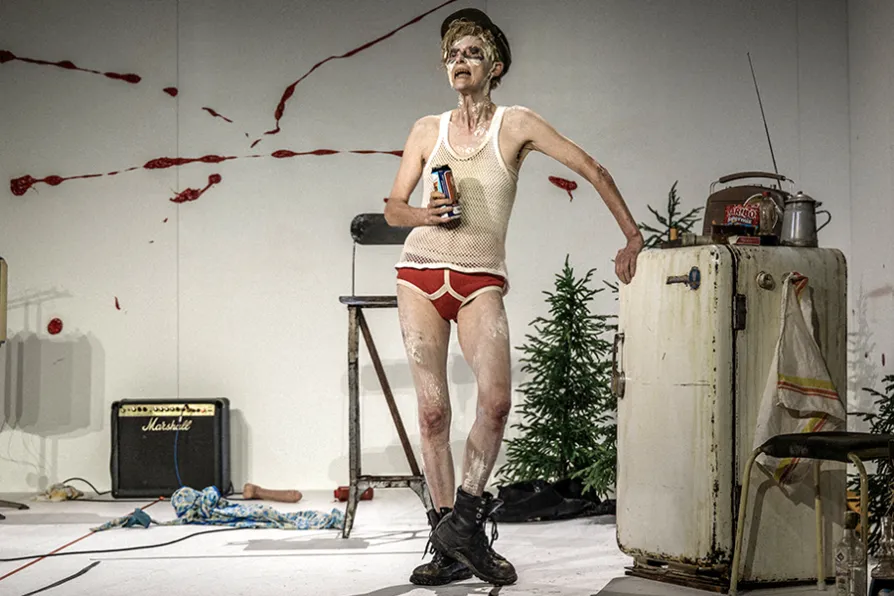
PETER MASON applauds the revival, 39 years later with the same team and cast, of Manfred Karge’s version of Brecht’s 100-year-old play, Mann Ist Mann

Cottoning on
KEVIN DONNELLY asks HOLLY GRAHAM how she, as an artist, can confront an institution over its own association with the slave trade
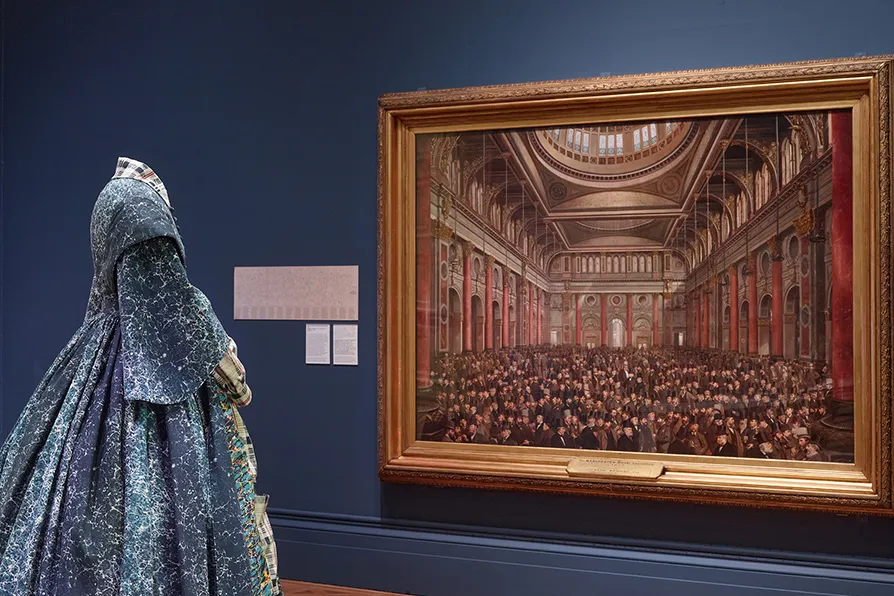
 A SPECTRE HAUNTING MANCHESTER: Holly Graham, The Warp / The Weft / The Wake, 2025. [Pic: Courtesy of the artist/Manchester Art Gallery/Michael Pollard]
MAYER WAKEFIELD applauds a fearless attempt to bring to the stage the 1984 toxic gas disaster in Bhopal, India
ALEX HALL applauds the account of a dogged, traumatic and punishing campaign for justice that has lasted from 1998 to the present day
NICK WRIGHT laments the political bias of an epic attempt to tell the history of the liberation of France from the Nazis, that excludes both the decisive contribution of the Soviet Red Army, and of the French communist party itself
JOE GILL traces the ideology and method of contemporary imperialism back to the greed, hubris and violence of the late 15th century Portuguese





“The spectre… continues to haunt us, reminding us of the unfinished business of emancipation.”
This quote by Jacques Derrida, although referencing Marxism, could also be applied to THIS thought-provoking exhibition which explores the “grid” — the “pattern” between cotton, capitalism and colonialism – and the importance of “agency.”
While the show has been open for a while, a new “performance” aspect is being added and it offers an opportune moment to catch up with the artist, Holly Graham, to discuss the work.
How did it come about, and why did she decide to explore this “material” dimension of cotton?
Graham’s starting point was her involvement with the 20/20 Initiative which, in partnership the Decolonising Arts Institute, had set up a project that aimed firstly, to investigate the diversity of who was represented within public collections within the UK – particularly in relation to ‘global majority artists” — and secondly, to “instigate decolonial discourses in response to these collections.”
This took Graham to Manchester Art Gallery (MAG) and to a collection of abolitionist objects which had informed her previous work exploring the connections between slavery and sugar. It was this latter aspect, “those material histories through the substance that is so culturally ingrained in the UK,” as Graham put it, that got her thinking about cotton and the relationship of this material to industrial Manchester and slavery.
From this, a number of strands emerged which were woven into the fabric of the work. Firstly, she started to ask “where is the wealth in Manchester? What are the connections between the wealth generated in Manchester through the cotton trade and the institutions that exist in the city today?”
The Guardian’s “Cotton Capital” initiative and the Global Threads project were invaluable sources of material here, which led to a closer look at the history of (supposedly) “liberal” institutions and individuals tied to the cotton industry and therefore to the slave trade.
Another important strand to the work was in providing a challenge to the dominant narratives relating to abolition – around “white paternalism” and the idea that black enslaved people weren’t involved in their own emancipation. The exhibition therefore aimed to focus on the counter-narrative of “self-liberatory work” and it is here that the 19th-century black abolitionist Sarah Parker Remond entered the picture, as part of a wider cohort of black American free people who travelled to Europe. Graham then found out that one of the places Sarah spoke at was the Athenaeum, an elite club, now physically part of MAG.
“I loved the idea of thinking about the very particular history of ‘place’ and the potential of speaking back into ‘space’” says Graham, and therefore “channelling that black abolitionist liberatory voice into the space of the institution.”
The initial work consisted of a costume based on both that worn by Remond herself, and on patterns from the MAG archives. This articulated ideas about the everyday use of cloth and the “wider histories of dress” itself, and demonstrated that even the patterns used in the industry were inscribed by slavery and colonial exploitation: “Guinea Cloth,” for example.
One image from the exhibition shows the dress “gazing” at a picture of the elites of Manchester, lending it a “spectral” presence, as it were.
John Berger asserts that any conventional representations of art fall into what he called a “control system,” in terms of representation and “seeing” art. Is Graham’s exhibition designed to be ambiguous, so as to subvert this “controlling” process, and bestow an (alternative) social function on the work?
Graham explains that her intention was for the work not to be “fixed” on situating and referencing Remond alone, but to also “speak” to other black abolitionist voices, to “the idea of the structures of the institution,” and to “the Atlantic and the ocean”, as a “potential space of both trauma and liberation.”
This is the theme that informs the new performance, and film of the performance, which is being introduced this year. It is “the idea of the costume being very intentionally activated through movement” and, supplemented by texts and readings (abolitionist, institutional, methodological), moving through MAG and offering “pushback against the potentially static nature of the museum space.” A film of this performance offers a new dimension: “flexibility or agility in being out in the world.”
In terms of audience reaction Graham feels that an understanding has been gained of how everyday “material” objects, such as cotton, are embedded culturally and carry associations with broader historical processes – and therefore offer a way to address the big questions of race, class and agency.
But she acknowledges that it is a “big ask” for an artist to challenge institutions historically associated with the slave trade. To what extent is this even possible? Nonetheless, The Warp/ The Weft/ The Wake is a work which offers a re-presentation (rather than a representation) of important themes, and in which space is created for the “subaltern” to speak to power through design and materiality.
Holly Graham: The Warp/ The Weft/ The Wake runs at Manchester Art Gallery until September 6. Admission free. For more information see: manchesterartgallery.org
