TUC president and POA leader STEVE GILLAN speaks to Ben Chacko on the eve of Congress 2026


 Latest editorial
The ‘Class of the Phoenix’
Out of the ashes of Gaza rises the world’s most remarkable graduating class, reports LINDA PENTZ GUNTER
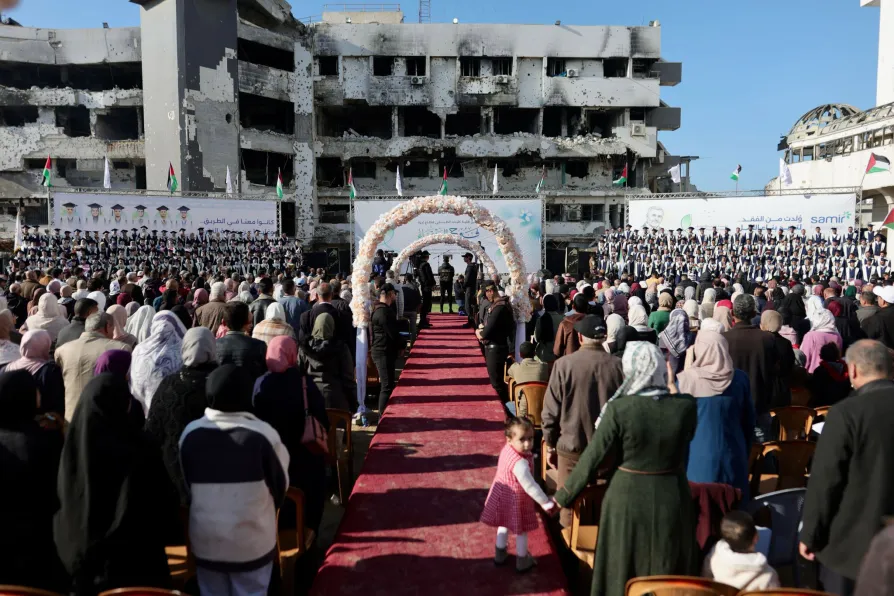 The Al-Shifa medical graduation is testament to the students’ resilience

DOUG NICHOLLS welcomes a turning point at this year’s Congress, where many motions call for a co-ordinated plan to revive British industry, a perspective outlined in his new book
HOPE VIRGO of campaign Dump the Scales warns MPs voting today they should be alert to the threat legalised assisted death poses to people with eating disorders
The Together Alliance is hosting two summits, North and South, to build power and plan action against the scourge of racism peddled by the right. DANIEL KEBEDE urges mass participation
The drift toward militarisation in Europe is not inevitable, left-wing and peace movements can preserve sovereignty and prevent war, says DÁIRE HUGHES MP
Whatever differences exist among international sympathisers of the Bolivarian revolution about its current trajectory, they should unite against the imperialist power that is the source of an enforced retreat, argues ROGER D HARRIS
Trade unions need to step up and force a turn in the policies of the labour movement to effectively confront the far-right threat, argues NICK WRIGHT





ON DECEMBER 25, something remarkable happened in Gaza. Against the backdrop of the rubble that is the almost entirely destroyed Al-Shifa Hospital, 230 Palestinian medical students celebrated graduation. Like other graduates around the world, they smiled and waved and threw their mortar boards joyfully into the air.
Except that not one of them was like any other graduate anywhere else in the world. For more than two years they had studied under bombardment, displacement, starvation, a drastic lack of supplies and constant electricity cuts.
They had treated not only strangers but members of their own families and even each other. And yet, it was the largest medical graduation ceremony held in Gaza during the genocide.
They had also buried their own teachers. Several prominent doctors working at Al-Shifa were killed while the students struggled to study, either by Israeli strikes or in the Israeli prisons to which they had been abducted. Among some of the most notable were Dr Adnan al-Bursh, the head of orthopedics, Dr Hamman Alloh, a prominent nephrologist, and Dr Ziad Eldalou, an internal medicine specialist. Bursh and Eldalou both died in Israel prisons, where horrific reports of torture and abuse continue to emerge.
More than 1,700 medical personnel have been killed by Israel since October 2023, a loss conveyed most powerfully in the 2025 documentary Gaza: Doctors Under Attack, which the BBC first commissioned and then shamefully refused to air. It has since been seen widely on other outlets.
Almost all of Gaza’s medical facilities are destroyed. The World Health Organisation estimates it will cost at least £5 billion to rebuild Gaza’s health system alone, never mind all the other essential infrastructure that also lies in ruins. But who will run it?
“Young doctors are going to be the foundation of Gaza’s healthcare system,” said Ezz Lulu, one of the students who graduated at Al-Shifa. “The responsibility falls now on this generation, the young doctors and students who kept working throughout this genocide.”
That work included procedures well above their qualifications and of a nature far more horrific than any expected to see in their future professional lives.
“During the war, these students were not only learners, they were volunteers in emergency rooms, they assisted in surgeries, they helped triage patients when resources were almost non-existent,” Lulu said during a recent webinar hosted by Doctors Against Genocide.
“They were medical students when medicine was under attack. We are talking about active healers in the midst of catastrophe.”
The stress began to take its toll, but the students persisted. That word resilience, “sumud” in Arabic, came to embody their fortitude, as it has continued to do for the still besieged Palestinian population.
“Nothing prepared me for what I had to face there”, said Lulu of his student experience over the past two years during a recent interview with Al Jazeera. “I was not even a graduate yet and suddenly I was dealing with crush injuries, traumatic amputations, fourth-degree burns, things we never studied and never imagined we would see. We were treating our own people, children, mothers, classmates. The numbers of martyred weighed heavily on us. Without having taken the actual oath yet we were already living it through Al-Shifa Hospital.”
Six of Lulu’s classmates were killed before they could graduate “and doctors who taught us, did not live to see this day,” recalled Lulu of the graduation ceremony. Fittingly, the students called themselves the Class of the Phoenix.
Out of those ashes also rose the Samir Foundation, which Lulu created in memory of his father, Samir, who was killed in a single air strike along with 19 other members of Lulu’s family, including his brother. Lulu’s father still remains missing beneath the rubble.
The students had also endured the horrors of the siege of Al-Shifa Hospital in November 2023, when it was cut off and surrounded by Israeli forces, with at least 18,000 people trapped inside, including medical personnel, patients and displaced people seeking refuge.
“Tanks were approaching, snipers were targeting the people in the corridors and we couldn’t reach them,” Lulu recalled. “We had to watch patients bleed to death because moving even a metre meant becoming a target.”
After the Israelis cut off oxygen supplies, “eight patients in the ICU just died before my eyes,” Lulu said. When the siege ended, students, doctors and nurses buried at least 100 people in a mass grave on the hospital grounds.
“Our counterparts in Gaza have undergone a medical education in the face of unimaginable violence — bombings, starvation, targeting of healthcare workers — at great personal cost,” said US medical student, Natalie Wang, who is in her first year of studies at Johns Hopkins School of Medicine in Baltimore. “We are inspired and led by their commitment to care and duty to alleviate suffering.”
Tanya Haj-Hassan, a US pediatric intensive care physician who also works with Doctors Without Borders and who has been to Gaza many times, told ABC News during the Al-Shifa siege that her colleagues were pleading for international help. “We may not survive until morning,” they told her. Some didn’t.
In testimony before the United Nations in November 2024, Haj-Hassan said: “As one of the few international observers allowed into Gaza I can tell you: spend just five minutes in a hospital there and it will become painfully clear that Palestinians are being intentionally massacred, starved and stripped of everything needed to sustain life.”
As we now know, Israel was all too ready to ignore international law. It had attacked Al-Shifa Hospital again in March 2024, occupying the premises for more than two weeks and leaving it almost entirely in ruins. But some services were eventually restored, rendering it what Lulu described as “a place known globally as a symbol of suffering and medical resistance.”
Gaza Health Ministry official Youssef Abu al-Reish described the December 25 ceremony at Al-Shifa as a graduation from “the womb of suffering, under bombardment, among rubble and rivers of blood,” according to reporting by Quds Network.
“We lived an experience no book could teach, and carry memories no force can erase,” said Raghd Hassouna in her commencement speech. “We learned that medicine is not only knowledge, but presence — showing up despite fear, loss and impossible conditions.
“Today is not a celebration of graduation; it is a victory of will, of medicine and of those who refused to disappear. It is a victory against genocide, against rubble, against all odds.
“To those we lost, to those who endured, and to those who graduated — this Phoenix Class is the rebirth of Gaza’s healthcare, rising even as it was meant to be destroyed.”
Added Lulu: “Despite everything we lost, our families, our homes, our friends, we stayed in the hospitals and continued treating people. And now we are the generation that will rebuild the healthcare system from zero.”
Linda Pentz Gunter is a writer based in Takoma Park, Maryland. Her book, No to Nuclear: How Nuclear Power Destroys Lives, Derails Climate Progress And Provokes War, will be published by Pluto Press in March.
