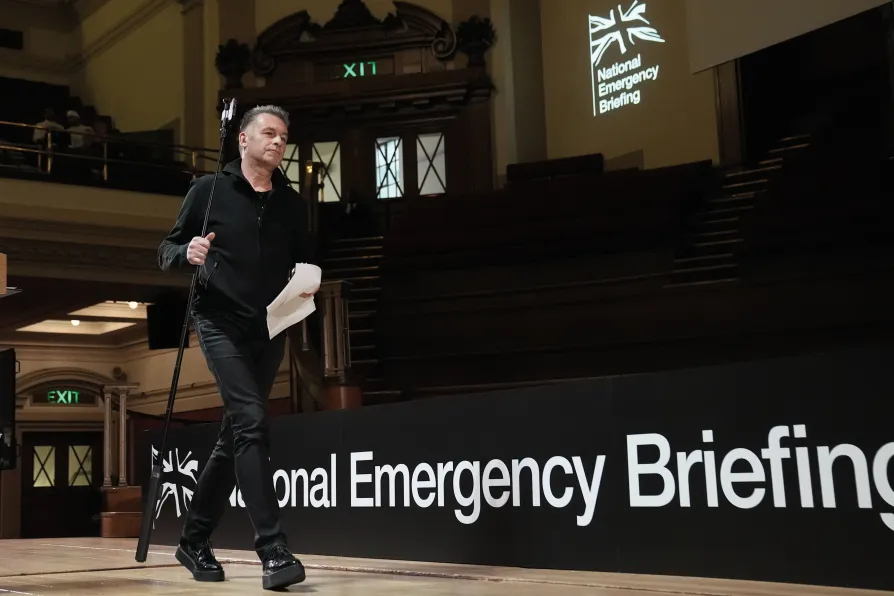
The National Emergency Briefing outlines the need for urgent action to address environmental crisis, says PAUL DONOVAN, warning that there’s no time to indulge the arguments of the fossil-fuel-funded climate-change deniers


 Latest editorial
A citizen, not a criminal
The case of journalist Huseyin Dogru, who faces oppressive sanctions without courtroom scrutiny, challenges the EU’s claim to uphold due process and the rule of law, says DENNIS POOLE

Campaigners say criticism of Labour MP Stephen Morgan’s position on Gaza has been met with police intervention and cancelled opportunities for debate. HESTER WOLFE reports
The Committee for the Defence of Iranian People’s Rights warns of escalation danger in Iran war
Claudia Webbe pays tribute tribute to KANYA KING CBE, February 12 1964 to June 3 2026
The Milburn review presents itself as a plan to help young people into work, but Dr DYLAN MURPHY argues it is laying the groundwork for a harsher benefits regime
Campaigners from across the continent will gather in Brussels on June 14 to oppose Europe’s accelerating militarisation and cuts to public services, write MAGGIE SIMPSON and BOB ORAM of No Cold War Britain





IN BERLIN, a man has been stripped not of his liberty in the formal sense, but of something quieter and, in many ways, more fundamental: the ability to function.
Huseyin Dogru is not a foreign agent operating in the shadows of Europe. He is not an external adversary to whom the language of sanctions was once reserved. He is, by all accounts, a German and European citizen, living within the jurisdiction that now constrains him. Yet he finds himself subject to measures designed for enemies of the Union — his bank accounts frozen, his capacity to work extinguished, his ability to receive support curtailed, his movement restricted for reporting as a freelance journalist on Palestine and the treatment of pro-Palestine protesters by the German police.
There has been no criminal trial. No public presentation of evidence. No moment in which accusation is tested against defence in the ordinary light of a courtroom. Instead, there is designation — administrative, opaque and immediately effective.
The consequence is not a sentence handed down after judgement, but a condition imposed in advance of it. Life narrows. Options close. The ordinary rhythms of existence — earning, providing, moving — become entangled in prohibitions.
The European Union has long defined itself through law: not merely as a system of rules, but as a space in which rights are secured, where power is exercised under constraint, where the individual stands protected against arbitrary authority.
The European Convention on Human Rights is not an ornament in this architecture; it is one of its foundations. It speaks, in measured language, of fair process, of the right to a private and family life, of the conditions under which the state may interfere and the limits within which it must remain.
Yet here the question presses itself forward with uncomfortable insistence: what becomes of those protections when the mechanism applied is not criminal law, but sanction? When the state does not prosecute, but designates?
When the consequence resembles punishment, but arrives without the procedural guarantees that punishment is meant to require?
The justification offered is familiar. We are told that the age has changed, that conflict now moves through information as much as territory, that states must defend themselves not only against armies but against narratives, networks and influence. There is truth in this. No serious observer denies that the informational domain has become a field of contest.
But the danger lies not in recognising that shift. It lies in allowing the response to it to loosen the very constraints that distinguish a constitutional order from the forces it opposes.
For what is being exercised here is a power both precise and expansive: the ability to isolate an individual economically and professionally without the burden of proving, in public, the necessity of doing so. It is a power that does not need to persuade, only to assert. And once established, it does not confine itself neatly to its original purpose. Instruments forged for external defence begin, almost imperceptibly, to turn inward.
It is said that this is about disinformation, about hybrid threats, about the protection of democratic stability. Perhaps it is. But when such language is applied to a citizen engaged in political reporting — however controversial, however disagreeable to some — the line between defence and suppression becomes difficult to discern. And when that line is blurred, it is not only the individual who stands at risk, but the principle itself.
The absence of widespread coverage in mainstream media does not diminish the seriousness of the case. If anything, it sharpens it. For it suggests that measures of considerable consequence can unfold at the margins of public attention, shielded not only by legal complexity but by silence.
A constitutional order is not tested by the cases in which it acts against the obviously guilty, but by those in which its actions are contested, ambiguous, uncomfortable. It is tested in the treatment of its own citizens, especially those who speak in ways that challenge prevailing narratives.
Huseyin Dogru’s case asks a question that cannot easily be set aside. Not about one man alone, nor about one conflict, but about the direction of a system that has long claimed to be anchored in law.
If a citizen can be rendered economically inert, professionally excluded and socially constrained without the ordinary disciplines of due process, then the issue is not merely whether the power is effective.
It is whether it remains lawful in the deeper sense.
And beyond that, whether it remains recognisably European at all.
