Britain funds the policing of black culture 16 times better than the culture itself. The Diamond Jubilee is the moment to end that, argues CLAUDIA WEBBE


 Latest editorial

A ‘British FBI’ and the myth of police independence
As Labour plans a centralised National Police Service, the resignation of a chief constable over the Maccabi football ban reveals how policing, technology and narrative management converge when public order and class power are at stake, says NICK WRIGHT
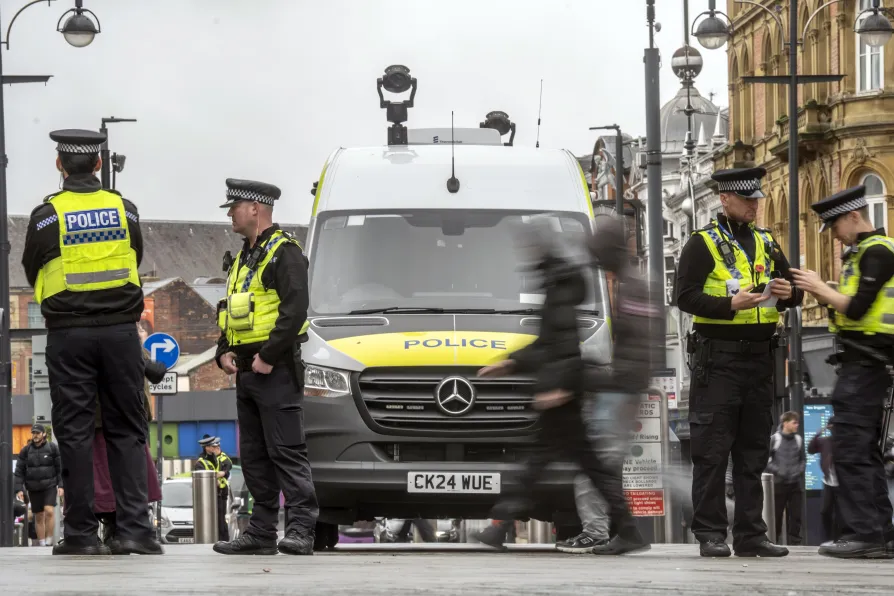 A Live Facial Recognition (LFR) van is deployed on Briggate in Leeds, as West Yorkshire Police use the facial recognition technology for the first time in Yorkshire, November 11, 2025

Growing instability in the US economy and financial markets could have serious consequences worldwide because of the central role of the US dollar and financial system, argues MICHAEL BURKE
Despite Andy Burnham’s declaration defending the continued partition of the island, all major international and internal trends are converging to make Irish reunification inevitable
Humans are part of the ‘animal kingdom’ – and of nature in general – but also distinct from it and labour (work) is part of what makes us unique, declared Engels. His insights 150 years ago into how our species came to be and how we differ from the rest of nature, are as important today as they were then, says the MARX MEMORIAL LIBRARY
Growing instability in the US economy and financial markets could have serious consequences worldwide because of the central role of the US dollar and financial system, argues MICHAEL BURKE
From Margate to Deal, mining memories are being kept alive. National co-ordinator for General Strike 100, HENRY FOWLER continued his nationwide tour of partner organisations in the Garden of England





POLICING and crime are hot-button issues that Home Secretary Shabana Mahmood thinks can be sorted with a new National Police Service (NPS) which will allow local forces to deal with so-called “everyday crime,” with responsibility for counter-terror, fraud and organised crime investigations to be handled by what she calls a “British FBI.”
This is not a good look in a week in which the model of US federal law enforcement bids to take the public order policing title from Maggie Thatcher’s boot boys.
The new set-up aims to link the National Crime Agency (NCA) and the police regional organised crime units with a brief to integrate new technology like facial recognition, along with a more intensive digital regime including artificial intelligence procedures.
The background is a long-running debate about how policing must adapt to new patterns of crime no less than new threats to security and public order. In 2024 the National Police Chiefs Council issued a detailed document which set out its position on the reform programme processes under way.
A key line in its document states baldly: “Public confidence in policing has fallen and we must act now to rebuild trust and ensure the future legitimacy of the British police service.”
At that point chief officers bought into plans to reduce the number of regional police organisations, strengthen the role of metropolitan mayors and, critically, of central government in the direction of the police.
This is against a background in which over the last decade crime levels have greatly reduced and crime has assumed a different shape. The Association Of Police And Crime Commissioners said: “Crime that crosses borders and operates online has significantly increased, with 90 per cent of crime today having a digital element. Alongside increasing demand, crime is also now more complex, evolves quicker, takes longer to investigate and requires more specialist skills.”
This is a story that demands a more detailed treatment but it takes place against an incident that has thrown into sharp relief the vexed question of the “operational independence of the police.”
A statement from Mahmood which said she had “lost confidence” in the West Midlands Chief Constable Craig Guildford and that he should resign his post dispatches the myth that our police forces — nominally organised on a local basis — are independent in matters of “operational policing.”
Guildford went into retirement after an interrogation before the Commons home affairs select committee.
The charge was that he presented “flawed” intelligence to explain a ban on Maccabi Tel Aviv fans attending a Europa League match against Aston Villa.
Guildford’s critics accused his force of caving into anti-semitism after the West Midlands Police justified the ban with concerns of potential violence from Maccabi Tel Aviv fans.
Culture Secretary Lisa Nandy — perhaps unwisely — all too ready to prove her loyalty to the fading Starmer regime, immediately found reason for Guildford’s decision in an “anti-semitism” hitherto undiscovered in Britain’s police.
Chief constables are elevated beings who traditionally exercise god-like powers in the running of their organisations and it is extremely unlikely that Guildford pored over his computer for artificial intelligence revelations about the propensity of Maccabi fans to trash any neighbourhood they find themselves in or, indeed, their almost legendary tendency to violence against any Palestinian, Muslim, secular or Christian.
Before MPs Guildford insisted his decision was not taken lightly and that it was a “necessary tactic with a legitimate aim, absolutely not anti-semitic, rather a carefully considered, legitimate and necessary measure to ensure public safety.”
But he did put his hands up to including material generated by the use of AI, perhaps with the idea that this might dodge the charge of anti-semitism. If this was the case he misread the Commons committee room.
Quite why Guildford’s underlings thought artificial intelligence tools were necessary to discover the violent behaviour of Maccabi Tel Aviv’s fans is a mystery.
No doubt Nandy might sniff out incipient anti-semitism in the Israeli authorities themselves after last autumn when a local derby between Maccabi and Harpoel Tel Aviv was cancelled on the same grounds as Guildford.
It is surprising she hasn’t condemned AI tool Microsoft Copilot itself as institutionally anti-semitic for generating a false account of a match between West Ham and Maccabi. (Note to the minister: It is called artificial intelligence for a reason).
The West Midlands investigators might have talked to the Dutch police over the widely televised behaviour of Maccabi fans in Amsterdam the previous November.
Middle East Eye reported that Dutch police told their British counterparts that over 200 Maccabi Tel Aviv football fans who wreaked havoc in Amsterdam were “linked” to the Israeli military.
MEE said it had seen documents reporting that hundreds of fans were “experienced fighters,” “highly organised” and “intent on causing serious violence.”
The preliminary review by the police watchdog — that the West Midlands Force’s investigation revealed “confirmation bias” in influencing the operational decision to ban the match — rather runs counter to the normal police investigatory procedure which is to note patterns in human behaviour as a predictor of probable outcomes. There is very little in the public accounts of Maccabi FC’s fans that suggests any bias is necessary in concluding they are a bunch of racists thugs likely to wreak havoc.
Guildford’s resignation is not the end of the matter. The discussion over whether or not Guildford’s discretion in “operational” matters could be justified on the facts alone needed to be shut down if the official anti-semitism narrative was to be maintained.
And if West Midlands PCC commissioner Simon Foster thought he was off the hook in rushing to commend Guildford’s resignation “in the best interests of the West Midlands Police and the region” he was mistaken.
The Campaign Against Antisemitism called on Foster to resign over his “pitiful” failure to sack the chief constable and, soon after Guildford’s retirement the Independent Office for Police Conduct (IOPC) said it would investigate the actions of his force.
The watchdog’s interest in Guildford and other officers involved “does not end” following his decision to step down, according to IOPC director general Rachel Watson.
“Over the last few days, we have been examining a wealth of evidence, and we have met with His Majesty’s Inspectorate of Constabulary (HMICFRS) to request additional material.
“We will continue examining all available evidence to inform our assessment of whether we should undertake any independent conduct investigations. If that is the case, we’ve said we are prepared to use our powers of initiative to independently investigate in the absence of formal referrals.”
This is at a piece with the home affairs committee over evidence given by Guildford and other officers: “If there is any indication of misconduct we will act.”
This is the exercise of administrative power in order to sustain an “anti-semitism” narrative the political imperative for which is located neither in the public order situation on the streets of Birmingham nor in the internal culture of the West Midlands Police.
Britain’s policing model is based on a mystification of the real basis of class power. Sir Robert Peel’s — hence the sometimes derogatory term “Peelers” — foundational principle rests on the idea that police officers must be non-partisan and free from political control and influence. To hold the office of constable one swears allegiance to the monarch, which, in this account, stands above the contending classes in society.
This widely promulgated principle is that police officers carry out their duties independently, without fear or favour.
Almost no-one believes this mystification but it works to both insulate politicians from police excesses and to weave a shroud of illusions about decision-making procedures, especially in relation to public order, which is always subject to political direction and around which some hard lessons are learnt. Public order policing is a distinct discipline within the service’s professional ideologies and police well understand the problems that flow from policing Britain’s now systemic crises. Apart from the routine but nevertheless highly problematic policing of sports events, especially football, the police have been pressed into partisan service in every significant rupture in relations between the people and authority.
Nominally neither politicians even the Home Secretary may tell the police what decisions to take or what methods to employ, or not employ, to enforce the law. This legend is hard to sustain when periods such as the miners’ strike or, more recently, actions in support of Palestine Action are factored in the public understanding.
People on the left and in the labour movement need to understand that while the police is a uniformed and disciplined institution, it is stratified, with sometimes contradictory interests contained within, and that a necessary level of mystification is necessary to make sense of what police officers have to do.
Among serving and former police officers who I know, there is rather muted sympathy for Guildford, although there is respect for the way he went with dignity and without performative and extravagant apologies. One experienced officer with a specialist public order background was quite clear that police operational independence is a principle that must be upheld if the notion of the police as somehow above the contending forces in society is to be maintained.
But there is concern at command level about the exercise of the Home Secretary’s real-life powers even if the constabulary as a whole regard these matters as for chief officers. And hardly relevant to their daily duties.
Police at all levels understand that they stand between contending forces in society and a professional ideology which, for them, makes sense of their role in the conflicts that arise is necessary, even if it wears thin at times like this.
On the left and in the labour movement it is important to understand how the police function and the contradictions that arise when myth conflicts with real life.
At sharp points in class struggle the coercive role of the state and the direction of the police is rendered particularly transparent.
However, at the theoretical and strategic level, the left needs to find more compelling ways to dissolve the myth that the police stand above the basic conflicts between the contending classes. In this the notion of operational independence is something which produces a necessary contradiction between the professional ideologies mobilised around policing and the actual functions police are compelled to carry out.
It is in these interstices that the forward movement of society is found.
In the 1980s, as a community relations officer Nick Wright worked in Greater London Council-funded police monitoring in south London and later as head of Haringey’s Police Research Unit before and after the Broadwater Farm fighting.
