CLAUDIA WEBBE speaks out against the lethal mechanics of Britain’s culture-war press


 Latest editorial

Beyond the tickle and slap of art
PHIL KATZ explains how ‘Cultures in Resistance’ is forging a new cultural manifesto
Powerful agribusiness interests are trying to overturn efforts by the Lula government to protect the environment and indigenous peoples of the Amazon region, writes GABRIELA SA PESSOA
Trade unions and community groups are mobilising to push back against Trump’s racist raids after new revelations of spying on legal protesters. MARK GRUENBERG reports from the US state of Minnesota
The best wildfire service may begin with the community, argues KOMAL RAJ ARYAL
The evolution of the Scottish nationalist leadership into cheerleaders for Nato has led the party to betray its pledges on Palestine and social spending, writes COLL McCAIL
While riding the No 3 bus in Glasgow MATT KERR has ample time to dissect the moribund Scottish Labour decline into near oblivion and watch intriguing bus passenger dynamics





FOR five days, a residential conference in Sheffield has done more than just house artists, activists, and trade unionists. It has become a crucible. The Cultures in Resistance gathering, a path-breaking attempt to weld social activism to arts and cultural practice, has transformed a conference into a living workshop on how to break the chains of capitalist culture.
The conference was co sponsored by the Hans Hess Foundation, with sessions given over to scrutinising both Hess’s marxist critique and his methodology and Manifesto Press, which work in tandem with the Foundation to publish the selected writings of Hans Hess in book and audio formats. In recent years Manifesto Press has become recognised for the quality of its public events, conferences and now an arts and cultural residential school.
The Hans Hess Foundation exists to promote the life and works of Hans Hess, and his Marxist cultural critique through events and publications, symposia and collaborations with arts institutions and working-class artists. Anita Halpin, Hans Hess’s daughter, trade union leader and past chair of the Communist Party of Britain opened the event and made a series of powerful interventions including in a session of the impact of Artificial Intelligence on culture.
Asked about the event she reflected, “For me the the most interesting thing was the international attendance, the representation of young people with active participation, of many young sisters and the request that we hold the event again in the future.” And the issue of youth was reinforced by a powerful intervention in the opening session by Sophia Lima-Halpin, Hess’s great granddaughter.
The Foundation and Manifesto bring internationalism to the fore in all their work and this event was partnered by our very own Morning Star and from Germany, the Junge Welt newspaper, the Zetkin Forum and the Munzenberg Forum. The collaboration involved publishers and arts groups, unions alongside theatre and film makers.
The conference represented new opportunities for two strategic alliances being built by the Foundation. Roger McKenzie of the Morning Star and Kate McKenzie of Red Star Media hosted a series of podcasts and interviews with participants that will be released in sequence from next week. Check them out on social media and the Red Star Youtube channel. These will also be syndicated by Tricontinental Research Institute online, which was joined this year by Manifesto Press in the International Union of Left Publishers.
In June 2025, the Foundation sponsored a conference on AI and artists with the Biblioteca Herziana and the Max Planck Institute during which a new collaboration was developed with Taring Padi a mass arts and struggle movement from Indonesia.
Taring Padi are noted for their campaigns against environmental degradation and their street parades of banners and puppets. They brought this skill and their sense of purpose to Cultures in Resistance playing a vital role in developing the politics and practice of the five day event.
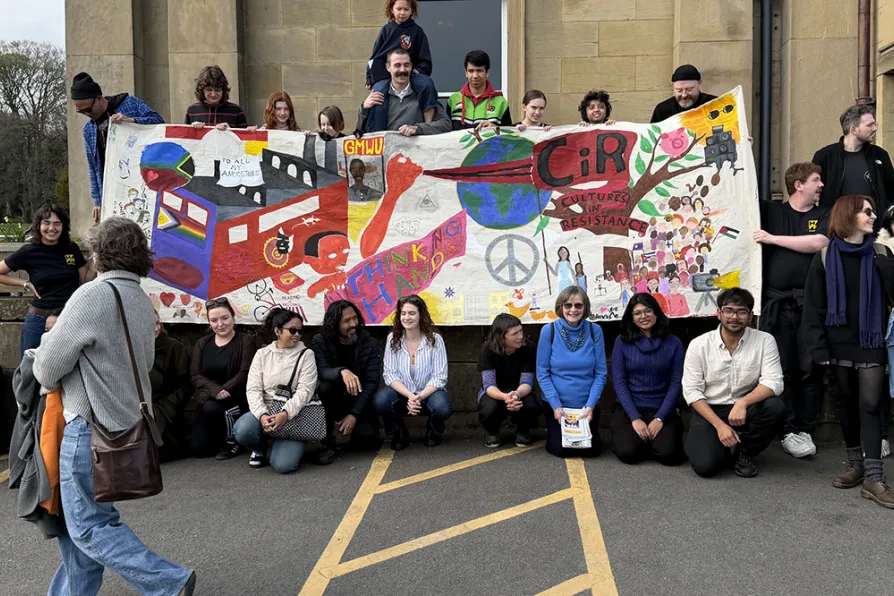
Parallel to the conference was a youth workshop, Thinking Hands, which involved play, discussion, banner-making and art presentations, run for 6-16 year olds by arts and youth professionals. Its probably true to say that Thinking Hands “stole the show.” Some attended with parents, other attended for the day. Everyone had great fun.
Drawing on a rich history of dissent — from the Dadaists to the anti-apartheid movement — the conference has been a masterclass in strategic provocation, with participants involved in “doing sessions,” discussion and collective working.
Dr Lucy Burke, union activist and academic director of the Hans Hess Foundation, helped to set the ideological tone.
Speaking on the power of manifestos, she argued that their primary function is to “disturb and disrupt” existing political balances. For an audience of creatives and battle-hardened unionists, the message landed with force. “Arts Manifestos provide a mechanism to challenge and change cultural, and therefore political, formations,” Burke explained, leaving no stone unturned as she scrutinised the Futurists and Surrealists for lessons on how to shatter convention. New Internationalist co-editor Conrad Landin spoke about the power of the arts to block the path to power of the right.
That theme of disruption was picked up by David Wilkinson, who spoke on “A Gentle Slap Writing a Manifesto for a Youth Culture in a Time of Crisis.” Wilkinson argued for a tactic of political irony and provocative humour — what he called “a gentle slap in the public face.”
He had high hopes for the newly established Museum of Youth Culture in Camden, in London. But it was his closing maxim that truly resonated with the residential delegates; echoing past manifestos he demanded — “Be reasonable, demand the impossible.”
As participants began drafting their own collective declarations and Manifestos, the conference moved from theory to praxis.
Nick Wright, chair of Manifesto Press, delivered a wide-ranging lecture dissecting the blurry line between art and propaganda. Where one ends and the other begins became a central question of a subsequent Taring Padi workshop, which saw delegates on their feet creating slogans, posters, and collective responses. The atmosphere was one of joyous defiance. “Bringing working-class culture out and bringing working-class people into culture space,” was the rallying cry, with a specific emphasis on using poster parades, song and giant visuals, to make different kinds of intervention.
Few subjects were left out. Arts director Gavin Clayton joined Workers Music Association secretary and composer-conductor Ben Lunn to discuss arts funding.
Dr Alexander Supertono of Taring Padi and Edinburgh University led a session on activism and the driving ideas behind the mass political and justice movement in Indonesia and their new worldwide platform. He warned of “Capitalism appropriating the revolution by buying its art.”
Amidst the serious political discourse, the conference agenda made space for rest and reflection (one of the collective manifestos was the “Manifest for Rest”). It noted pointedly that “Rest is resistance.” Another pointed out “food is vital” and relied on a harmonious relationship between humans and nature. The delegates argued that capitalism exploits every moment of our lives, and therefore “we need to fight for time to ‘get lost,’ stepping out of known spaces to find each other, and new people.”
This ethos of finding solidarity outside the traditional factory floor or gallery white cube was echoed in evening film screenings, including Oliver Tambo’s London Recruits which looked back at anti-apartheid activism by young volunteers as a blueprint for modern film and performance.
The conference was thrilled by an evening performance of the theatre group Malandra Jacks. They presented their illuminating play Census to a packed audience — which was encouraged to think about local community, class structure and struggle and treated to a game of Working-Class Bingo, the winning prize was a loaf of bread, won by a local trade union activist.
By the final session, titled “Learning and Working Together as a Way of Developing Collective Struggles,” the conference had achieved its aim. The talk of “audacity” was no longer theoretical.
As one participant put it, summarising the week’s sentiment, “We need audacity to break out of the constraints that are put on us from day one at school onwards.”
Cultures in Resistance did not simply ask what art should look like. It argued that we rewrite the rules of who gets to make art, for art to reflect community and real lives and that has, in the words of William Morris, “A sense of values and a sense of purpose.”
Conrad Landin from the New Internationalist thought: “Cultures in Resistance has brought together global movements for a collective reckoning. That is, we have reckoned with the fact that we cannot change the world unless we change the means of cultural production.”
For Matze Nehls from the Munzenburg Forum, “This was a great conference and opportunity to be here, meet new activists and to organise further events together.” As the delegates prepare to share their final manifestos, one thing is clear — the gentle slap has landed, and the resistance is only just beginning.
Oliver Snelling spoke for Thinking Hands. The event closed with the handing over of a hand-painted banner prepared by young participants in the Thinking hands classes, to the event participants. Snelling called for the convening of a working-class culture festival in 2027.
Taring Padi spoke for all when they said: “Next year, we return, to work together, learn together, bigger and better. We speak different languages, with different accents, but we fight together.”
