
Washington’s inability to subjugate Iran is an example of how it is trying to preserve a regional order that no longer exists, argues RAMZY BAROUD


Beyond slogans: reimagining how we fight the far right
The Morning Star publishes the speech by writer and editor JULIA BARD of the Jewish Socialists’ Group given at the paper’s annual conference at the weekend
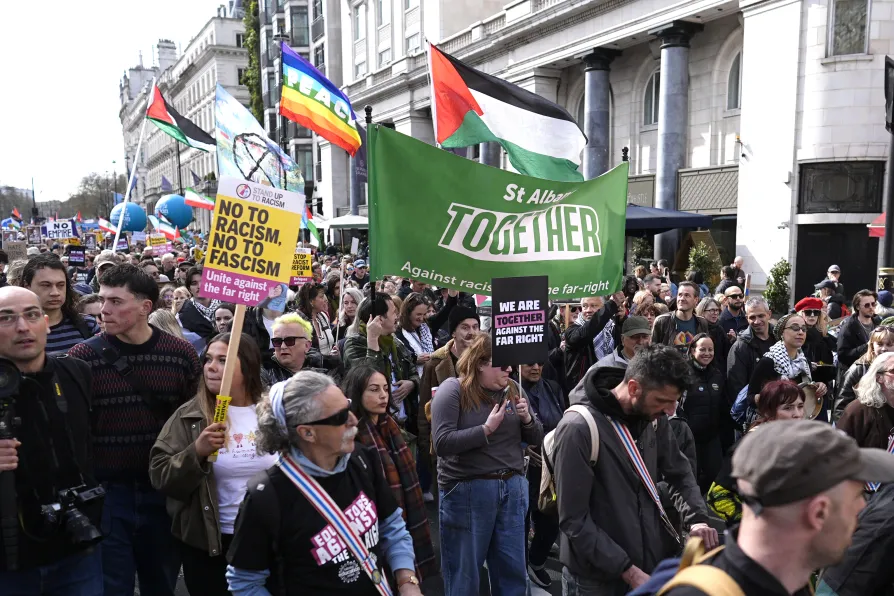
 People take part in a Together Alliance march, through central London, to demonstrate against the far-right, March 28, 2026

US financial instability is exposing the limits of a dollar-dominated global economy — and giving the Global South a historic chance to build an alternative, says MURAD QURESHI
DOUG NICHOLLS says the parasitic finance markets must be challenged or another British government could be toppled
The late country singer’s Imagination Library has put hundreds of millions of books into children’s hands. We should build on that legacy by defending the libraries at the heart of our communities, says BRENDA AITCHISON
Deprivation is a fundamental factor in criminal behaviour that must be addressed but, KENNY MacASKILL argues, there needs to a major rethink in sentencing to tackle overcrowding
MML director MEIRIAN JUMP outlines the recently refreshed library’s busy autumn schedule that ranges from book sales, archival exploration, community work with online education and the ever popular site tours
TONY BURKE surveys the shifting political landscape and the challenges Labour needs to address if it is to prevail in the 2028 federal elections





I’M GRATEFUL to the Morning Star for encouraging me and others to challenge left orthodoxies and ways of campaigning that have become so ingrained that sometimes we seem to be on rails, rather than questioning our methods and thinking creatively about how we can move the dial from right to left.
Reform is threatening all of us, and most immediately, migrants, refugees and Muslims. But alongside the work we put into understanding the far right, we need to look analytically at some of our own ideas, tactics and assumptions.
Our campaigning has to rest on solid, principled foundations, foundations that enable us to withstand the reaction, not only from the far right itself, but from the state and the institutions that have opened the door to them or, at best, stood aside, while they rampage through people’s lives.
Reform’s policies are a catalogue of malevolence and xenophobia: “Stop the boats”; “Secure our borders”; “Deport illegal migrants”; “Scrap indefinite leave to remain.” On and on it goes — even promising to “Help British people have children” (which doesn’t conjure up an alluring image).
Clearly, we need to challenge all of their destructive, divisive policies: their manipulation of people’s fears and suffering to turn them against others who have done them no harm, but who are also fearful and suffering.
We need to defend all the things we have fought for and won, but our campaigning can’t just be defensive. We need to have a vision of a different way of organising human life and human relationships.
At Stand Up to Racism’s launch of its campaign against Reform UK this week, Mothin Ali, deputy leader of the Green Party, described an experiment they ran in Leeds to assess what kind of canvassing was most effective in winning people away from Reform.
They found that name-calling and criticising the far right was much less persuasive than positive campaigning: celebrating diverse communities and class solidarity, listening to people’s concerns.
This approach means moving beyond familiar slogans and injunctions. One of these is the repeated call for unity.
Obviously, united action is important and there have been moments when we’ve achieved it. Cable Street was one. But even on those rare occasions, unity has usually been fleeting and fragile.
That’s not necessarily a bad thing — if we accept that uncertainty, knowing we will either have to resolve our differences or agree to disagree. But more often the call for unity papers over disagreements, so when they emerge, we collapse into acrimony and factionalism.
The concepts we use need to securely underpin our activism. So, rather than focusing on unity, it might be more sustainable to build coalitions, to collaborate. I know it’s well intentioned, but I hate the term “allyship,” which implies a hierarchy of powerful people standing alongside powerless people.
Rather than unequal allyship and ephemeral unity, we need to build our movement on solidarity — mutual support on equal terms. We give and we take; we learn from each other; but we don’t need to agree on everything. Solidarity gives us the best chance to build movements that are robust enough to withstand the murderous, avaricious forces we’re up against.
We are all embedded in a horribly competitive and hierarchical system and none of us escape that imperative to outdo each other. This sometimes takes expression in the anti-racist movement in the form of hierarchies of victimhood, with different groups invoking their experiences and histories as credentials or as sticks to beat whoever is not in the crosshairs at a particular moment.
Racists and fascists play us off against each other, but they still have all of us in their sights. But this is not a zero-sum game. When the great black American civil rights pioneer, WEB du Bois, visited the ruins of the Warsaw Ghetto in 1949, he said that seeing the devastation the Nazis had wreaked there shone a light on his understanding of slavery and anti-black racism.
That was a life-changing flash of insight, an experience of solidarity that strengthened him, and which he used to build and encourage the wider struggle against racism and fascism.
In the Jewish Socialists’ Group one of our fundamental principles is a concept we’ve inherited from the Bund, the Jewish Socialist movement that was at its height in the 1930s, and was at the heart of the resistance to both Polish fascism and to the Nazi occupation that followed. That concept, is a Yiddish word, Do’ikayt — it means “presence” or “here-ness,” and is expressed in the slogan: “Wherever we live, that’s where we belong.”
A more recent manifestation of this idea was the slogan of the Asian Youth Movements in the 1970s: “Here to stay. Here to fight!”
These slogans are challenges to nationalism, because they place all the inhabitants of any territory — minorities, majorities, old communities and recent arrivals — on an equal footing. They challenge the falsehood on which nation states are based: that you can draw a border round a piece of land and declare that everyone within it shares a common culture, language and history — a common understanding of who they are — and a negative view of other groups as invaders and polluters.
It’s a credit to the power of ideology that so many people actually believe this in a world where, throughout history, humans have been multilingual, mobile, and adaptable.
Our challenge to Reform UK and its insular, hate-filled politics must be based on our own multifaceted, kaleidoscopic, egalitarian, solidarity-based vision of the world we want to build.
