
APURBA CHATTERJEE explains how British artists in India used the “picturesque” to reshape colonial landscapes and celebrate imperial power


Be hospitable to the other
MATTHEW HAWKINS enjoys the work of reading the essays of a rigorous and leading London/Caribbean cultural participant
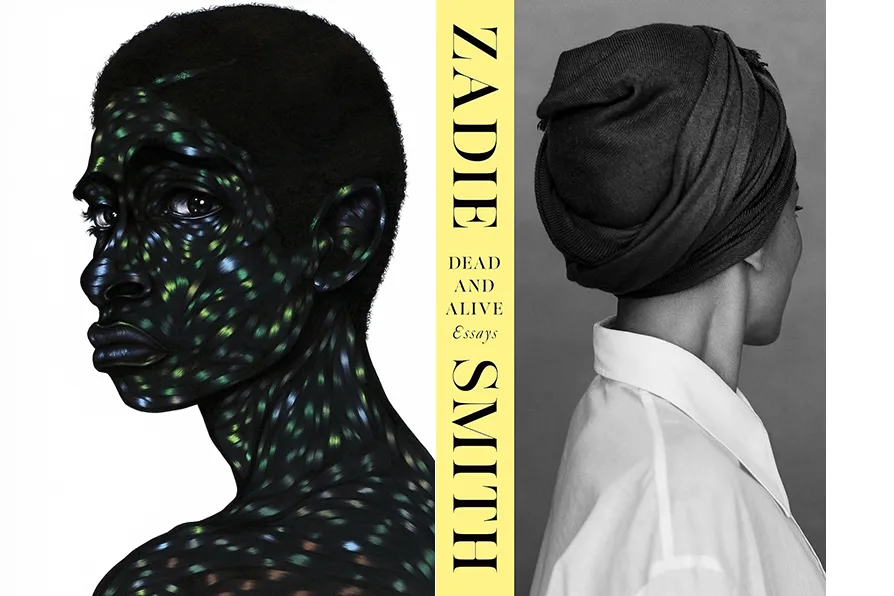
 Toyin Ojih Odutola, Lonely Chambers (T.O.), pen ink and marker drawing on paper, 2011 [Pic: Public Domain/CC]
PAUL DONOVAN welcomes a revival of Reginald Rose’s classic play that reminds us of the fundamental need for trials with juries
SIMON PARSONS applauds an exceptional performance of Wesker’s little-known play, by the same actor for whom it was written 45 years ago
ANDY HEDGECOCK and MARIA DUARTE review Late Fame, The Death of Robin Hood, Leviticus, and Gail Daughtry and the Celebrity Sex Pass
ANGUS REID recommends a uniquely accomplished documentary collage that contemplates our relation to the natural world
GORDON PARSONS enjoys Kant’s ‘mind-boggling’ theory of human reality: that we create the reality we experience





Dead and Alive: Essays
Zadie Smith, Hamish Hamilton, £22
With its pale-yellow spine, jet black Queen Anne jacket font and monochrome cranium shot, this book is itself a covetable object, containing many described instances of finessed craft and committed labour.
Over time Zadie Smith has found and fostered her uniquely London/Caribbean sense of self-orientation through literature. Her fundamentally working-class rigour — when she tapped it — became extended by study at Cambridge. In terms of selling, prizewinning and a broad sense of arrival Smith is a full cultural participant. This is great fun. There’s a buzz. There’s conscious wit. There’s a layered instance of cosmic joke acknowledgement in her choice to call her most recent novel The Fraud.
In Dead and Alive, she communicates her immediate impressions through transparent writing. First thoughts then cede to journeys.
Some kind of editorial choice has been made to place these essays in a sequence, though Smith suggests in her foreword that one could dot around, drawn by topics of preference.
By my own lights, given the distinct shape of individual essays, the nature of a larger sequence surely signifies. It’s also questionable whether an essay will read richer or poorer according to how its subject falls within the scope of a punter’s prior interest.
I hadn’t seen paintings by Toyin Ojih Odutola but an essay on A Countervailing Theory — her solo exhibition — employs direct description that amply documents the images and their mark-making. Like Blake and Hogarth, Ojih Odutolah has something vital to say via figurative images amid a visionary/satirical narrative. In parallel, Smith’s tonal arsenal escorts the reader through physical inventory to subjective delineation of lightbulb moments.
Leaping to part four — subtitled Mourning – one encounters short memorial pieces on accomplished writers. Here Smith can directly quote the deceased, but the ease of passing writing into further writing doesn’t match the kind of purchase involved in descriptions of creativity in other media, such as the cinema, the sculpture, or the Freud portraiture discussed elsewhere in this collection.
Pieces on Martin Amis and Phillip Roth flew past me somewhat. I don’t know their work. Nor have I read Hilary Mantel (where have I been?), but something about her creative identity was made vivid in Smith’s tribute piece, What Lodged In Her Mind. A parked Mantel tome might henceforth dislodge from my bookshelf. Mantel’s “several” nature clicked with Smith, whose prose capture thereafter compels exploration.
Dickens and Thackeray appear in Smith’s recent novel The Fraud. Did my being familiar with their work add to my reading experience? An essay on writing The Fraud turns up in a section entitled Confessing. Here Smith refers to the web of historic and geographic alignments that informed her original scratch notes. She states: “Coincidence piled upon coincidence to such an extent that … I felt the book was hardly mine at all … that I’d been dragged in to write it – to do the grunt work.”
Labour again. As with the drone that must be present in certain music, Smith consistently invokes the matter of work, whether unsung or culturally luminous. The ethic of reading-as-working is also in play, as chimes with an anecdote about a renowned novelist who dropped everything to close-read heaps of historic literature on slavery — Roth, as it happens — and surprisingly, this key nugget had clearly lodged in my mind.
Speaking of nuggets, who but Smith will have noticed how the title of the movie Tar could be an abbreviation of Tarkovsky? She also identifies how Tar’s leading actor Cate Blanchett deliberately skates between acting-as-if-acting and something more visceral. Smith then mentions how cultural luminaries, in acts of self-fashioning, publicly pretend to consider questions long settled in their own minds.
In a transcription of an acceptance speech given on a podium in Austria, Smith herself goes a bit Tar, diddling around questions of immigration (problematic) and patriotism (understandable). Yet in this book’s introduction — On Hospitality — she cites Derrida’s aspirations to give place not only to the foreigner but to the absolute other, without demanding reciprocity or even identification.
Smith’s is an ambiguous world where “what seems monolithic separates into parts.” As she also says, “my kind of writing describes the liveable.” As I would describe it, her writing’s mask-slip revelation of necessary personal strategies makes for a wink of intimate and generous connection.
These essays can maintain communication with any curious flawed person working on their self-knowledge. This could be you.
