Britain funds the policing of black culture 16 times better than the culture itself. The Diamond Jubilee is the moment to end that, argues CLAUDIA WEBBE


 Latest editorial

With assisted dying back on the agenda, it’s time to get behind Hospice UK’s four-point palliative care plan
GEOFF BOTTOMS says improving palliative care needs to move up the political agenda — and the risks to vulnerable and socially disadvantaged groups posed by legal assisted suicide make this more urgent
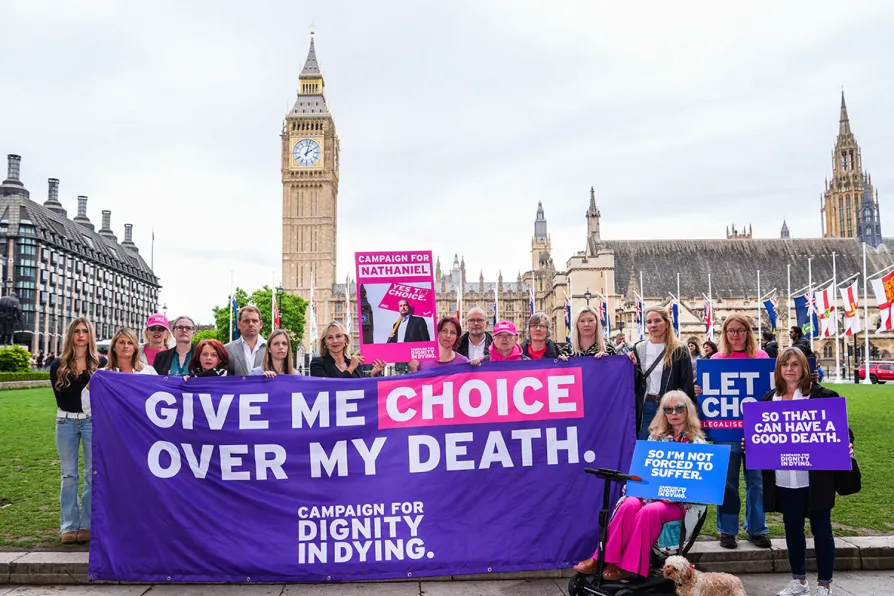 Supporters of the Terminally Ill Adults (End of Life Bill), during a photocall at Parliament Square in London, ahead of a government petition debate in Westminster Hall, June 8, 2026

Growing instability in the US economy and financial markets could have serious consequences worldwide because of the central role of the US dollar and financial system, argues MICHAEL BURKE
Despite Andy Burnham’s declaration defending the continued partition of the island, all major international and internal trends are converging to make Irish reunification inevitable
Humans are part of the ‘animal kingdom’ – and of nature in general – but also distinct from it and labour (work) is part of what makes us unique, declared Engels. His insights 150 years ago into how our species came to be and how we differ from the rest of nature, are as important today as they were then, says the MARX MEMORIAL LIBRARY
Growing instability in the US economy and financial markets could have serious consequences worldwide because of the central role of the US dollar and financial system, argues MICHAEL BURKE
From Margate to Deal, mining memories are being kept alive. National co-ordinator for General Strike 100, HENRY FOWLER continued his nationwide tour of partner organisations in the Garden of England





A FRESH attempt to legalise assisted dying in England and Wales has been launched by Lauren Edwards, the Labour MP for Rochester and Strood, who reintroduced the Terminally Ill Adults (End of Life) Bill in parliament on June 17, originally brought by Labour MP Kim Leadbeater in 2024.
This would have allowed adults over the age of 18, who were expected to die within six months, to be given help to end their own life, subject to approval from two doctors and a specialist panel.
It passed two votes in the Commons in June 2025 but ran out of time to pass the House of Lords, after peers opposing the Bill submitted more than 1,200 amendments.
by bringing exactly the same legislation, Edwards is threatening to trigger rarely used powers to override peers’ objections should they refuse to pass it again.
Bills usually only become law if both Houses of Parliament agree on their final wording. But the powers under the Parliament Act, which have only been used seven times in the last century, mean that if MPs pass an identical Bill in two consecutive parliamentary sessions, peers cannot block it a second time.
The Lords can suggest amendments, which would be added to the Bill with the agreement of the Commons, but if they do not pass the Bill as a whole before the end of the next session in a year’s time, the unamended Bill could become law even without their approval.
Opponents have warned that using the Parliament Act would risk creating a law out of a Bill about which the Royal College of Psychiatrists, as well as a range of disability charities and hospices, have major concerns, while the former health minister Ashley Dalton has objected to debating yet again a deeply divisive and flawed Bill whose supporters have refused to listen or to make the necessary changes.
She argues: “This Bill would hand sweeping unchecked powers over life and death and our NHS to future governments, whatever their political persuasion. We should not be using more of our limited time and political capital on something that simply isn’t safe or a priority for the people who put us in power.”
Edwards, who was born in Victoria, Australia — the first state in the country to legalise assisted dying — came second in a ballot of private members’ Bills, meaning she will have a good chance of passing the Bill should MPs continue to support it. It will be debated in September when it receives its second reading although the government has said that it will remain neutral.
In essence, assisted dying is a class-based issue, where access and restrictions reflect social inequalities, and material conditions shape individual choices about life and death.
This perspective frames the debate as part of a broader struggle over social justice, healthcare, and state power, rather than solely an individual rights issue, in contrast with liberal or individualist approaches, which emphasise personal autonomy and the right to choose death.
It also warns against the normalisation of assisted dying as a substitute for social support, particularly for vulnerable groups. Evidence from countries like Belgium, the Netherlands, and Canada shows that assisted dying can expand beyond terminal illness, raising concerns about coercion and systemic pressures on vulnerable populations.
While Britain largely resists the commodification of essential healthcare, the rise of private and consumer-driven services indicates a gradual encroachment of market logic in specific sectors, most notably in elective, diagnostic and technological wellness services.
Also the creeping privatisation of the NHS in tackling record waiting lists as a result of underfunding, and the surge in those who can afford it opting for private treatment, is creating fears of a two-tier service undermining the service’s core founding principles.
This drift from a purely collective healthcare system — funded and run uniformly by the state — toward an increasingly individualised model means that more and more people are taking personal responsibility for managing their health and funding their care independently.
It is in this context that assisted dying has become a hotly contested debate. Yet alternatives in the form of palliative care exist, with hospices forming a vital part of the nation’s care system, supporting thousands of people every year alongside NHS services.
But even here, rising demand, increasing costs and a broken funding model mean many hospices are facing difficult decisions about the services they can provide.
Nearly six in 10 hospices have already made, or are considering making, cuts to front-line services. Without urgent action, more patients and families risk missing out on the specialist care they need at the end of life.
Hospice UK represents over 200 hospices across the UK. While not directly providing patient care, it supports, funds, and champions the wider hospice network. When the government on June 4 published an interim Modern Service Framework for palliative and end-of-life care, it welcomed its recognition of the urgent need to improve palliative and end of life care, including its commitment to moving towards sustainable contracting of hospice services.
The Modern Service Framework sets out a vision for improving palliative and end-of-life care, helping to ensure people receive high-quality, consistent care when they need it. For too long, access to palliative and end-of-life care has not been equitable, with people’s experiences often depending on where they live, who they are and why they are ill.
As Toby Porter, CEO of Hospice UK points out, “Already nearly one in three do not get the end-of-life care they need, and it is patients and families who pay the price for diminishing hospice services.”
In response, Hospice UK has set out a four-point plan to create a fair and sustainable funding model for hospices.
This includes full funding of specialist palliative care provided by hospices, proper NHS contracts for hospices, funding to cover the cost of NHS pay rises for hospice staff, and national accountability for equitable provision of palliative care, wherever people happen to live.
It’s also calling on the government to take urgent action through this four-point plan. As a first step towards fair hospice funding, it’s asking the government to commit £112.5 million in additional recurring revenue funding from this financial year.
This would be an important first step towards fully funding the specialist palliative care provided by hospices, which it estimates would require an additional £450 million in total.
The theme of this year’s World Hospice and Palliative Care Day, held each October, is “Pain Management: An essential part of palliative care.”
As a progressive campaigning movement we must demand that improved universal palliative and end of life care moves further up the political agenda, and provides a genuine alternative to ending one’s life that is as pain-free as possible.
This is especially critical now that the Assisted Dying Bill is receiving a new lease of life with the reintroduction of the Terminally Ill Adults (End of Life) Bill, considered by disability rights organisations, Royal Colleges and domestic abuse charities as unsafe and prone to coercion. Life before death really matters.
