
The Defence Universities Alliance is a bit to co-opt higher education into the wider drive to war — we should resist as earlier generations of scientists did, argue say ROX MIDDLETON, LIAM SHAW and MIRIAM GAUNTLETT of SCIENCE AND SOCIETY


1916 and the unfinished struggle
This year marks the 110th anniversary of the 1916 Easter Rising. TOM GALLAHUE and ROBERT POOLE from Educators for a United Ireland discuss the role played by the Irish diaspora, and why the Rising remains relevant today
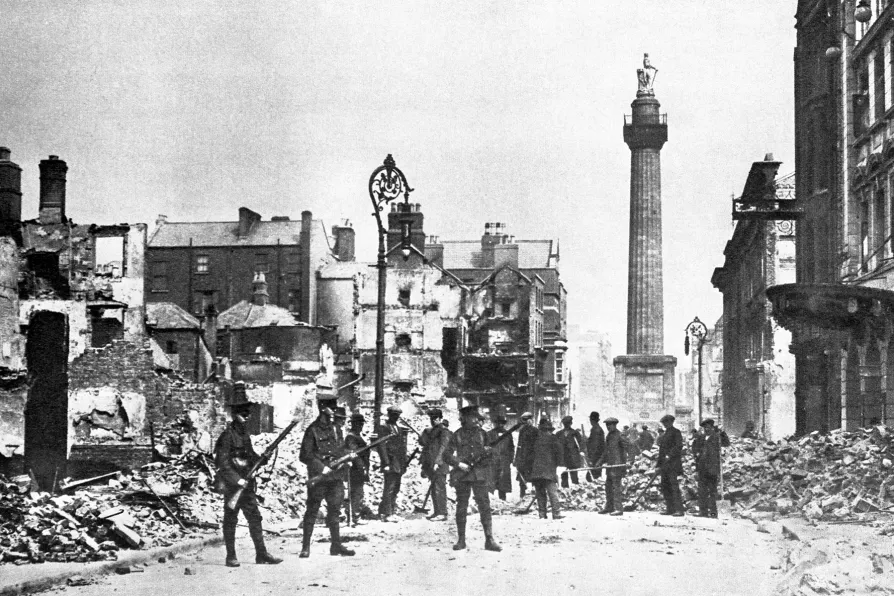
 Scene from O'Connell Street in Dublin, during the Easter Rising, April 25, 1916
In the third of a four-part serialisation from her new book No to Nuclear, LINDA PENTZ GUNTER explains how the world had a chance to build an energy system around renewables more than 70 years ago — instead, it chose nuclear
In the fourth and final part of our serialisation from LINDA PENTZ GUNTER’S book No to Nuclear, she asks how anyone can see nuclear as value for money given its constantly ballooning costs
Elon Musk says AI will make work optional. The world of abundance he predicts actually spells the end of the capitalist system, argues FAWZI IBRAHIM
CARLOS MARTINEZ responds to liberal hawk Simon Tisdall’s evidence-free China-bashing and asks whose agenda it really serves
Indian students have fought for the right to education, schooling us all in the process. Comrades from the Students’ Federation of India (SFI) — UK comment on the resistance and its ripples here





THE Rising, which took place in Ireland over Easter week, left almost 500 dead, thousands wounded, and Dublin in ruins.
Despite the execution of the rebel leaders and the smashing of the volunteer movement, the Rising should not be seen as a failure. Instead, it must be understood as a pivotal moment in the anti-imperialist struggle, an international revolt against the British empire.
Today, as in Britain, the far right is on the rise in Ireland. One tactic it has become adept at is hijacking legitimate campaigns and grievances for their own ends. The cost-of-living crisis, driven by war and corporate greed, is one such example of right-wing opportunism.
That is not to say these grievances are not real, nor that we should disengage from those protesting. On the contrary, we must not cede economic struggles to the right, who seek to turn them into vehicles for division and xenophobia.
Instead, socialists must draw the connections between the current crisis, imperialism and capitalism. In doing so, we continue the work of James Connolly, who placed class at the centre of the struggle for independence:
“If you remove the English army tomorrow and hoist the green flag over Dublin Castle, unless you set about the organisation of the Socialist Republic your efforts would be in vain.”
By highlighting the role of the capitalist class, we can wrest this moment away from those who seek to divide us. We should also remind people that during Ireland’s revolutionary period, internationalism was not an abstract idea but a lived reality. From Glasgow to New York, migrants, socialists and workers stood alongside Irish revolutionaries against the British empire.
While Dublin was the focal point of the Rising on April 24 1916, it neither began nor ended in the Irish capital. It is often remembered, and increasingly misrepresented by the far right, as a purely national uprising. This is simply not the case.
The Rising was Irish, but it was also international.
To properly understand 1916, we must recognise that it was made possible through migration, exile, labour struggles and diaspora networks. Republican traditions across generations understood that the fight against British rule in Ireland was part of a wider struggle against empire and imperialism.
Connolly himself, one of the signatories of the Proclamation, was born in Edinburgh. A revolutionary socialist, he organised labour movements in Scotland, England, Ireland and the United States. His politics went far beyond narrow nationalism. As he put it, “The cause of labour is the cause of Ireland, the cause of Ireland is the cause of labour.”
Another signatory, the Fenian veteran Thomas Clarke, was born in Milford-on-Sea in Hampshire. After imprisonment for his role in the Irish Republican Brotherhood, he spent years in the United States organising through transatlantic republican networks.
These international threads ran through many key figures of the Rising. Constance Markievicz, a suffragette, revolutionary and the first woman elected to the House of Commons, was born in London, educated in Paris and married to a Polish noble. She fought at St Stephen’s Green and became one of the most prominent figures of the period.
Margaret Skinnider, born in Glasgow to Irish parents, was a teacher, feminist and trade unionist. She travelled to Dublin, where she fought as both a sniper and a courier. She commanded a unit during the fighting and was seriously wounded, shot three times.
Roger Casement brought a broader anti-imperialist perspective shaped by his exposure of colonial atrocities in the Congo and the Amazon. Ireland’s experience under British rule was not unique, but part of a global system of domination.
These were not marginal figures, but part of the living core of the rebellion.
The international dimension extended beyond leadership. Eamon Bulfin, who raised the green “Irish Republic” flag over the GPO, was born in Buenos Aires. Though sentenced to death, his punishment was commuted, and he was deported to Argentina.
The Irish diaspora did not simply observe from afar, it helped make the Rising materially possible. In the years leading up to 1916, global networks raised funds, spread political ideas, and supported organisation on the ground.
The Howth gun-running of 1914 is a clear example. Erskine Childers, born in London, and his wife Molly Childers, a US-born activist, played leading roles in importing rifles from Germany for Irish revolutionaries.
Seen in this way, the Rising appears not as an isolated event, but as part of a wider international network of resistance. It drew in people from across Britain and beyond, and depended on support from Europe and the United States. Those involved understood that empire was global, and had to be confronted globally just as capitalism still is today.
Many of those who fought over Easter Week would later leave Ireland and become migrants to other nations.
For educators, we should show that the Easter Rising offers far more than a narrow nationalist narrative. It provides a way to teach empire, class, migration and resistance as interconnected processes. At a time when curriculums are often constrained by government edicts and narrow middle-class perspectives, 1916 could allow our students to explore how ordinary people, workers, migrants and activists, shaped history across borders.
For trade unionists, the Rising is not only a national story but a labour story. The leadership of James Connolly and the participation of organised workers demonstrate that struggles for political independence and workers’ rights are deeply intertwined. At a time when trade unions once again face pressure, this history reminds us of the central role organised labour can play in wider movements for liberation from Palestine to Cuba.
For those of us in Britain, this history carries particular responsibility. The British working class has a long and complex relationship with Ireland. Not always one that covers the workers’ movement in glory but one shaped both by solidarity and by divisions fostered by empire.
Revisiting 1916 through a socialist and internationalist lens allows us to reclaim a tradition of solidarity that crosses borders and challenges imperial narratives.
This remains as relevant today as it was 110 years ago. Struggles against occupation, colonial violence, and national oppression rarely remain within borders. Diaspora communities continue to play decisive roles in liberation movements today, including in Palestine.
Their activism has helped transform local suffering into global political movements, mobilising millions worldwide.
The lesson of 1916 is not simply that Ireland rose, but that it did so through international solidarity, through migrants, exiles, workers and diaspora communities who saw Irish freedom as part of a wider struggle against empire and imperialism.
The task today is not simply to remember the Rising, but to continue its unfinished struggle. For internationalism, for socialism, and for a world beyond empire.
Tom Gallahue and Robert Poole are campaign co-ordinators for Educators for a United Ireland, a cross community group aimed at promoting Irish unity through education, dialogue, and trade union activism.
