
The UK Prime Minister may have the regal touch in northern England, but he’s been wrong-footed on the constitutional challenges posed by the Celtic Alliance of first ministers from Scotland, Wales and Northern Ireland, argues KENNY MacASKILL

Future-proofing the railways means investment in people, tech and regions
Train drivers’ union Aslef general secretary DAVE CALFE speaks to Ben Chacko about his hopes that Burnham’s devolution agenda will include the importance of the railway

 Dave Calfe outside Aslef’s HQ [Pic: Jess Hurd]
NEIRLAY ANDRADE, a member of the Communist Party of Venezuela’s political committee, outlines her party’s position on the crisis facing the country
A look at Taylor Wimpey’s accounts shows why Labour’s market-led housing strategy won’t deliver more, cheaper homes, as promised, says SOLOMON HUGHES
DAVID HORSLEY remembers the remarkable life and death of US black revolutionary George Jackson, whose politically passionate prison letters were published as Soledad Brother
Cuban trade union federation CTC leader OSNAY MIGUEL COLINA speaks to Ben Chacko about life and work under a crippling US siege
A part of the British empire’s network of slavery, today the Caribbean island of Nevis faces a new form of exploitation in the form of crypto-colonialism, CLAUDIA WEBBE writes
Challenges from the unscrupulous misuse of AI to steal actors’ voice and physical likenesses is being met with a firm union response, writes LYNDA ROOKE





ANDY BURNHAM’S government is much more inclusive than Keir Starmer’s and this opens opportunities for unions to influence policy, train drivers’ union Aslef leader Dave Calfe believes.
“The engagement is much greater, the [meetings with affiliated unions] very positive and the policies he’s announced so far might not be groundbreaking but are going to make a difference,” he told the Morning Star during the week’s TUC Congress in Brighton.
For Aslef, a Prime Minister prepared to listen to union demands, and publicly committed to extending public ownership, has an early chance to show he means it by intervening over the sale of freight operator DB Cargo.
The union’s deputy general secretary Simon Weller pointed out moving an emergency motion on the sale that progress towards public ownership of the railway applies to passenger services, but not freight — though increasing rail freight capacity is another key part of reducing emissions and achieving net zero.
DB stands for Deutsche Bahn and DB Cargo is among the many examples of privatised British services being operated for profit by foreign state-owned firms. It owns a lot of railway-adjacent land and rail-connected sites, making it a tempting prize for asset-strippers who could have no interest in keeping it together — meaning the sale could threaten thousands of jobs and reduce rail freight capacity in Britain.
“We’d like to see the government coming in and taking DB Cargo on, using it to run the Network Rail contracts that are currently contracted out to private companies — keeping that profit in the rail sector and not let it go out to shareholders.”
The union is calling on the government to look at expanding Direct Rail Services, a publicly owned operator running trains carrying active nuclear materials, to take on more freight including services currently run by DB Cargo.
Calfe also hopes that Burnham’s devolution agenda will include recognising the importance of modernised rail services connecting all parts of the country, with Britain having fallen behind other countries in high-speed rail.
Advanced rail services that can compete with domestic and short-haul flights are another means of reducing emissions — with Airbus recently slashing its forecasts for Chinese passenger jet demand because the rapid rollout of high-speed rail there is shifting passenger preferences away from flight.
“High Speed 2 is not the way to build a railway, is it,” he observes, pointing to a schedule that will see the long-running project start running trains from Old Oak Common in outer London to Birmingham only by 2036, with it not expected to reach central London until 2040.
“We don’t just need it from outer London to Birmingham, we need it up to Scotland and we need it across the country, down to the south-west as well.
“The railway for too long has been preoccupied with routes in and out of London, but it’s leaving behind other areas and cities.”
Burnham says we’ve been on the wrong track as a country since the 1980s, but should we look back further still, reverse the Beeching cuts and reopen the branch lines?
“We may have to temper expectations on that, but we need to maximise access to local services and yes, modernisation is not just about electrification and re-signalling but identifying lines that should be reopened.” He notes the vulnerability of the coastal route in south-west England closed when storms breach the Dawlish sea wall, and how much slower trains run once you get beyond Plymouth.
“Transport planning is seen from SW1, from Westminster. How does that represent people in other parts of the country? They understand travelling in London, but not in Liverpool, or Leeds. There are lots of places where there are issues with commuting and long-distance travel.”
Money for the investment required would be freed up, Aslef argues, if operators now being shifted to public ownership found alternatives to leasing rolling stock from profiteering private companies. Another motion it brought to Congress pointed to the losses to shareholder profits this causes, as well as the barrier it puts up to long-term planning because of the need to seek agreement from contractors about renewing and upgrading trains.
There are alternatives to leasing from the rolling-stock companies known as Roscos — in the Liverpool City Region Mayor Steve Rotheram bought new Merseyrail trains using public funds.
Rail unions have long criticised an attitude of managed decline towards our railway, when it should be a sector with huge potential for the future.
One win for Aslef in that regard was securing a reduction in the age you can start training as a train driver from 20 to 18, meaning people can join the career path on leaving school.
An aversion to investment in workers, including training, by private companies is one reason driving trains is an ageing occupation — “the average age is in excess of 50 and they need to use every option to get people into the industry,” Calfe says. “I started at 17 on the railway and I hope there are future general secretaries who start not much older than that!”

Similar stories
Privatisation and the break-up of our integrated rail system have been disasters. The Labour government’s pledges on reindustrialisation and renationalisation offer the solution, argues DAVE CALFE of Aslef
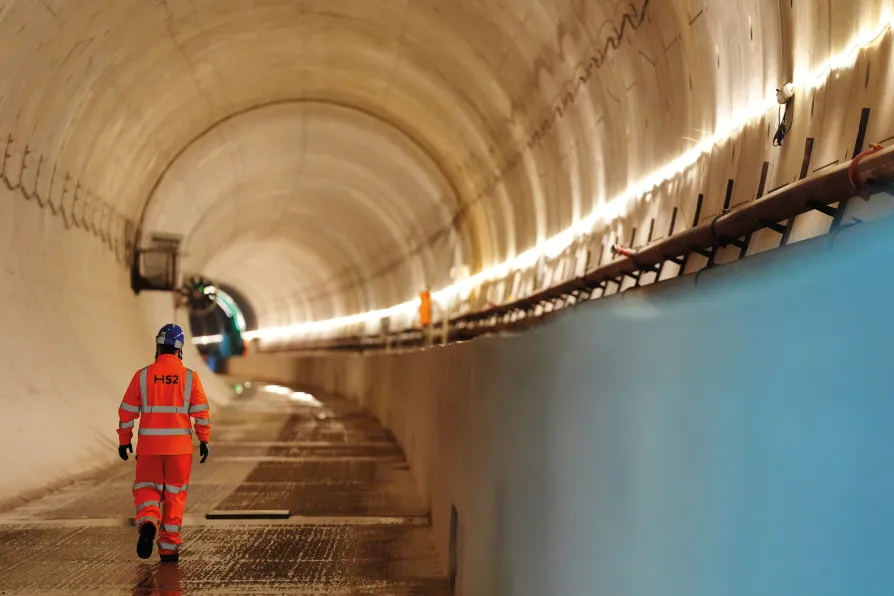
The HS2 debacle exposes what happens when public infrastructure is handed to private contractors – especially when set against China’s state-led high-speed rail success, says CARLOS MARTINEZ