Latest editorial
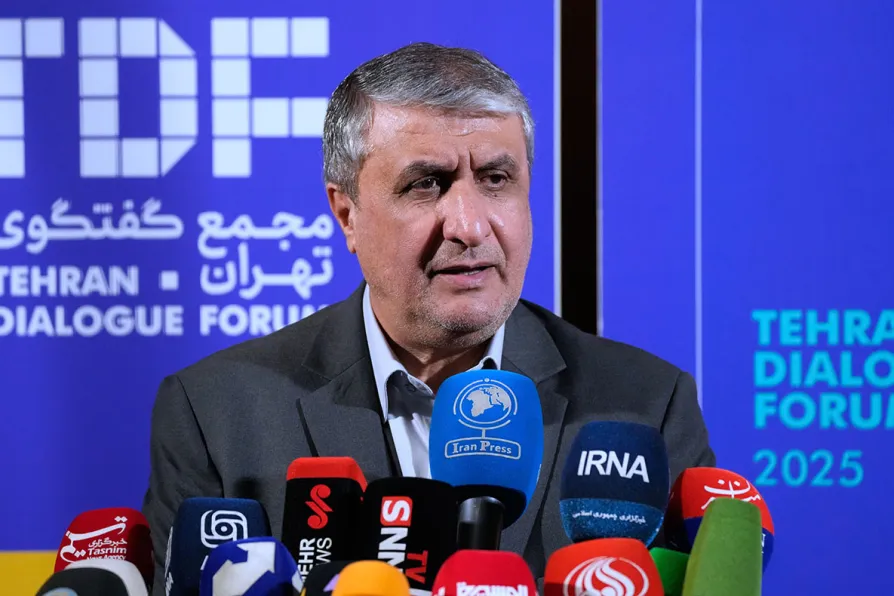 Head of Iran's Atomic Energy Organization Mohammad Eslami speaks at a news briefing in Tehran, Iran, November 16, 2025





IRAN has blasted the exclusion of the head of its Atomic Energy Organisation from the annual gathering of the United Nations nuclear agency in Vienna, saying that it constitutes “a serious breach” of Tehran’s rights as a member nation.
It has since emerged that the United States was behind the exclusion of the Iranians.
Iran’s ambassador to the agency Reza Najafi told delegates at its general conference yesterday that: “By obstructing our full and effective participation, the denial of access contravenes both the letter and the spirit of the legal framework” governing attendance at meetings of the International Atomic Energy Agency (IAEA).
Mr Najafi slammed Austria, the host country of the IAEA and other UN organisations, saying that Vienna’s decision not to grant a visa to Mohammad Eslami “violates the host country’s obligation.”
The Russian ambassador to the UN in Vienna, Mikhail Ulyanov, accused Austria of “grossly” violating its obligations as host nation of the IAEA.
He said Western nations had “unleashed a genuine campaign of visa-related abuses so as to settle scores with countries they deem to be undesirable.”
Iranian Foreign Ministry spokesman Esmail Baghaei also condemned yesterday Austria’s refusal to issue a visa to Mr Eslami.
Mr Baghaei said that Tehran protested against the decision and summoned the Austrian charge d’affaires, saying Austria was obligated as the host country to issue the visas.
Austria responded by saying that a UN security council committee had rejected Austria’s request to exempt Mr Eslami from the travel ban.
“As a consequence, Austria was obliged to deny one member of the Iranian delegation entry into its territory,” said Christian Ebner, Austria’s ambassador to the IAEA.
As the host of international organisations, Austria can request exemptions from travel bans to enable sanctioned officials to attend international conferences at the UN in Vienna.
The committee is responsible for overseeing the sanctions reimposed against Iran last year over its nuclear programme.
The reinstated sanctions include a travel ban, a conventional arms embargo, restrictions on ballistic missile development, asset freezes and a ban on producing nuclear-related technology.
Iran, Russia and China reject the legality of the sanctions reimposed under the snapback mechanism.
The US ambassador to the UN in Vienna, Preston Wells Griffith, admitted that an Austrian request for an exemption for Iran was denied after Washington lodged an objection with the committee.
He said: “While we are focused on a diplomatic solution to the challenges posed by Iran’s nuclear programme, we could not allow a UN-designated official to travel without any meaningful co-operation on nuclear safeguards.”