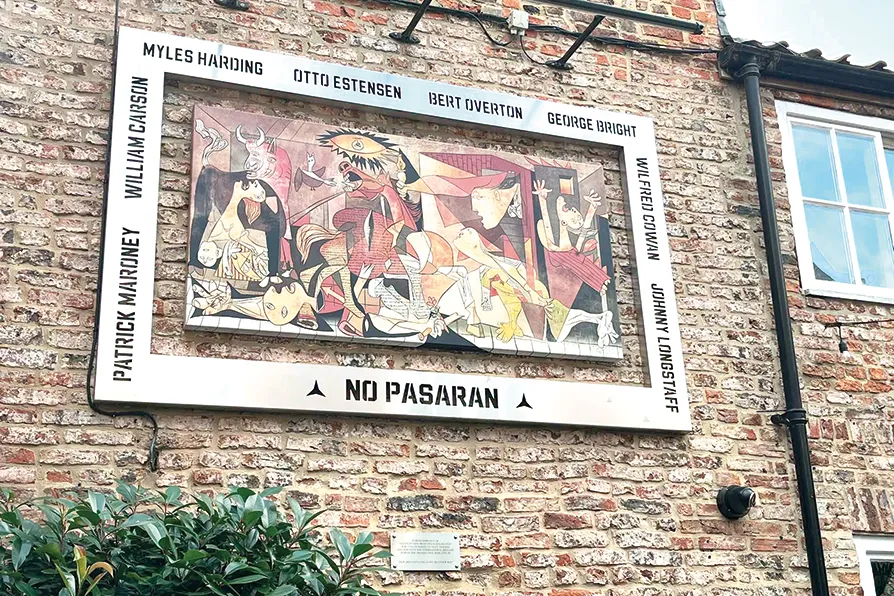
As the 90th anniversary of the outbreak of the Spanish civil war is marked, Teesside campaigners will gather to remember the local men and women who stood against fascism, explains TONY FOX


 Latest editorial

Fascists must not be allowed space to play their patriot games
Trade unions need to step up and force a turn in the policies of the labour movement to effectively confront the far-right threat, argues NICK WRIGHT
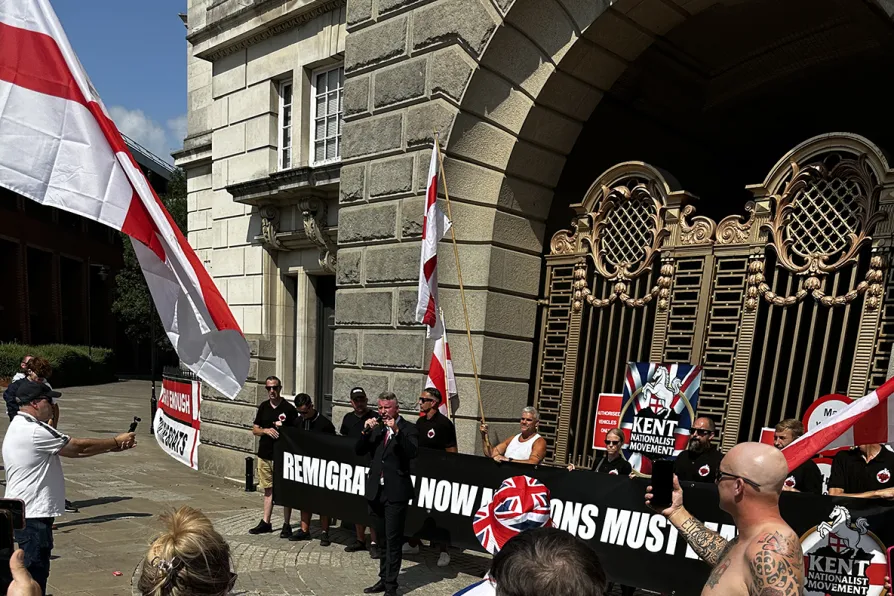 Far-right agitator Paul Golding of Britain First speaks at a Kent Patriotic Movement rally in Maidstone [Picture: Author supplied]
Whatever differences exist among international sympathisers of the Bolivarian revolution about its current trajectory, they should unite against the imperialist power that is the source of an enforced retreat, argues ROGER D HARRIS
Washington’s inability to subjugate Iran is an example of how it is trying to preserve a regional order that no longer exists, argues RAMZY BAROUD
US financial instability is exposing the limits of a dollar-dominated global economy — and giving the Global South a historic chance to build an alternative, says MURAD QURESHI
Deprivation is a fundamental factor in criminal behaviour that must be addressed but, KENNY MacASKILL argues, there needs to a major rethink in sentencing to tackle overcrowding





A COUPLE of weekends ago, the Kent Patriotic Movement appeared on the streets of Maidstone, the county seat, where Reform UK is barely hanging on to its majority in the face of depredations that have seen several of its councillors defect to parties even more deluded, one to jail and others to obscurity.
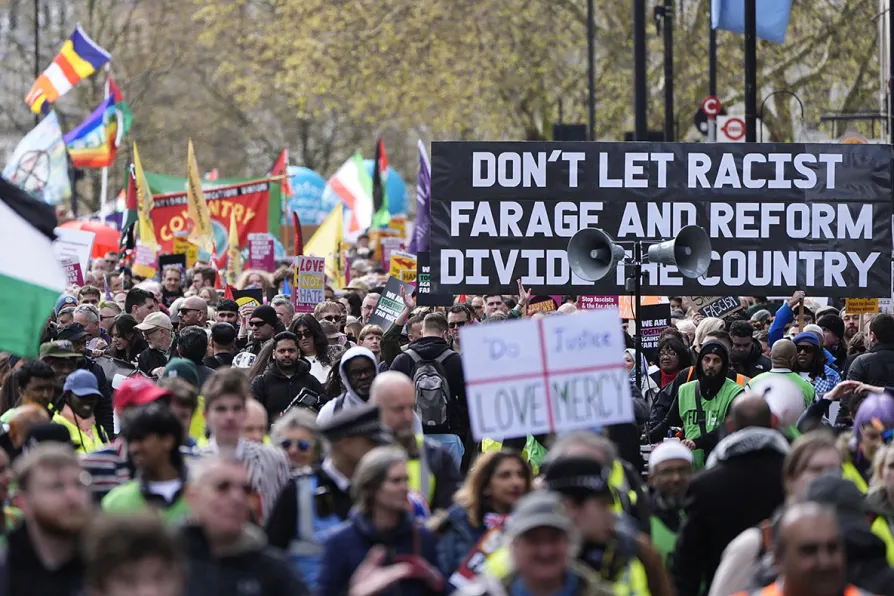
The anti-racist movement in Kent mobilised to easily outnumber the fascist fringe, who were confined to the county hall precincts until being allowed to perambulate round the ring road, while anti-racists claimed the main shopping street with a joyful march.
The day’s events were exceptionally well policed. The officers I spoke to were clearly well briefed and alert both to the possibility of clashes and the political significance of what the speakers were promoting.
These included the demand for the enforced expulsion of migrant communities. The key speaker at the rally — and the one most in command of the English language and the code words used by the far right — was Paul Golding (pictured at Maidstone), the leader of Britain First, whose many convictions include one for wearing a political uniform.
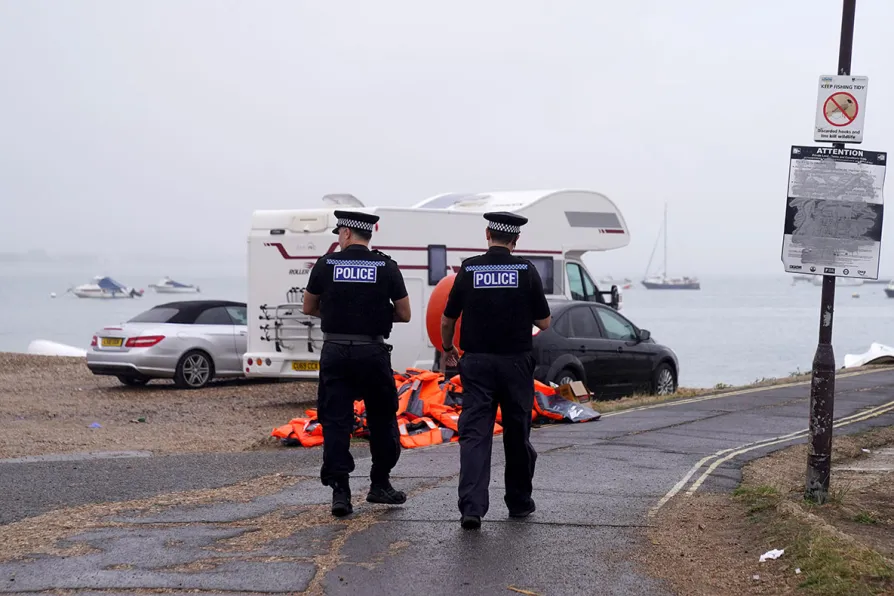
This small success was followed by last week’s “fascist flash mob” takeover of Dover port by hundreds of masked men dressed identically in black clothing and balaclavas. This clear act of intimidation was ostensibly organised by Patriot Platform, which is the window dressing for a network of far-right and openly fascist outfits in southern England.
The leading light in this effort is one Daniel Thomas, aka Danny Tommo, and it is entirely possible, even likely, that this too will degenerate again into a sordid squabble about revenue streams, position and profits. Already the grandiosely named and Kent-based Patriots UK has left the Thomas brand.
Clearly someone in this lot — perhaps the collective noun might just be “a squabble” of fascists — has mastered the design tools available with artificial intelligence, because each of these groups is badged with the cloned iconography of the Anglo-American far right, infused with symbolic representations of St George and the Risen Christ, etc.
This late adoption of an ostentatiously Christian identity is less a sudden revelation of divine truth and more a bid to access the cash of transatlantic fundamentalist multimillionaires.
While these efforts by the more media-savvy among the wannabe Fuhrers to monetise the far-right franchise results in a constant battle for attention, the appearance of a fascist phalanx on our streets is a new departure.
It is an offence to wear a uniform in a public place or at a public meeting that signifies association with a political organisation or the promotion of a political objective.
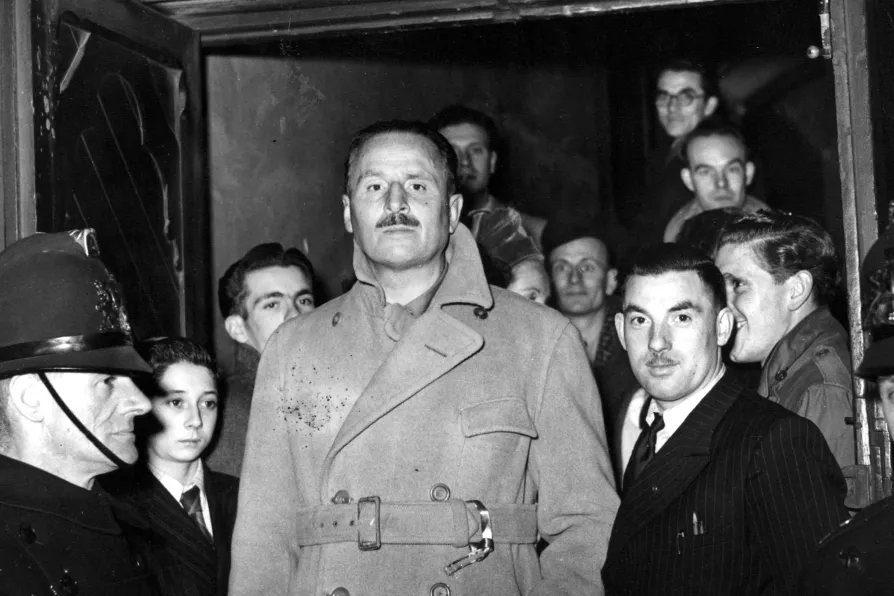
The Public Order Act 1936 was introduced ostensibly to deal with Oswald Mosley’s British Union of Fascists, with the additional aim of ensuring the state’s monopoly of coercion.
Today’s Public Order Act 1986 bans organising, training or equipping an “association of persons … for the purpose of enabling them to be employed in usurping the functions of the police or of the armed forces of the crown,” or “for the use or display of physical force in promoting any political object.”
This rather raises the question of what the Kent police thought they were doing when they reported that no arrests were made during the fascist parade at the port of Dover.
It seems highly unlikely that the Kent police were caught unprepared. The far right in Britain is highly invigilated, both by the state and by the anti-fascist movement.
The social media and communications entailed in the mobilisation of such a large group — from a wide range of formal and informal networks — were undoubtedly captured by routine surveillance, while the state’s extensive network of informers within the far right ensures that the authorities are always well briefed.
Either Kent police were negligent or they were complicit and should be made accountable for their failure to act.
It is here that things become darkly comic. Beyond the elaborate fiction of “police operational independence,” the police are accountable to the Home Secretary Shabana Mahmood.
She, of course, is the government figure in both Keir Starmer’s and Andy Burnham’s Cabinets who has been most associated with the reactionary narrative around migration. This posits small-boat arrivals as the defining feature of Britain’s immigration system. In fact, it comprises a tiny minority of arrivals, most of whom come here to study or at the specific request of employers and enter on visas issued by the government.
Role of the state
Concealing this truth is the shared objective of both government and the far-right chancers who make political capital from the confusion.
But beyond this there is the question of the state’s role in managing street politics, protest and the steady accumulation of threats to the political order.
The Dover incident revealed one aspect of the far right’s capacity to organise. Before parading in Dover port, the fascists assembled at dawn in a nearby village and so alarmed the residents that many reported the sudden presence of the interlopers to the police.
The Portsmouth incident, where a masked contingent joined a late-night anti-migrant protest, is evidence that these people also have a capacity to mobilise at short notice.
For three years now, we have seen summer-time provocations by the far right which reveal a substantial measure of national co-ordination. The “hotels” protests, the “flagging” campaign and this latest shift to an openly intimidatory presence on the streets, is evidence of strategic planning that offers a new dimension to the far right’s operations.
Reform UK’s response to this new challenge to its brand was to send one Zia Yusuf to Portsmouth to meet Daniel “Tommo” Thomas, who had criticised Nigel Farage for his statement that the Dover stunt was “disgusting.”
Farage is caught up in a mass of contradictory pressures. At some level in the Establishment nexus, there is an impulse to limit his appeal. His treatment by the media, especially the Murdoch media, is less tolerant and less extensive. The pressure from the parliamentary standards committee is driving exposure of his shady financial dealings. The wholesale entry into his enterprise of most of Boris Johnson’s Cabinet has added to the sense that Reform UK is an unlikely vehicle to meet the wider aspirations of the working-class element in his electoral base.
Meanwhile, the increasingly Tory flavours of Reform UK’s economic policies are a counterweight among workers of such appeal as his immigration policies exert. This is reflected in Reform UK’s diminishing polling figures.
At the surface level, Farage is compelled to distance his party — and himself as its brand leader — from the threatening behaviour of the uniformed “squadristi” on the streets. But he still needs to claim ownership of the rather wider appeal of the “stop the boats” rhetoric.
Another pressure exerted on his command of the anti-migrant movement comes in the form of Rupert Lowe’s schismatic and more thoroughly fascist-inflected Restore Britain.
While Farage is compelled by the continuity of his economic programme with Tory policies to admit to the necessity of some immigration, Restore Britain is content to run with the openly fascist call for “remigration” — the forced removal of millions of families now firmly embedded in British society, as well as the more temporary migrants who come here on short-term work contracts or to study.
This is the slogan that distinguishes the emergent street army of fascism.
To hold on to his franchise, Farage needs to channel the full spectrum of the far right’s anti-migrant impetus into supporting his electoral strategy.
“The only way we’re going to solve this is at the ballot box,” he said in response to the Portsmouth events, “and the only political party that’s offering a solution is Reform UK.”
These are new challenges to the cosy conformity of Britain’s neoliberal economic and political system. Unless a clear alternative emerges to this highly variegated drive to the right, the working class will find it very difficult to act in its own class interests.
The direction the Burnham government takes will be decisive. If it adopts a programme that more directly tackles the cost-of-living crisis and whole range of problems in housing, health, education and employment that working people experience, the appeal of the populist right can be resisted.
If continues along the path of austerity and war preparations the lessons of history are clear.
When the working-class movement offers a real alternative to the deadly combination of an unchallenged ruling-class hegemony buttressed by a far-right street army, it can again become the motor of history.
The first steps in this can be taken if Britain’s unions — soon to meet at the TUC conference — find the unity and organisational heft both to put pressure on the Burnham administration and take the lead in the streets, communities and workplaces.

Similar stories