ROB WARZYNIAK wades knee deep through a pile of ‘dead canaries’ of Trumpist policies which exacerbated the horrors of US capitalism domestically


 Latest editorial

Heeding the clarion call to defend Spanish democracy
Les Preger was one of Manchester’s first volunteers to volunteer in support of republican Spain, writes his daughter JANEY PREGER
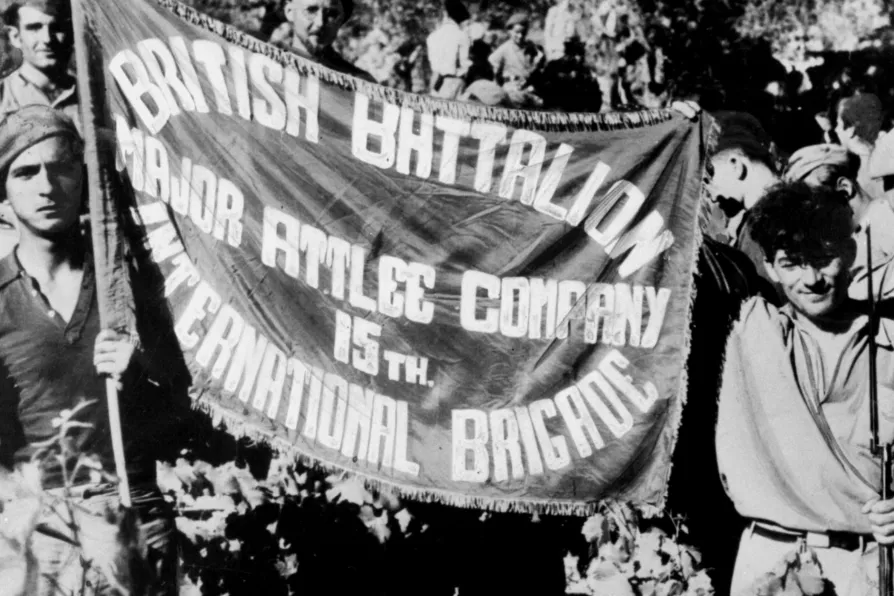 Members of the British Battalion, Major Attlee Company, 15th International Brigade, displaying their banner during a lull in the fighting during the Spanish Civil War
Without evidence or Nato consultations Berlin’s answer to the Leipzig incident is a rupture of relations. SEVIM DAGDELEN examines why
FRANCISCO DOMINGUEZ introduces the background to a conference on defending Latin America’s sovereignty
The glacier collapse in Nepal is yet another warning that a warming planet is making Himalayan disasters more frequent and destructive – but the countries facing the greatest risks are often those least responsible, says LI YANG
Nick Blair is set to benefit from a hugely lucrative contract to ‘virtually’ train the British army for its next war. Like father, like son, writes SOLOMON HUGHES
Even when tragedy strikes, Western media cannot resist the opportunity to turn it into a sordid propaganda opportunity, as the Nepal-China border tragedy shows, writes CARLOS MARTINEZ
Trade unions should be at the heart of the anti-racist push for reparations for the historic legacy and continuing impact of slavery, writes ROGER McKENZIE





MY father, Les Preger, has now been dead for longer than he had been alive when he signed up for the International Brigade in 1936, and went to fight the fascist leader Francisco Franco in the Spanish civil war, alongside socialists, anarchists and separatists.
He was just 24, an idealist and a communist. Despite the city’s long tradition of social justice, he was the first person from Manchester to commit to the cause.
Towards the end of his life, he spoke about those experiences.
“I was so excited,” he recalled. “I was an ardent communist in those days. I spent hours in the Clarion Cafe in Manchester with my left-wing friends discussing politics, books and girls. The Clarion was meant to be a cycling club — but balls to that!” he added. “I didn’t want to be biking about the Cheshire lanes with a thermos of tea. I wanted to be where the action was.”
Joining up wasn’t straightforward, Les recalled.
“I had to have an interview with a panel of doctors in London because I wanted to go with the medical unit,” he said. “I could drive, and I’d been offered a place at medical school, plus I knew a bit of first aid. Bizarrely, they seemed to like the fact I was middle class.”
Once admitted: “They sent us to Alkits in Cambridge Circus, but we were given gas masks as well, which brought us up short. Reality hit. We were going to war.”
Despite that wake-up call, arriving in Barcelona was, he said, “Bloody marvellous. People were so joyful to see us. Shots were fired in the air. People stopped in the middle of the Ramblas and sang The Internationale. We were given flowers. It was all very — this is a strange word to use — cheerful.”
In July, the city had become a socialist hub, with collectivists taking over buildings and businesses.
“I was so fired up, thinking: ‘Let me get to the front. Let me help. Let me get killed for these wonderful people!’ he said. “There were even a few men in immaculate suits, but without ties. To show they supported the workers, the middle classes took their ties off.”
After a night in the city, his group set off towards the front.
“There were 18 of us in the medical column and just six vehicles, including my friend Archie Cochran’s old Triumph Roadster, which was stolen by anarchists,” Les remembered. “We were sent to a village on the Aragon front called Granen and given a farmhouse which had been used as a hospital by the fascists.”
He referred to its state as “indescribable” but later explained: “Instead of burying the old bandages or the bits of arms and legs and piles of excrement, they had chucked it all into this square. The first thing we had to do was spend a week getting all this foul stuff into a handcart and, in the blazing heat, push it through the village until we found some deep undergrowth and empty it there.” He added: “I said to my mate, Sam. ‘Look at us. War heroes. Shovelling shit for democracy’!”
Following this, the men were tasked with turning the building into a makeshift hospital for the wounded coming from the front.
“I had to go round before each operation with a fly-gun to try to get rid of the flies. About 80 per cent of the lads with serious wounds died on the table.”
When that happened, he went on, sombre: “The soldiers had to be put in the cellar until dark. Seeing the dead affected morale, so we had to get them out then. Sometimes, there were up to 15 bodies stacked in there.”
Every day, four men from the first aid unit went out to the nearest front line.
“There was sporadic firing and battles. We gave first aid and brought them in when we could. We were an ambulance unit, but fighting was expected of us,” Les went on. “I was given a rifle printed with ‘Montevideo 1890.’ A superb weapon of war!” he laughed.
Women had also joined the fighting, but despite best intentions, he admitted: “It was not a success. It might be an atavistic thing [for men] but the basic feeling of wanting to protect women from danger was there. There were the problems of being in close proximity, too — sexual attraction was a big thing. We were all starved of affection.”
Although it failed, he recalled: “There were some wonderful nurses. When we had an afternoon off, we heard that there was music, and socialising in a nearby meadow, so off we went. Someone had a gramophone and they played It Happened In Monterey — a very sentimental tune. I was dancing with a nurse and I thought, ‘What a funny way to go to war.’ I was very popular that day because my sisters back home went round all the family asking them to buy cigarettes to send to me at the front. I handed a lot round!”
In 1937, Les briefly met the poet WH Auden, who had travelled to Spain.
“He was around but it seemed he was writing poetry about what he observed rather than getting engaged in the conflict,” he said. “That was the impression I and the other lads got. Then he went to America and got American citizenship… Great poet though.”
What did he learn as a young man in his twenties, living through such trauma?
When questioned, he paused: “The first casualty of war is truth. But, more importantly, I remember that when I first went out there, I took The Albatross Book of Living Verse and some packets of Earl Grey tea. But. when I went back again after my first leave, I took thick socks and some packets of Durex.”

Similar stories
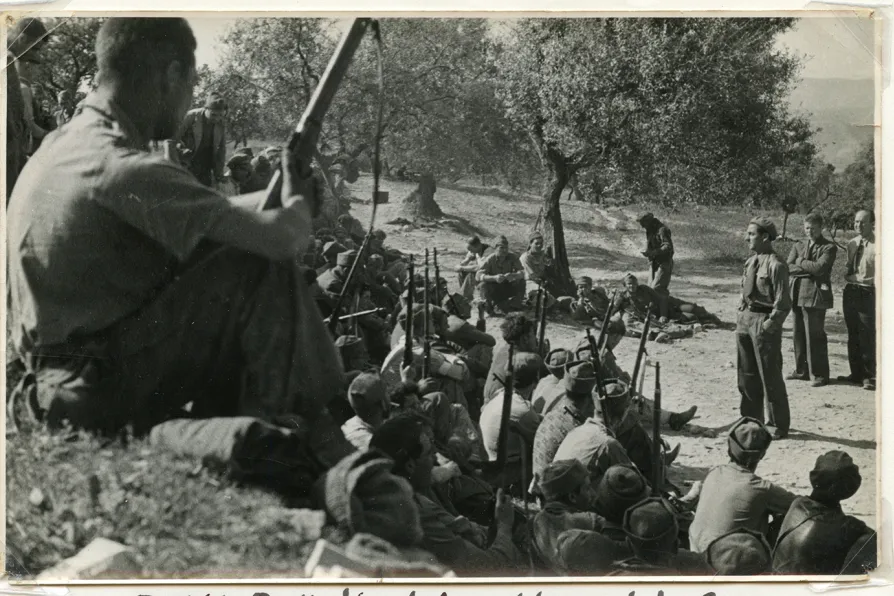
Thousands of remarkable Britons left ordinary lives behind to join the struggle against Franco. Here is a snapshot of those who answered the call
![Harry Pollitt (right) with International Brigade volunteer David Guest, who was killed at the Ebro in July 1938 [Pic: Marx Memorial Library]](https://msd11.gn.apc.org/sites/default/files/styles/desktop/public/2026-07/a-2_a_50b_Harry%20Pollitt_David_Guest.jpg.webp?itok=Ag0u-8n5)
ALEX GORDON applauds the leading role played by Harry Pollitt and the Communist Party in the fight against fascism in Spain and salutes the memory of the International Brigades
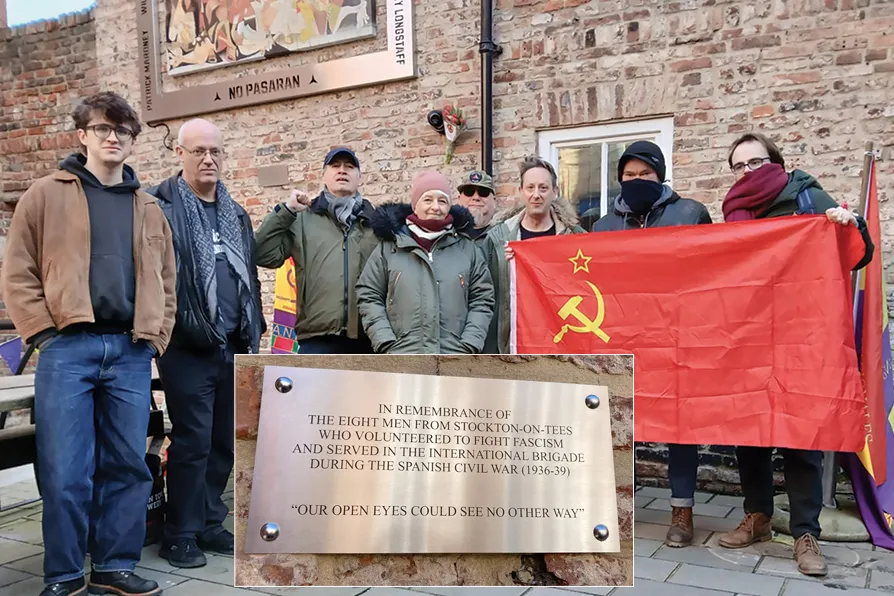
TONY FOX reports from a commemoration of the legendary Battle of Jarama in which four Stockton-on-Tees volunteers fell
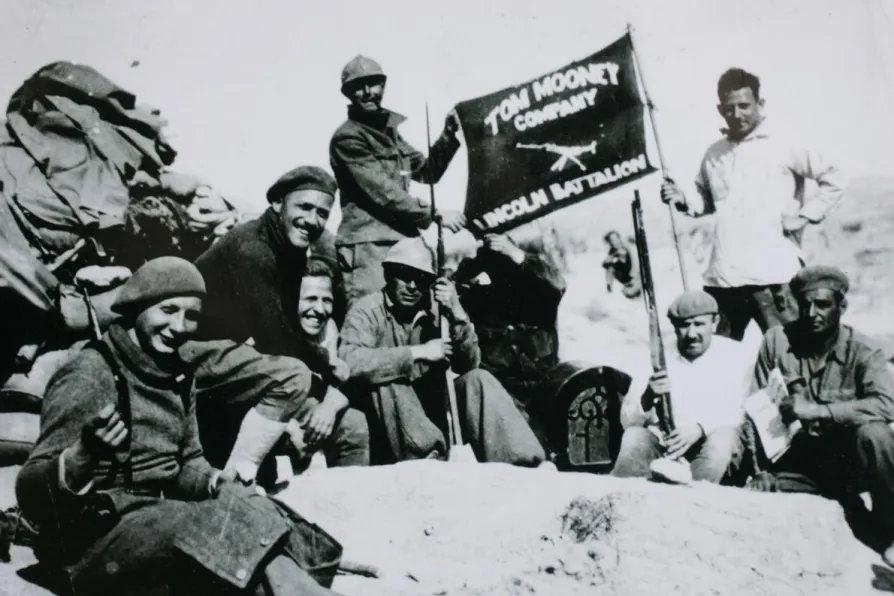
CJ ATKINS commemorates one of the most dramatic moments in working-class history