Trade unions need to step up and force a turn in the policies of the labour movement to effectively confront the far-right threat, argues NICK WRIGHT


 Latest editorial

Is Mecca Pact a counterweight to Israel, or simply a Muslim Nato?
There are many intricate details about the new Saudi, Turkish and Pakistani alliance we do not yet know, suggests ROGER McKENZIE, but its impact could be considerable
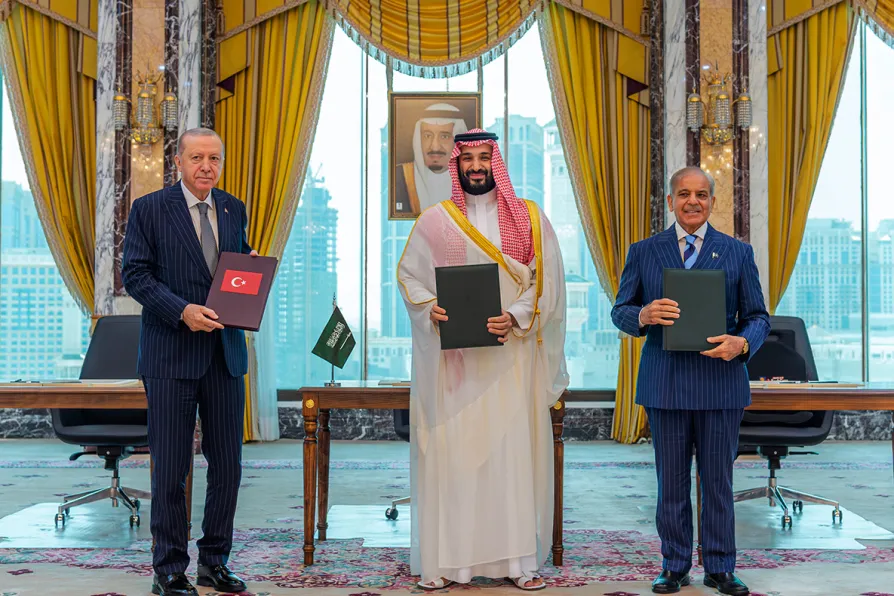 From left, Turkish President Recep Tayyip Erdogan, Saudi Crown Prince Mohammed bin Salman and Pakistani Prime Minister Shehbaz Sharif pose after signing a trilateral defense agreement in Mecca, Saudi Arabia, Aug. 7, 2026. (Saudi Press Agency via AP)
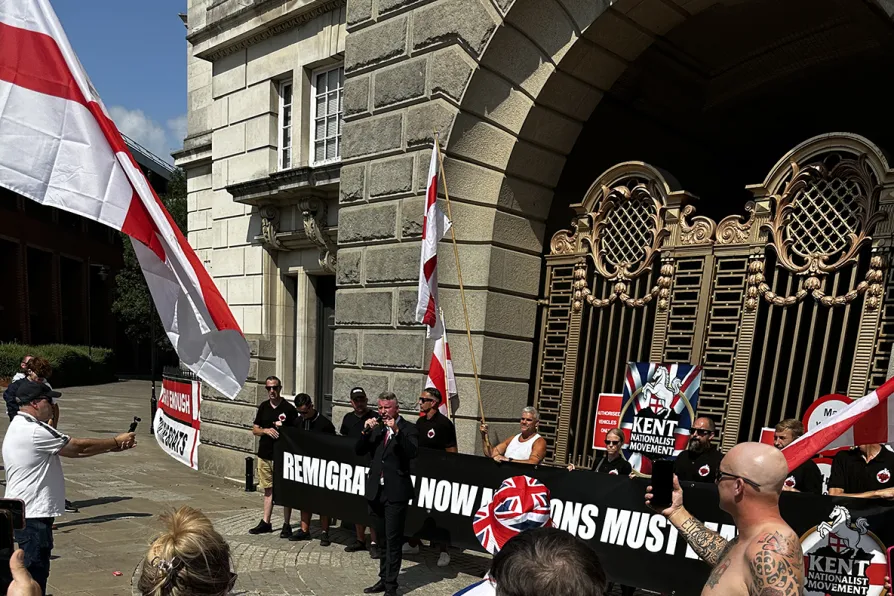
As the 90th anniversary of the outbreak of the Spanish civil war is marked, Teesside campaigners will gather to remember the local men and women who stood against fascism, explains TONY FOX
Whatever differences exist among international sympathisers of the Bolivarian revolution about its current trajectory, they should unite against the imperialist power that is the source of an enforced retreat, argues ROGER D HARRIS
Washington’s inability to subjugate Iran is an example of how it is trying to preserve a regional order that no longer exists, argues RAMZY BAROUD
US financial instability is exposing the limits of a dollar-dominated global economy — and giving the Global South a historic chance to build an alternative, says MURAD QURESHI
Deprivation is a fundamental factor in criminal behaviour that must be addressed but, KENNY MacASKILL argues, there needs to a major rethink in sentencing to tackle overcrowding





WE SHOULD view the new military pact between Saudi Arabia, Turkey and Pakistan as a reaction to the increasingly unstable times in which we live.
As a great part of the cause of these unstable times is down to the actions of the United States, we should also see it as a reaction to that.
The US’s destabilising role goes back decades. Nonetheless there is no doubt that the increasingly erratic and unstable US presidency of Donald Trump has hastened the need for countries in the region to distance themselves from the form of rule that they have been subject to since World War II.
Much of this US mis(rule) has been carried out through the vehicle of the Nato military alliance, backed by the dominance of the dollar and petro-dollar.
So, it is tempting to see the establishment of the “Mecca Pact” as just another Nato-type alliance because it has a clause in the pact that is similar to the infamous Article 5 of mutual defence (attack) in the event of an attack against any one of its members.
But we shouldn’t see it as anything more than a pact between three countries that are highly unlikely to do anything to enforce the Nato-like clause of mutual defence (attack) in the event of an attack against any of them.
The Mecca Pact is, in fact, a deepening of a military deal that was already in place between Pakistan and the Saudis.
They have added Turkey to the deal. There are rumours that Egypt may also join the pact and there are plenty of indications that the arrangement is open to other countries to join.
Each of the existing members of the pact has for many years been viewed as client states of the US. So the fact that they have taken this step could be viewed as either US-backed or US-inspired or, alternatively, as a reaction against it.
There is no possibility that the US was unaware of the deal in advance. It is debatable, though, what it could have done to stop it from going ahead.
President Trump took to social media to claim that he welcomes the deal as it means countries in the region are coming together to defend themselves. While an absolutely farcical response by Trump, the only surprise is that he didn’t actually take credit for the deal.
The truth is more likely that the US was largely powerless to do anything about it.
The countries involved are far too important strategically. It is more important to stay on reasonable terms with the authoritarian regimes ruling the pact members. One of these is Turkey, a Nato member with its second-largest army. Saudi Arabia is critical to oil production at a time when US reserves are at a 40-year low. Pakistan is a geographically important nuclear power that helps to temper the power of India in the region.
The reaction of India to this deal has been muted. They fully understand that there is zero likelihood that any of the partners would ever involve themselves in any potential military conflict between India and Pakistan.
It is highly unlikely that the members of the pact would take up arms in the event of an attack from outside its numbers.
After all, the Houthi-led Yemeni forces have continued to attack Saudi targets without any of the others coming to the aid of Riyadh.
There is a great deal of speculation that the pact came about because of the attacks by Iran against US assets across the region, including in Saudi Arabia.
Outside of the illegal and unprovoked attack by the US and Israel on Iran, Tehran has no motivation to attack any of these three nations. It has indicated that it does not feel threatened by the new pact.
In any case, the retaliation by Iran was largely against US sites and actually raises questions about whether these targets were seen as sovereign US territories within the borders of these client states.
The issue of sovereignty aside, the Saudis, in particular, see themselves as being expected to take the brunt of any retaliation by Iran if the US reopens the conflict with Iran.
Saudi Crown Prince Mohammad bin Salman has, according to sources, called President Trump on at least two occasions and told him bluntly that the Saudis refuse to be attacked on behalf of the US and have even refused to allow the US to use its bases or air space for any further attacks on Iran.
The US military umbrella has failed to protect the Saudis from Iranian fire.
Leaving aside whether they would or could actually provide that protection, it is nevertheless an important moment in the relations between the two countries.
All of this is taking place on the doorstep of China. Beijing was almost certainly aware of the deal in the making.
China has been playing a leading role in pressing Pakistan, one of its key allies in the region, to breathe life back into the Memorandum of Understanding agreed between Iran and the US.
The priority principle of the Chinese is never to interfere in the internal affairs of another country. But they do want a stable environment to underpin regional relations, including trade.
There is also speculation that the deal is aimed at Israel.
Far-right Israeli politicians have long argued for an expansionism known as Greater Israel which largely encompasses all or part of Egypt, Iraq, Jordan, Lebanon, Saudi Arabia and Syria.
The pact must be considered as an important counterweight to Israel and a significant setback to the strategy of attempting to sign up nations in the region to Trump’s Abraham Accords, which, in itself, was a step toward achieving the Greater Israel so yearned for on the far right of Israeli politics.
Israel will, I believe, attempt to undermine the pact and may even resort to false-flag attacks to test the limits of the military alliance.
In fact, if Israel succeeds in any false-flag operations, it would bring the most powerful, predominantly Muslim states into direct conflict with each other – something which is exactly in Israel’s interests.
The Mecca deal seriously alters the security architecture as well as reshaping the already unstable environment in the region.
But it is a pact with zero concrete obligations and deliberately vague language.
There are no existing mechanisms for any joint military co-operation between the members of the pact. There are also too many conflicting strategic interests to make this a concrete deal that would create genuine deterrence in the region.
For example, Turkey is still a Nato member, the Saudis still rely, even with recent events, on US security and on cheap labour from India. Pakistan has an important trading and strategic partnership with China. which they will not disturb.
The geographical distance between the countries also make effective mutual military action unlikely.
For all the difficulties that arise with the Mecca Pact, the move away from US control in the region must be seen as positive and a decisive step forward toward that much-heralded new multilateral world with Eurasia at its beating heart.
Roger McKenzie is international editor of the Morning Star.

Similar stories
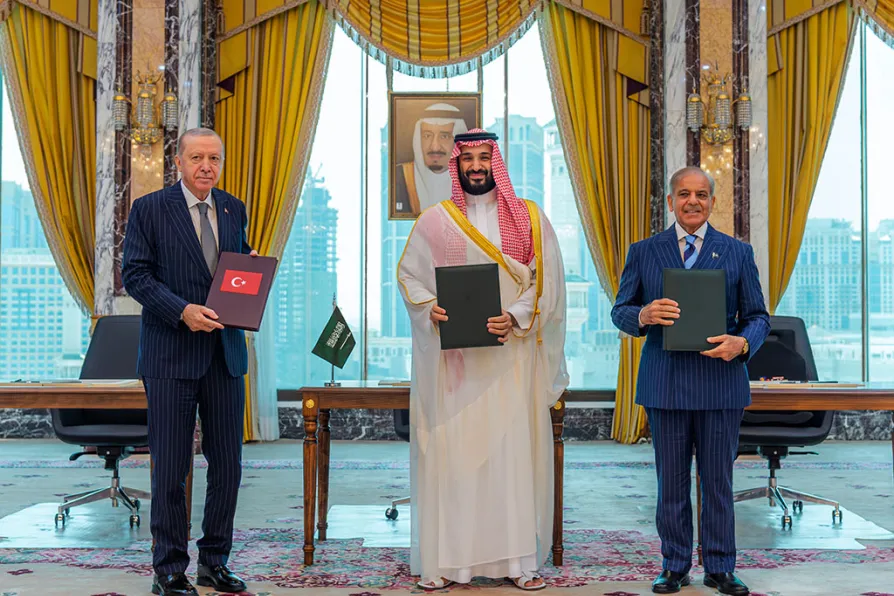
The US-Israeli conflict with Iran has had far-reaching consequences, including a boost to Pakistan’s regional standing, argues ROGER McKENZIE