Cuban trade union federation CTC leader OSNAY MIGUEL COLINA speaks to Ben Chacko about life and work under a crippling US siege


 Latest editorial
A missed opportunity: solidarity and the demand for peace in Haiti
The UN blames gangs for Haiti’s turmoil, while ignoring decades of foreign intervention and support for an unelected government that lie at the heart of the country’s continuing crisis, says RUBEN BRETT
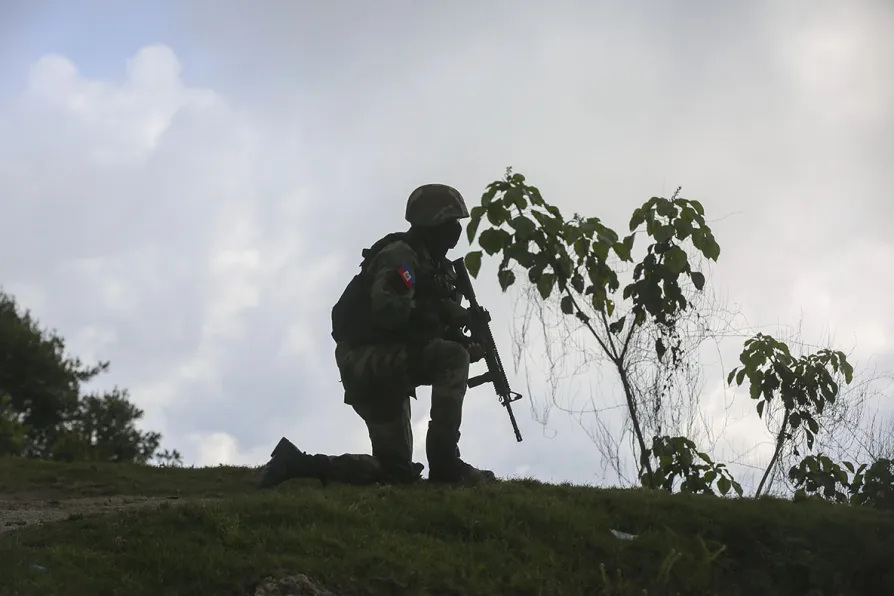 A soldier carries out an anti-gang operation in the Kenscoff neighborhood of Port-au-Prince, Haiti, February 3, 2025
A part of the British empire’s network of slavery, today the Caribbean island of Nevis faces a new form of exploitation in the form of crypto-colonialism, CLAUDIA WEBBE writes
A new book by Victoria Holmes illuminates the many hidden histories of the oppression experienced by Gypsy/Roma/Traveller community, writes ROGER McKENZIE
Even the oligarchs of the artificial intelligence industries are warning that their creations have the capacity for the ultimate destruction of the planet and its population. ANDREW MURRAY suggests that there might just be other solutions
The Labour government must deliver on its commitment to bring back privatised services into the public sector. This not only saves money but also creates accountability and generates wider social benefits, argues ANDY MCDONALD MP
Public ownership of Great British Railways has enormous potential to improve our railway network, but that can’t happen unless jobs, employee rights and union recognition is at the heart of the transition, argues MARYAM ESLAMDOUST
Challenges from the unscrupulous misuse of AI to steal actors’ voice and physical likenesses is being met with a firm union response, writes LYNDA ROOKE





UNITED NATIONS secretary-general Antonio Guterres visited Haiti on June 16, “in solidarity with the Haitian people,” according to a press release.
There he sympathised with victims of violence, inspected military facilities used by the multinational Gang Suppression Force and met with Alix Didier Fils-Aime — Haiti’s latest unelected and unconstitutional prime minister, regarded as a puppet of the United States.
Haiti’s plight gives a stark reminder of the stakes for nearby Cuba in its struggle to maintain national sovereignty. Guterres has rightly warned of humanitarian “collapse” if the US siege of Cuba continues, but he fails to recognise that interventions under the auspices of the UN since 1994 — the latest phase in two centuries of neocolonial domination over Latin America’s first free nation — have kept Haiti in just such a state of collapse.
Haitian sovereignty is non-existent. The country has gone more than a decade with no elections while a series of puppet leaders have been imposed on its people.
There is no parliament and even the transitional council, established under a Caricom plan following the overthrow of Ariel Henry in April 2024, has now been dissolved after its members attempted to remove Fils-Aime from office in January 2026.
The council constituted a collective interim leadership of Haiti’s elite factions, over which the United States held significant sway especially since a palace coup replaced French-backed Garry Conille with Fils-Aime in November 2024. With its dissolution, sole executive and legislative power now lies with Fils-Aime, Trump’s man in Port-au-Prince, often described as a “second Ariel Henry.”
“I have seen a crisis on an extraordinary scale,” Guterres says, without questioning who caused the crisis or what maintains it. He continues to place the blame on “gangs” who “terrorise the country,” while praising Haiti’s dictatorial government for the “encouraging results” of its “co-ordinated actions” — in other words the massacres assisted by notorious US private military contractor Erik Prince, whose victims are mainly impoverished civilians.
In fact, investigation by Human Rights Watch failed to identify a single gang member among the 1,243 Haitians killed by Prince’s company Vectus Global in drone strikes between March 1 2025 and January 21 2026 — of whom at least 17 were children. The UN’s own reporting attributes the overwhelming majority (69 per cent) of 2,310 killings and 1,100 injuries between January and May 2026 to government operations.
Guterres’s visit was a missed opportunity to confront grave violations of human and democratic rights by an unelected government which labels journalists as terrorists, responds to protest and industrial action with lethal force, and enacts collective punishment on its poorest citizens.
Despite a ceasefire between major armed groups for the World Cup, brokered by Jimmy Cherizier’s Viv Ansanm alliance, the start of June saw an acceleration of government drone strikes killing men, women and children in central Port-au-Prince. Beyond mass slaughter of civilians, government actions have not only yielded no “encouraging results” but have met with embarrassing failures.
On June 3, Viv Ansanm fighters burned an armoured bulldozer belonging to the police. A police statement the same day claimed the vehicle had been destroyed under protocol “to prevent strategic material falling into the hands of terrorist gangs” but video was already circulating of frantic police officers trying to extinguish the blaze. Helicopters belonging to Vectus Global have also been shot down and destroyed by Viv Ansanm.
Guterres observes that Haitian families are “uprooted and forced to flee” while children are “deprived of protection, schooling and a future.” All true. Responding to Guterres, Isabelle Papillon of independent investigative outlet Haiti Liberte is clear: “This reality is the undeniable product of the capitalist system.”
In an interview last year, Professor Jemima Pierre described the demonisation of Cherizier — once the only Haitian sanctioned by the UN — as “a boogeyman that is being used … to maybe give Erik Prince some kind of leverage” in acquiring lucrative contracts with the Haitian government.
Prince, notorious for war crimes in Iraq as then-CEO of Blackwater, has declared: “It’s time for us to just put the imperial hat back on” since in his view “Haiti cannot run itself.” Pierre notes that the US is responsible for “importing guns, supporting the oligarchy, and also enabling more violence in the country” in a destructive but highly profitable cycle, a familiar pattern for other Caribbean states like Jamaica.
Cherizier, whose forces reportedly control 90 per cent of the capital city, has continued to call on the government to open peace talks: “The only thing that can extract Haiti from the hole it is in right now is dialogue. Let us talk to each other and explain what we need.”
A political solution to the crisis, with all Haitian sectors included in dialogue, is exactly what Guterres should be throwing the weight of his position behind. Polling shows that most Haitians would support a peace process. In January, thousands marched in the capital’s Delmas neighbourhood for “peace, dialogue and national reconciliation.” Instead of backing these popular demands, Guterres’s visit served to legitimise a US-backed dictator who is murdering Haitians in the thousands while enriching foreign mercenaries.
If Guterres struggles to grasp the problem, he should listen to Pope Leo XIV’s new envoy, Archbishop Okolo: “Haiti’s reconstruction can come only from Haitians themselves.”
Imperialism is at the heart of the crisis — the solution must be political and it must be Haitian.
Ruben Brett is a central council member of Liberation, formerly the Movement for Colonial Freedom.
