

 Latest editorial

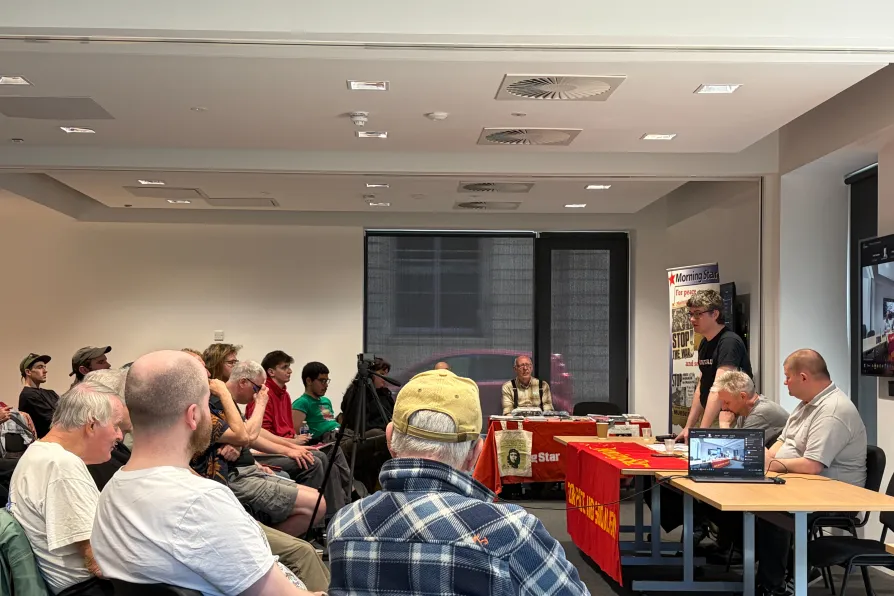 The Summer Morning Star Scottish conference in Glasgow





DOZENS of comrades packed the STUC buildings in Glasgow’s east end today for the biannual Morning Star Scottish conference.
The focus of the summer conference was on “looking beyond Holyrood” in the wake of an underwhelming election campaign.
Opening proceedings, socialist former MSP Mercedes Villalba issued a call to action: “Our movement must be everywhere our class is, to drive out capitalist ideology and replace it with common sense labour empowerment.
“This work must continue until no-one is hungry, no-one is homeless, and no-one is dying from work.
“For too long we have relied on the popularity of tall poppies. No more. Our cause is to plant the seeds of spring not just this year or next year but every year until the season’s end.”
In its first session, conference heard from the Red Paper Collective’s Vince Mills and CND Scotland’s Samuel Rafanell-William on building an alternative to Prime Minister Keir Starmer’s war economy, outlining both the scale of investment diverted into weaponry and the fallacy of it being a driver for economic growth.
Just a fortnight after the election, attention turned to demanding an alternative programme for government. RMT Scotland’s Gordon Martin warned of “Carmont-type rail disasters” without investment in rail. “If you don’t renew the railways, you are looking at more crashes and more deaths,” he said.
Turning to the wider economy, he told comrades: “We have an energy crisis and yet we’re throwing workers in the industry onto the scrapheap. We have no industrial strategy. China knows how to invest in infrastructure — and it’s not China kidnapping world leaders or bombing schools.”
Looking to history for inspiration in the final session, Communist Party executive committee member Mary Davis spoke of the General Strike as a “major turning point in working-class history.”
She warned: “The strike was a success but its defeat was devastating. In 1926 the government prepared, the TUC did not.”
Brian Filling, honorary consul for South Africa in Scotland, looked to more recent developments, focusing on the lessons of the struggle to topple apartheid.
He told conference: “It shouldn’t be forgotten that throughout the time of apartheid, Israel and South Africa worked hand in glove,” not least on the development of nuclear weapons.
“The parallels with Palestine are obvious, beginning with the Nakba in 1948,” he said.
