New releases by Interpol, Phoebe Bridgers, Lambchop


 Latest editorial

‘We have access to a moral voice, and the question of that moral voice is paramount’
Rita Di Santo speaks to Hungarian director LASZLO NEMES about his new film, a portrait of the French Resistance leader and hero, Jean Moulin
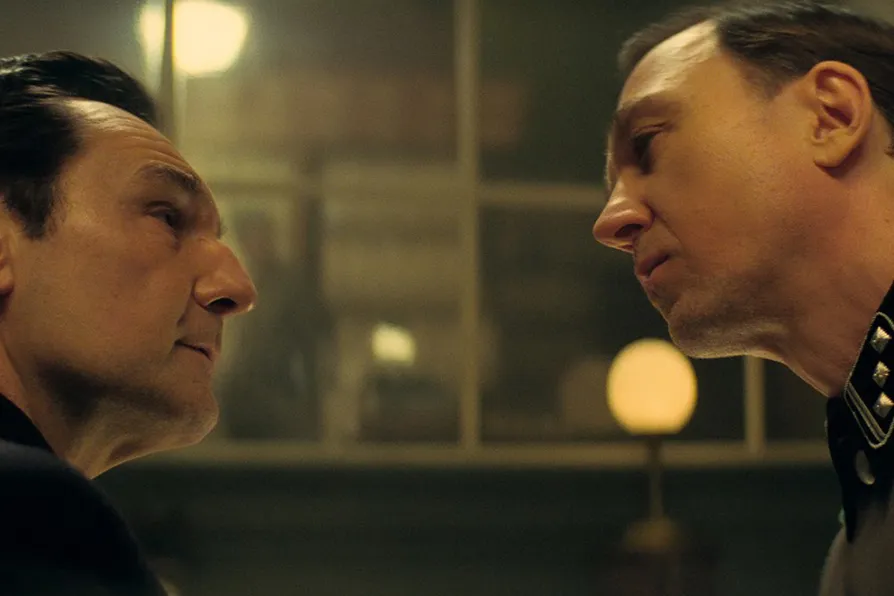 HUMAN V PSYCHOPATH: (L to R) Gilles Lellouche as Jean Moulin, and Lars Eidinger as Klaus Barbie in Moulin [Pic: Courtesy of Cannes Film Festival]
ANGUS REID urges us to understand the persecution of Jason Arday from a political and historical perspective, and to see the victim in human terms
Re-releases of the classics Gypsy Rhumba and Buena Vista Social Club, and a stunning album by Palestinian artist Faris Ishaq
Nothing, says ANDY HEDGECOCK, can rescue this undistinguished amalgam of ponderous melodrama and shallow philosophical speculation
JAMIE BRITTON invites readers to visit 3,500 locals as part of a marathon artistic pub crawl
JOHN GREEN welcomes a valuable and incisive analysis of a world become hyperpolitical but without the mass movement institutions to represent it





THE Hungarian director Laszlo Nemes returns to Cannes with a new film set during World War II. Moulin considers France under the German occupation, focusing on the final 10 days of Jean Moulin, a leader of the French resistance, as he faces Klaus Barbie, a Gestapo officer infamously known as the “Butcher of Lyon.”
At the heart of the film lies the intense confrontation between these two figures. Barbie, akin to a cat toying with a mouse, embodies a cruel psychological torment that gradually escalates into horrific physical torture. In many ways, both men represent fundamental aspects of human nature.
Nemes told me: “There’s a tendency for destruction, self-destruction, and there’s a possibility to transcend ourselves and become the best version of ourselves. These forces coexist within us.”
He was particularly drawn to the philosophical and moral dimensions of Moulin’s resistance. “He had a complete philosophy of life,” Nemes explains, emphasising that he did not want to portray a purely heroic figure. “I aimed to create a film about a human being, moving beyond the conventional tropes of heroism to explore what it was like to be swept up in the tumult of history and totalitarianism. Moulin was a true humanist.
“This narrative represents a clash of civilisations: one rooted in humanism and the other intent on destroying the good in humanity. The confrontation between these two men speaks volumes about human civilisation and its dual nature.”
While working on this film, Nemes found the outlook for his country quite bleak. However, following the defeat of Hungary’s long-time ruler, Viktor Orban, he now perceives a brighter future, describing it as “a beautiful moment,” a popular uprising.
Nonetheless, he believes that stories set during World War II remain relevant today. “The current fragility of democracy is precisely why these narratives feel pertinent. The struggle between democracy and tyranny continues to be at the forefront of our times.”
For Nemes, history moves in cycles between our worst and best impulses, and they’re never separate.
He told me he fights first and foremost for artistic freedom. “Many assume it’s all about money, but I believe the opposite is true. We live in a very conformist, money-driven society that produces something superficial. Cinema has never been so uniform and standardised; everything feels polished and predictable.
“My form of resistance is to return to a different way of making films. For me, this means not adhering to current trends or commercial pressures. Cinema is about discovering my unique voice, rather than emulating what has already been done. When you pitch a movie today to a financier, they reference ‘comps’ — comparing your work to something already made. F*ck comps; that notion genuinely frustrates me. That’s my way of resisting, and I refuse to be comped.
“We have access to a moral voice, and the question of that moral voice is paramount. For me, it’s rooted in humanism. It’s about individual freedom and expression, which the West seems to be relinquishing in favour of a crowd mentality fostered by the internet. This shift undermines individuality.
“I perceive a troubling trend towards erasing individuality, as with the obsession with plastic surgery, where individuals strive to resemble some non-human ideal. We seem to be living in a fantasy of a post-human world, which echoes the ideologies of the Third Reich. This fantasy of a post-human existence is incredibly dangerous, yet it remains largely unaddressed.”
It’s in that context that Moulin lands. Nemes refuses to turn sacrifice into myth. Moulin does choose to save the world with his life, yet the film avoids making him a saint or a symbol detached from reality. By forcing the audience into that brutal room, Nemes stages the clash between humanism and the erasure of the individuality that he warns against.
The film ends where his argument begins: stripping away distance and leaving each viewer after with one question when the credits roll: where do you stand?

Similar stories
RITA DI SANTO talks to Scottish-Irish filmmaker MARK COUSINS about his new panorama of world cinema The Story of Documentary Film
RITA DI SANTO takes us through the prize winners, and takes the temperature of a festival that prioritised narratives of exile, state violence and class division

RAMZY BAROUD looks at how Western media are being forced to kowtow to the Establishment’s war narratives