


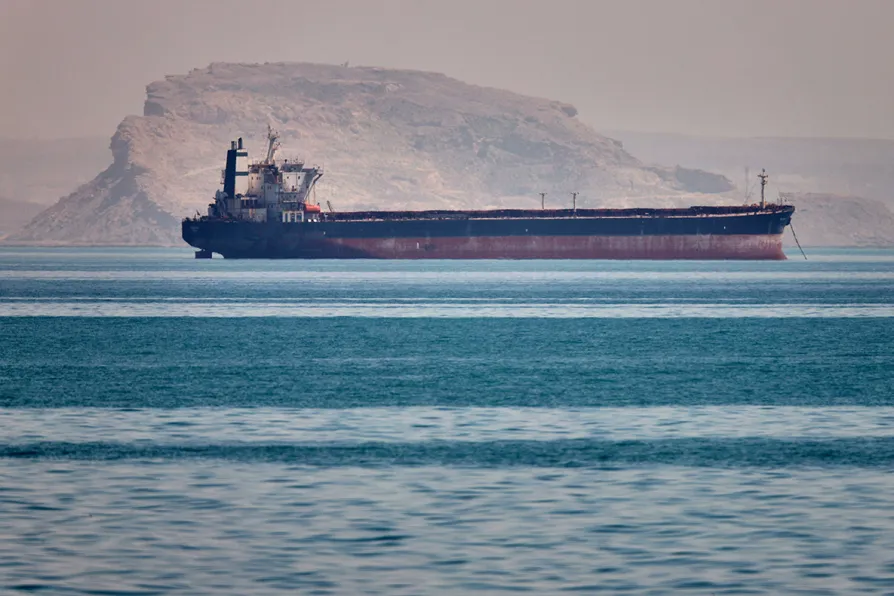
 A bulk cargo ship sits at anchor in the Strait of Hormuz off Bandar Abbas, Iran, May 2, 2026





ARAMCO, the world’s largest oil company, said on Sunday that its first-quarter profit jumped by 25 per cent as the Iran war disrupted oil supplies and raised prices.
Saudi Arabia-based Aramco said that it successfully shifted some oil exports to a pipeline to avoid the Strait of Hormuz, which has been disrupted by the war.
On Sunday, the price of Brent crude, the international standard, rose 2.58 per cent to $103.91 (£78.40) per barrel. That’s below its heights above $119 (£87.50) during the war, but way above the roughly $70 (£51.46) in late February before the United States and Israel launched their illegal and unprovoked attack on Iran.
Aramco president and chief executive Amin Nasser said that the company’s East-West Pipeline, which runs across Saudi Arabia from its Eastern oil fields to the Red Sea, is now operating at its maximum capacity of seven million barrels of oil per day.
Mr Nasser said the pipeline is “helping to mitigate the impact of a global energy shock and providing relief to customers.”
Still, that’s only a fraction of Aramco’s typical production. Aramco produced 11.1m barrels of oil per day in the fourth-quarter of 2025, for example.
Aramco reported a profit of $32.5 billion (£23.9bn) for the quarter ending March 31, up 25 per cent from the same period a year ago.
The company reported a 12 per cent decline in annual profits in 2025.
Before the war, 20 per cent of the world’s traded oil typically flowed through the strait every day, as well as large supplies of natural gas, fertiliser and other petroleum products.
Iran and the US have duelling blockades of the critical waterway.
In a statement Mr Nasser said: “Recent events have clearly demonstrated the vital contribution of oil and gas to energy security and the global economy, and are a stark reminder that reliable energy supply is critical.”
