TUC president and POA leader STEVE GILLAN speaks to Ben Chacko on the eve of Congress 2026


 Latest editorial
Making history not reliving it
Capturing the general strikes history is a vital part of our struggles today, posits HENRY FOWLER
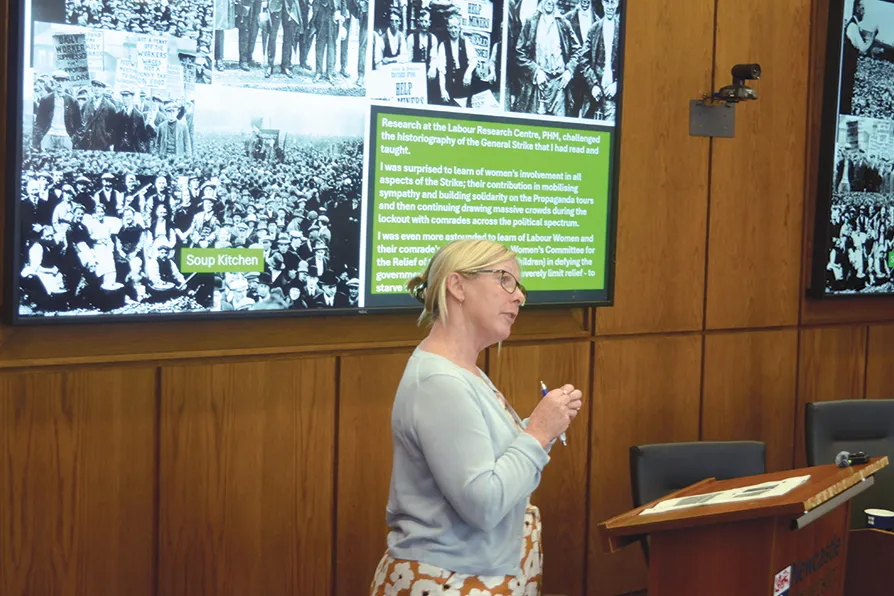 Janet Hughes (Anglia Ruskin University, Cambridge) / Pic: Henry Fowler, GFTU

DOUG NICHOLLS welcomes a turning point at this year’s Congress, where many motions call for a co-ordinated plan to revive British industry, a perspective outlined in his new book
HOPE VIRGO of campaign Dump the Scales warns MPs voting today they should be alert to the threat legalised assisted death poses to people with eating disorders
The Together Alliance is hosting two summits, North and South, to build power and plan action against the scourge of racism peddled by the right. DANIEL KEBEDE urges mass participation
The drift toward militarisation in Europe is not inevitable, left-wing and peace movements can preserve sovereignty and prevent war, says DÁIRE HUGHES MP
Whatever differences exist among international sympathisers of the Bolivarian revolution about its current trajectory, they should unite against the imperialist power that is the source of an enforced retreat, argues ROGER D HARRIS
Trade unions need to step up and force a turn in the policies of the labour movement to effectively confront the far-right threat, argues NICK WRIGHT





ON May 7, we joined a distinguished gathering of academics, activist researchers, and labour history enthusiasts at an important conference hosted by our partners, the Labour and Society Research Group at Newcastle University, exploring new directions in research on the General Strike.
The keynote address was delivered by Professor David Featherstone (University of Glasgow), who examined the transnational dimensions of the strike through the lens of radical solidarities and “coal capitalism.”
The presentation offered a compelling analysis of the anti-communist and anti-left politics that shaped sections of the trade union movement, including among some union leaders and rank-and-file activists.
A particular attention was given to the National Sailors’ and Firemen’s Union (NSFU) and its leader, Havelock Wilson, whose politics were often bound up with wider pro-empire and imperialist outlooks.
Featherstone highlighted the remarkable international solidarity shown by seafarers across the world, many of whom refused to break the strike despite the reluctance of the NSFU itself to support the action.
Counterposed to these currents of anti-communism and anti-leftism within the labour movement was the influence of revolutionary activists in developing militant working-class organisation. Featherstone reflected on the role of figures such as Donald Moore, the Barbadian merchant seaman who honed his skills as an agitator through close collaboration with William Gallacher, famed for his role in the Clyde workers’ struggles.
The conference’s first panel focused on mobility, resistance, and the disruption of capital circulation, featuring Dr Quentin Outram (University of Leeds and SSLH), Dr Joe Redmayne (Newcastle University), and Dr David Lyddon (Keele University).
Dr Outram outlined the immense scale and strategic importance of coal production to both the British economy and the wider Empire. Britain dominated global coal production, with 50.8 million tons extracted annually compared with second place, the US’s, at 18.4 million tons.
Through export bans, rationing, and government importing coal, the Conservative government of Stanley Baldwin’s prepared extensively for confrontation with the miners. Combined with the tactical advantage of the strike and subsequent lockout occurring during the warmer months, the government ultimately proved more organised than the trade union movement.
Conference organiser Dr Joe Redmayne followed with a presentation on the strategic importance of maritime networks in the north-east and beyond. He highlighted the region’s central role in the circulation of goods and capital, emphasising the authority exercised by local strike committees.
This was demonstrated in their rejection of Sir Kingsley Wood’s proposal for “dual control” as Northern civil commissioner — a refusal that resulted in the strike committee withdrawing trade permits.
Echoing earlier discussions, Redmayne stressed the importance of international solidarity in maritime labour struggles. The International Transport Workers’ Federation (ITF) made direct donations to both the Miners’ Federation of Great Britain (MFGB) and the Trades Union Congress (TUC), while also calling for a complete blockade on shipments to Britain.
Dr David Lyddon returned the discussion to the themes of funding and solidarity during the strike. He examined the limitations of the so-called “Triple Alliance” between the Miners’ Federation of Great Britain, the National Union of Railwaymen, and the National Transport Workers’ Federation and noted that, in 1921, individual unions remained solely responsible for supporting their own striking members, whereas by 1926 limited forms of cross-subsidy and inter-union loans had begun to emerge.
He concluded by examining participation figures, with TUC data confirming that 1.55 million workers from around 80 trade unions joined the strike alongside an additional 1.05m miners.
Despite major mergers creating unions such as the Amalgamated Engineering Union (1920), the Transport and General Workers’ Union (1922), and the National Union of General and Municipal Workers (1924), fragmentation and poor co-ordination weakened the movement in this period.
Janet Hughes (Anglia Ruskin University, Cambridge) argued powerfully that the relief work undertaken by women during the strike and lockout was deeply political.
She demonstrated how the women’s movement during this period differed structurally and politically from many contemporary organisations, with ideas and initiatives often developing from the grassroots upwards rather than being imposed from above.
Women played central roles not only in planning support for the strike, but also in delivering it.
Prof. Matt Perry (Newcastle University) then provided a detailed account of Ellen Wilkinson’s impact on the General Strike, wider political movements, and international solidarity campaigns.
A key figure in the 1936 Jarrow Crusade as well as the general strike, Wilkinson emerged in Perry’s presentation as a complex and committed activist involved in struggles ranging from anti-fascism and anti-imperialism to strike solidarity.
Following her work organising support during the General Strike, “Red Ellen” travelled to the US in August 1926. In her visits she combined meetings with leaders of the American Federation of Labor (AFL) with support for striking workers — most famously during the 1936 Detroit sit-down strikes, where she became a prominent media figure. During the height of the General Strike itself, Wilkinson addressed 47 mass meetings, mobilising support and strengthening the movement across the country.
The final presentation was jointly delivered by Dr Shirin Hirsch (Manchester Metropolitan University) and Dr David Swanson (University of Manchester). Their visually rich presentation examined the workers’ photography movement in Britain and across Europe, emphasising the political significance of documenting history “through the lens.”
The scarcity of accessible photographs of strikers reflected a combination of factors: ideological biases within the mainstream press, which prioritised images of strike-breakers or portrayed the strike as weak and disorganised, alongside the practical limitations of early photojournalism, when many publications still lacked access to photography altogether.
In this context, the emergence of workers’ photography became increasingly important, following trends already established elsewhere in Europe. As the speakers argued, photography was, and remains, a weapon in the class struggle.
The final session of the day we explored the growing success of the General Strike 100 partnership, not simply as a project of remembrance, but as a living call to action — one that helps provide the infrastructure for class struggle today.
Our next visit takes us to Brighton for the unveiling of a blue plaque commemorating the famous “Battle of Lewes Road.”
To explore the full partnership and plan your own visit, head to GeneralStrike100.com and find your nearest event.
