


Meanwhile, far-right Reform UK projected to gain around 1,550 representatives
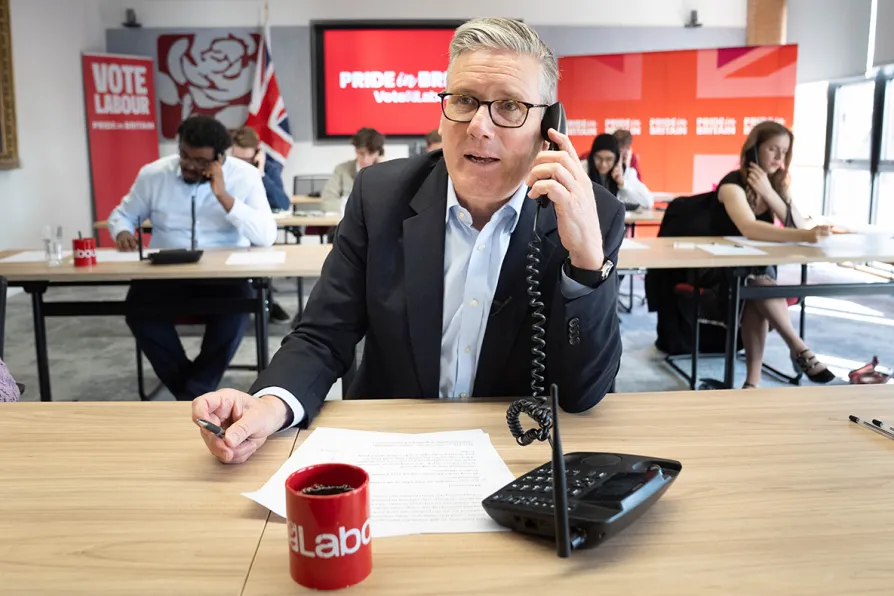
 Prime Minister Sir Keir Starmer helps out in the call centre at Labour Party headquarters in London, on the last day of campaigning ahead of the elections, May 6, 2026





LABOUR is facing electoral annihilation across the country on Thursday in elections that could bring the hard-right Reform UK a major step closer to power.
Much of Britain is set to deliver a damning verdict on Prime Minister Sir Keir Starmer’s two years in power in one of the most consequential sets of local elections ever.
Voting for the Scottish and Welsh Parliaments and local authorities across England, including every London borough, could mark a landmark in the breakdown of the long-standing two-party system.
Reform boss Nigel Farage claimed that “we will emerge over the course of the next couple of days as the only true national party.”
Last-minute polling suggests Labour could lose up to 1,850 of the 2,550 seats it is defending and crash to defeat in Wales for the first time in more than a century, with Reform projected to gain around 1,550 representatives.
If these predictions are borne out as results emerge on Friday, pressure will grow still further on Sir Keir to quit, given his epic-level personal unpopularity is clearly a deadweight on Labour’s vote.
Wales First Minister, Labour’s Eluned Morgan, indicated that she blames Labour’s nationwide record for the prospect of the party losing control of the Senedd for the first time since it was established in 1999.
She acknowledged that the premier “comes up as an issue on the doorstep” and not in a good way. Baroness Morgan was reduced to pleading with voters not to “pick a fight” with Sir Keir today.
Inertia may prove the Prime Minister’s ally. Enthusiasm for his leadership is at rock-bottom among Labour MPs but his most prominent rival, Greater Manchester Mayor Andy Burnham, is in no position to mount a challenge until he returns to the Commons, an event without a date on it presently.
Former deputy premier Angie Rayner and Health Secretary Wes Streeting both have their eyes on Downing Street but neither wishes to be seen to wield the knife.
However, a setback on the scale anticipated could finally push Labour MPs into action, with some sure to urge a change over the weekend.
Welfare Secretary Pat McFadden stressed today that Sir Keir would fight any attempt to remove him and there are reports there may be yet another prime ministerial relaunch at the weekend.
Pushing satire to its limits, former Labour deputy leader Tom Watson called for an end to “plotting.” Lord Watson’s own career has involved little else, with both Tony Blair and Jeremy Corbyn among his targets, perhaps the only thing they have in common.
Baroness Morgan today declined to back the premier “beyond this point in time,” the most lukewarm endorsement available.
She is likely to be succeeded as first minister in Wales by Plaid Cymru leader Rhun ap Iorwerth.
Final polls for ITV showed Plaid polling 33 per cent, ahead of Reform on 29 per cent, with Labour in a dismal and unprecedented third place with just 12 per cent, only a third of its 2021 vote.
Those figures would point to a Plaid-led administration, perhaps in coalition with Labour.
Final polls in Scotland suggest the SNP could secure a narrow overall majority in the Parliament, or fall just short, with Scottish Labour leader Anas Sarwar claiming 38 seats were “on a knife-edge.”
An SNP win which would trigger demands, sure to be rebuffed, for a second referendum on independence.
Labour may be marginalised, possibly trailing both Reform and the Greens as well as the SNP, its worst-ever Holyrood result.
In England, Labour faces a major challenge from the Greens in London and from Reform almost everywhere else.
The Farage-owned party is challenging the Tories in their southern and eastern heartlands and Labour in “red wall” authorities like Barnsley and Sunderland which it has always controlled.
The Tories are set to lose about 600 seats, suggesting their 14 years of failure have not been forgotten or forgiven.
In London, the Greens are looking at major gains at Labour’s expense, with many councils likely to fall to no overall control. The Greens might top the poll in several boroughs, including Hackney, Lambeth and Islington.
Election Calculus has calculated that should the results pan out as anticipated and then be read over into a general election, Britain would be on course for an authoritarian and racist neoliberal government.
Reform would win 248 seats and the Tories 112, enough for a comfortable Commons majority should the two right-wing parties form a pact.
Labour would be reduced to 78 seats, with the Greens surging to 66, the Liberal Democrats on 61, the SNP 46 and Plaid 15.
