Growing instability in the US economy and financial markets could have serious consequences worldwide because of the central role of the US dollar and financial system, argues MICHAEL BURKE


 Latest editorial

Making trade union members’ voices heard with Labour
JOANNE THOMAS argues that unions’ political voice remains vital to winning stronger rights and protections for working people
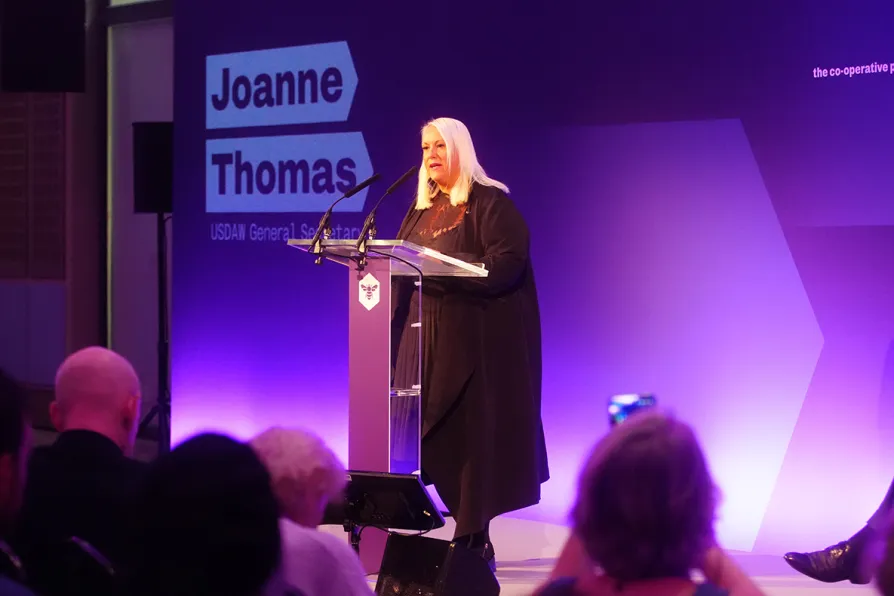 USDAW General Secretary and Labour Unions Chair Joanne Thomas speaks during the Co-operative Party Conference at the Leonardo Royal Hotel in central London, November 15, 2025
Despite Andy Burnham’s declaration defending the continued partition of the island, all major international and internal trends are converging to make Irish reunification inevitable
The left needs a bold energy vision – because if it fails to provide one, others will shape the future in their own interests, argues ALAN SIMPSON
From Margate to Deal, mining memories are being kept alive. National co-ordinator for General Strike 100, HENRY FOWLER continued his nationwide tour of partner organisations in the Garden of England
Humans are part of the ‘animal kingdom’ – and of nature in general – but also distinct from it and labour (work) is part of what makes us unique, declared Engels. His insights 150 years ago into how our species came to be and how we differ from the rest of nature, are as important today as they were then, says the MARX MEMORIAL LIBRARY
Boxes of books, family photos and heirlooms, labour movement anniversaries, along with nostalgic memories of glorious childhood days on the Ayrshire coast still leave room for a wistful MATT KERR to hope for a better future





EARLIER this year, I had the privilege of speaking at the historic Durham Miners’ Hall. Known across north-east England as the Pitman’s Parliament, it is a place where generations of working people came together to debate how to change the world for the better, much like Usdaw delegates are doing in Blackpool this week.
Standing there, surrounded by the banners of the Durham miners, I found myself reflecting on how far the trade union movement has come, where it is headed and the historic bond between trade unions and the Labour Party.
Usdaw is involved in politics because political decisions shape the lives of our members. That has long been understood. It is why our predecessor union, the National Union of Shop Assistants, Warehousemen and Clerks, was among the 40 or so unions that came together to found the Labour Party over a century ago. That link has always mattered because it ensures the voices of ordinary working people, including retail workers, are heard in the corridors of power, where they belong.
Trade unions like Usdaw played a central role in securing a Labour government in 2024, and in the past 18 months, we have seen genuinely transformative change. Last year, the government passed the Employment Rights Act. Usdaw was involved in shaping Labour’s New Deal for Working People from the outset, and now it is the law. I am proud of that.
For too long, our members have lived with insecurity as a fact of life. The Employment Rights Act begins to turn that around. It guarantees sick pay from the first day you need it, cracks down on exploitative zero- and short-hours contracts and curbs the use of fire and rehire to drive down pay and conditions. This is not tinkering at the edges. It is part of a wider effort to rebalance power at work, extending day-one rights, strengthening trade unions and making the law work in practice, so dignity, fairness and security are no longer the exception but the norm.
Now the government must ensure the Act works in the real world. It cannot simply be good on paper. That is why I have consistently raised critical issues with ministers, with the Chancellor and with the Prime Minister, including the need to ensure the right to a contract reflecting the hours you actually work applies to everyone.
Our members should be under no illusion. If the government gets this wrong, I will say so. We will work with Labour governments as a constructive partner, but I will never shy away from telling them when they fall short. Using our political voice to campaign on our members’ priorities is not optional. It is essential.
Usdaw’s campaigning has also driven action on the violence, threats and abuse faced by retail workers, an issue previous Conservative governments repeatedly refused to confront. The Crime and Policing Bill is nearing the end of its passage through Parliament, and Labour moved quickly to respond, backing stronger policing and more uniformed patrols in shopping areas.
Early signs of progress are emerging, including the first fall in recorded shop theft since the pandemic, but there is still much more to do.
Both the Employment Rights Act and the stand‑alone offence of assaulting a shopworker show what happens when trade union members’ voices are in the room. While other parties offer simplistic answers, Labour delivers because of its link with working people through trade unions, not in spite of it.
The industrial and political work of trade unions are two sides of the same coin. Strong Labour representation at Westminster, in Holyrood, the Senedd and local councils is essential to deliver the lasting political change working people need, at work, at home and in their communities. When members’ voices are heard, real progress follows.
Joanne Thomas is general secretary of Usdaw.
