


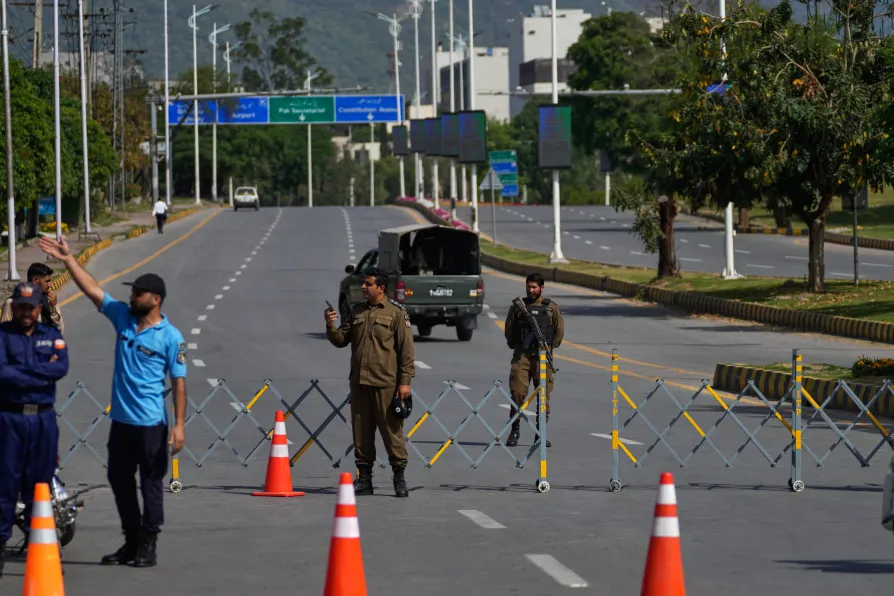
 Police officers stand guard at a checkpoint ahead of the second round of negotiations between the U.S. and Iran, in Islamabad, Pakistan, April 21, 2026





THE United States and Iran have signalled they will hold a new round of ceasefire talks in Pakistan, two regional officials said today.
Leaders from both sides warned they were prepared for more fighting if the fragile two-week truce expires without a deal.
Neither the US nor Iran has publicly confirmed the timing of the talks in Islamabad, with Iranian television denying any official was already in Pakistan’s capital.
Pakistan-led mediators received confirmation that the top negotiators, US Vice-President JD Vance and Iran’s parliament speaker Mohammad Bagher Qalibaf, will arrive in Islamabad early Wednesday to lead their teams in the talks, the regional officials told reporters.
Both sides remain dug in rhetorically.
US President Donald Trump has warned that “lots of bombs” will “start going off” if there’s no agreement before the ceasefire deadline, and Iran’s chief negotiator said that Tehran has “new cards on the battlefield” that haven’t yet been revealed.
The ceasefire could be extended if talks resume, though President Trump said in an interview on Tuesday with CNBC: “Well, I don’t want to do that. We don’t have that much time,” adding that Iran “had a choice” and “they have to negotiate.”
The US confirmed today that its forces boarded an oil tanker previously subjected to US sanctions for shipping Iranian crude oil in Asia. The Pentagon said in a social media post that US forces boarded the M/T Tifani “without incident.”
The US military did not say where the vessel had been boarded, though ship-tracking data showed the Tifani in the Indian Ocean between Sri Lanka and Indonesia on Tuesday.
The statement added that “international waters are not a refuge for sanctioned vessels.” Sanctions applied by the United States have no standing in international law.
Control of and access to the Strait of Hormuz remains key to the success of the negotiations.
The US imposed the blockade to press Tehran to end its stranglehold on the Strait, through which 20 per cent of the world’s natural gas and crude oil transits.
Iran’s grip on the strait has sent oil prices soaring. Brent crude, the international standard, was trading at close to $95 (£72) per barrel on Tuesday, up more than 30 per cent from February 28, the day that Israel and the US launched their illegal and unprovoked attack on Iran.
Over the weekend, Iran said that it had received new proposals from Washington, but also suggested that a wide gap remains between the sides.
Issues that derailed the last round of negotiations included Iran’s nuclear enrichment programme, Israel’s continuing war on Lebanon and terms for opening the strait.
