


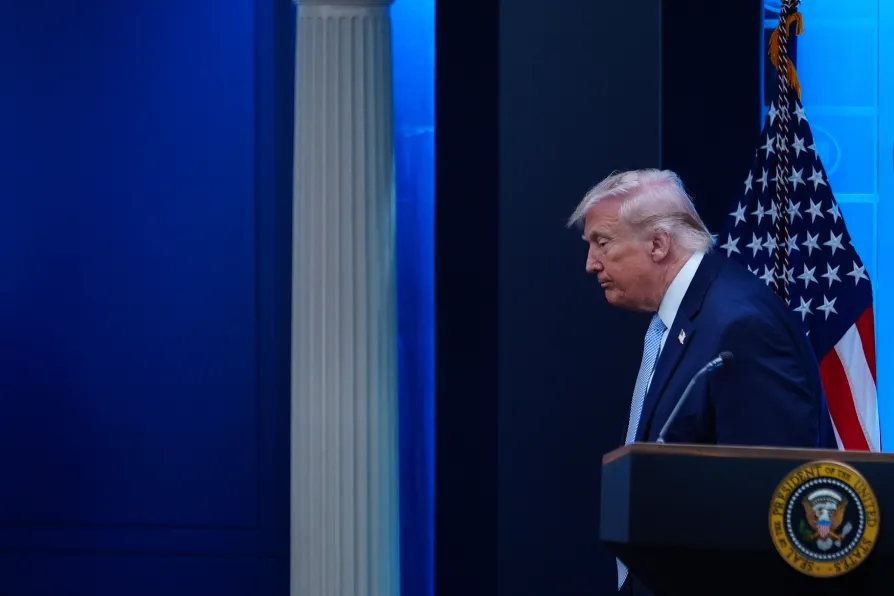
 President Donald Trump departs after speaking with reporters during a news conference in the James Brady Press Briefing Room at the White House, April 6, 2026, in Washington





THE two-week ceasefire brokered by China and Pakistan is a welcome initiative that meets both the immediate need to protect civilians and the necessity, for the global economy, for the resumption of fossil fuel supples.
Two features of the document issued by the two states — and reflecting the conditions imposed by both opinion and necessity on the the United States — is for an end to attacks on civilians, infrastructure and non-military targets.
That this directly repudiates the aims, however maladroitly and crudely expressed by Donald Trump, to bomb Iran back to the Stone Age, is but one of the setbacks the bellicose president has had to accept.
The Iranian people are the keepers of a culture and civilisation many millennia in the making, the guardian of a priceless heritage of art, science and thought and are situated at the crossroads of a vast and now renewed traffic in people, material goods and ideas.
This is one factor that, in conditions of a guaranteed peace, might begin to change the geometry of Iran’s domestic politics and allow for a democratic renewal on terms determined by the Iranian people themselves.
Perhaps similar conditions exist in the US and that the feeling among the US people for an end to foreign wars could lead to a revival of a politics centred on their needs rather than the divided interests of US banks, big oil and big business.
Iran is a multicultural nation of 90 million people that has already endured the worst that imperialism can level against it.
Long under the suzerainty of the British empire its people fought for sovereignty and when the oil was nationalised Britain and the US combined to install a despotic royal family to protect the assets of the Anglo Persian oil company, aka British Petroleum.
Iran suffered immense human and material damage when the US gave its then ally, Saddam Hussein, in neighbouring Iraq, the green light to begin a destructive war that served only imperialism’s permanent interests to keep the peoples of the region at war.
We don’t have to be partisans of the present regime to note the responsible tone of Iran’s diplomats in contrast to the deluded rantings of the US president and his crackpot appointees.
That key elements in the professional, administrative, judicial, intelligence and military bureaucracy of the empire is out of step with Trump is a marker of just how incoherent US foreign policy has become.
Britain, of course, could exercise what influence it has to act at variance with present US policies. It is an illustration of just how intertwined is British capital with US capital that the prime minister lacks even the imagination, let alone the will, to act in the interests of our people when they diverge from those of capital.
Two further provisions of the China/Pakistan initiative are for the opening of the sea routes and for the primacy of the United Nations Charter.
The first of these goes some way to meet the almost universal desire for a normal resumption of trade and gives Trump wriggle room to consider his options in the light of the increasingly clear understanding that Iran has a powerful weapon at its disposal for which the US has no adequate answer without a very high human cost.
The second gives expression to the almost unanimous sense that the unilateral exercise of US military power is not just a threat to the global South, the nations at intermediate levels of economic development, but also a problem for developed capitalist states normally in the US sphere of influence.
Some recognition of this by Labour and the government should be the demand of Labour’s affiliated unions.
