
APURBA CHATTERJEE explains how British artists in India used the “picturesque” to reshape colonial landscapes and celebrate imperial power


Palestine on Archway Road
JAN WOOLF invigilates images that meditate on Palestine, and the people who witness them
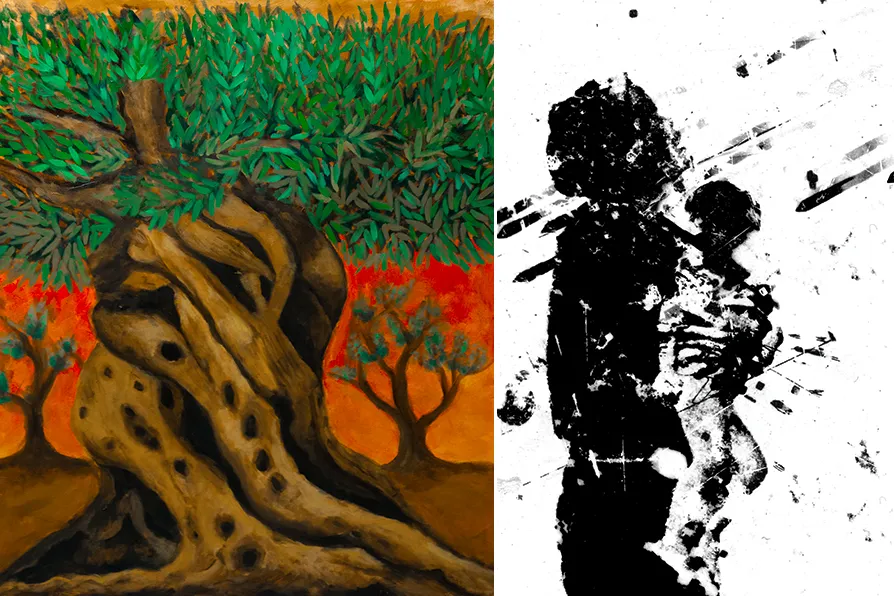
 (L) Malak Mattar, If the Olive Trees Knew, 2026; (R) Peter Kennard, Palestine Untitled 33 [Pics: Courtesy of Both Gallery]
PAUL DONOVAN welcomes a revival of Reginald Rose’s classic play that reminds us of the fundamental need for trials with juries
SIMON PARSONS applauds an exceptional performance of Wesker’s little-known play, by the same actor for whom it was written 45 years ago
ANDY HEDGECOCK and MARIA DUARTE review Late Fame, The Death of Robin Hood, Leviticus, and Gail Daughtry and the Celebrity Sex Pass
ANGUS REID recommends a uniquely accomplished documentary collage that contemplates our relation to the natural world
GORDON PARSONS enjoys Kant’s ‘mind-boggling’ theory of human reality: that we create the reality we experience





Malak Matter and Peter Kennard: If the Olive Trees Knew
Both Gallery, Highgate, London
★★★★★
I OFFERED a day’s invigilation to Both, a small gallery on Highgate borders full of big ideas and emotion – where, until this Sunday, fine art meets Palestine.
Fine in both senses of the word. Paintings by 26-year-old Palestinian artist Malak Matter and eight photomontage works from one of the masters of the form, Peter Kennard. Curated by Gabby Samara, the exhibitions reveal the horror and sadness of the Palestinian situation.
But beauty too, as Malek’s 3 canvases of olive trees, with time-bound solidity, fill their canvases, as they do the hearts of the Palestinian people. Her work has a feel of William Blake about it. Two monochromatic paintings are full of vigour as are the small unframed water colours; fat birds, people in costume, landscapes. It’s hopeful that a young artist can make such work in exile.
Kennard’s work is more familiar to me; a selection of photomontage works — all A1 size under glass relating to genocide in Gaza. Yet, sitting still, not walking past, they change in nuance. My eyes riffle across them, left to right; Gaza spelt in Keffiyeh fabric among bomb rubble, cross-hairs of a gun on a child’s face, a stars and stripes military medal, the shadow of a warplane over the ghostly landscape of a woman’s face, the skull and salt timer sucking up the Palestinian flag, the rubbing out of the words Never Again from a blackboard (this one the subject of recent abuse from a zionist-inclined visitor) bullets hailing at a mother and child, and the Palestinian flag with the red turned to blood dripping down the white. The monochrome of these images support Malak’s colour work and vice versa.
The thing about sitting still among this art for a day is that you get to know it better, unlike wandering around with a notebook and a catalogue. You realise too how art can put vitality into a movement — like yeast — and that the artists can carry the burden of their subject matter and make art — not just polemic — out of it.
It’s good to see the visitors’ reactions: people who look hard and then like to talk. Being behind a table — a helper — is liberating because I’m not expected to know that much. I could be from the “sitting behind a desk, knows how to operate a cash machine” agency. People talk honestly about the work and want to know more. I missed the zionists by the way, much as they missed the point of Never Again. I should add that I am accompanied by Both’s co-director, artist Justine Hounam. Not good to do this alone, because of possible bother, but good to talk and to get to know her.
The Archway Road traffic rumbles and swishes by, evoking the rumble and swish of missiles, dividing the gallery from Highgate’s ancient woods, making me think of the olive trees of Palestine. How would I feel if the oaks and beeches of my country childhood were spliced by rocket fire? Kids in the school down the road slain? I look out during quiet patches at passers-by, and then back to the work.
This six-hour invigilation has gone surprisingly quickly. I am intending to go on the Nakba Day march on May 16. Well, I would, wouldn’t I? I’m an activist — in the know — for offering to invigilate in the first place.
Yet sitting there does change things, like rain will change the olive trees, like a visitor staring at Kennard’s work for just a few seconds where two fused images present a new truth, will change. This is quite unlike the new faddish immersion art where senses are highjacked by spectacle.
And I look at people looking. Some wearing keffiyehs, their solidarity in place, others wandering in off the street, curious, full of questions. All leaving with those images indelibly in mind.
Runs until April 12. For more information see: bothgallery.com.

Similar stories
The artist, who has just died, is embedded in the subconscious of the Palestinian people
MIRANDA RICHMOND relishes the gloriously liberated art of Roy Oxlade, and traces his method back to the thinking of David Bomberg, his acknowledged teacher
JAN WOLF enjoys a British revival of the 1972 come of age farce/panto Pippin
JAN WOOLF examines work that aims to give viewers a material experience of the environments in the polar north and Britain equally affected by the climate crisis