

 Latest editorial
Turning Tottenham Hotspur into a ‘financial powerhouse’ has cost the team greatly, says BRANDON WILLIAMS
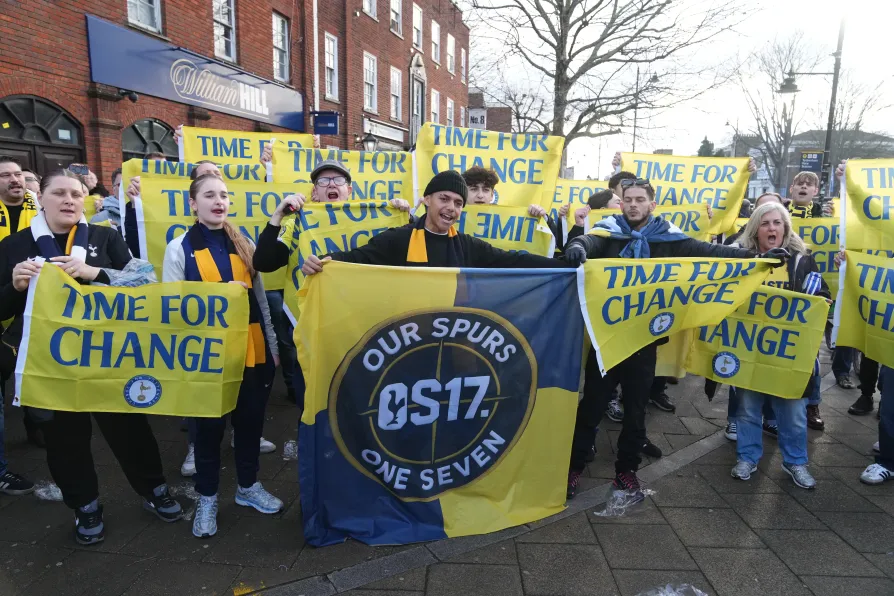 Tottenham fans taking part in a protest before the Premier League match at the Tottenham Hotspur Stadium, London, January 17, 2026





THERE is a video on the BBC Archive YouTube channel titled: 1979: Does English football need investment?
“We’re all a little bit wary of it in case they actually want to take us over so to speak. Being taken over by a big firm,” says then-Nottingham Forest manager Brian Clough about the potential perils of increased sponsorship in the professional game.
“I can think, for example, of the north-east where I used to work, at the ICI (Imperial Chemical Industries). A club taken over by the ICI, perhaps that club may be worried about losing its identity.”
Fast forward 47 years and deep in the heart of Texas, the South By Southwest festival is set to stage a talk by Ryan Norys, chief revenue officer at Tottenham Hotspur. The event is named “Beyond the Pitch: How Tottenham Hotspur Is Building a Cultural Powerhouse.”
The comically bad timing sees it land amid Spurs’ worst run of form … ever. Never before had the men’s side lost six in a row until February/March 2026, which has resulted in the Lilywhites being drawn into a relegation battle in the Premier League.
Norys’s talk was eventually cancelled. Organising a discussion about the club’s ability to generate seismic wealth during a time when the EFL Championship appears in the wing mirror like the T rex in Jurassic Park seemed to crystallise the corporatised identity of modern Tottenham and how far removed it is from its foundations as one of England’s most prominent clubs.
As turnover continues to exceed over £500 million, supporters have become increasingly disenfranchised with the team, leading to booing, protests and early exits. While these have increased after recent poor results, there is something larger at play here. Something that has arguably loomed over the north Londoners since the early 1980s.
What if Clough’s concerns about corporate takeovers were slightly misplaced? What if the clubs themselves became those corporations that left their identities behind?
In 1981, the FA made changes to Rule 34, allowing club directors to earn salaries if they were full-time and increase the dividends clubs were able to pay out from 5 to 15 per cent. Two years later, Tottenham’s new chairman Irving Scholar took advantage of the relaxed regulations and made Spurs the first football club to float on the London Stock Exchange.
Forming Tottenham Hotspur PLC as the holding company, the club was now, like a lot of Britain in the 1980s, at the will of the market. The move relieved debts for a brief time, even allowing Spurs to recruit Pauls Stewart and Gascoigne and proceed with a new West Stand at White Hart Lane.
Tottenham were pioneers of taking power from footballing authorities into the boardroom, helping set into motion the monetised focus of English football as a whole. Manchester United later joined them on the LSE and rumours of the Big Five teams breaking away had ballooned into reality with the formation of the Premier League.
This was not exclusive to Tottenham. Ending gate sharing and 1985’s Heathrow Agreement showed the gradual manoeuvring by some of England’s biggest teams to extract more wealth from the game.
As Arsenal vice-chairman David Dein later said: “After spending time in the States and seeing how the Americans operated their sport … I felt we were light years behind and we had so much more to give as an attraction.”
Scholar was not there to witness that as Tottenham became overloaded with debt again. Alan Sugar lifted that burden in 1991 and was set to take a fresh approach to this new era of elite football as he partnered with Terry Venables. The former taking care of business while the latter was centred on the pitch but both with a financial stake in the club. This relationship soon broke down as both men wrestled for ultimate control.
Unlike Scholar’s time in charge, however, Sugar’s chairmanship did not end in financial woes. In fact, the criticism that followed him was quite the opposite. While Spurs became a stronger company — appearing in the top 20 of the Deloitte Money League every year since its inception in 1996 — their footballing success dwindled, with supporters pointing the finger at Sugar’s decision-making and lack of investment.
Sugar never truly recovered from his falling out with Venables, and arguably neither have Tottenham. It was when the club fully morphed into its financialised self. The weight of the past was still there, but becoming lighter to those in the hierarchy.
As Sugar stated during a libel case with the Daily Mail, he never felt he was to blame for Spurs’ lack of success. “[The fault] ain’t mine. I don’t kick the balls, do I? Who else’s fault is it?”
Record appearance maker Steve Perryman was not so forgiving to Spurs’ new look. “I’ve been exposed to the likes of [Alan] Sugar and [Irving] Scholar. I fell out of love with football, and Spurs, when I was assisting Ossie [Ardiles] under Sugar. I saw then what businessmen can do to football and it soured everything.”
ENIC followed in this mould. It is remarkable in hindsight to read Daniel Levy’s opening words upon their takeover in 2001 as it seemingly predicts the calculated hawkishness he would come to run the club with. “We believe the long-term profitability and capital value of Tottenham can be significantly enhanced through further exploitation of media and sporting rights associated with the club.”
ENIC have lasted longer than Scholar and Sugar combined and built the club into a financial behemoth. This scaling up, however, was able to happen because of the work of a few talented managers and players.
Executive chairman Levy did not have success on the pitch at the forefront for the club’s plan, saying in 2009 that a new stadium was based on having “Premier League status; it is not based on European qualification.”
Until 2021, ENIC had only injected under £80 million of its own cash into the club since its takeover and there was never truly a strong structure within to supply the first team. The focus was that new stadium.
Often seen as the zenith of Spurs’ rise into the Big Six, they have only finished in the top four twice since moving into the Tottenham Hotspur Stadium. It is hard to believe it is now in its eighth season of use, such is the lack of warmth reflected in the atmosphere and ticket pricing.
“We’re starting to become not just a football venue,” Norys told the Unofficial Partner podcast in February. “But a global entertainment destination.”
Such a sentence reeks of cold capitalist practices and only exacerbates the disconnection between what Tottenham has been for a long time — a business scaling up — and what it should be — a football club. Too focused “beyond the pitch” if you will.
ENIC and Levy never provided the ambition Spurs needed either. The fear of collapse always lingered. “[When I joined] Daniel was afraid we were going to be in a relegation battle,” Harry Redknapp said upon qualifying for the Champions League in 2010. Even recently, David Ornstein reported that the current squad have relegation wage drops in their contracts.
Tottenham’s success became reliant on heroes in capes like Redknapp and Mauricio Pochettino, Harry Kane and Heung-min Son — individuals having to lift up what the collective around them couldn’t provide.
Levy would pay lip service to the attacking football principles of Arthur Rowe and Bill Nicholson, yet he and the board at large failed to understand that, to achieve their styles, ambition was required in recruitment. As was the case in the early ’60s, the “Tottenham way” needed everyone to buy into it.
“A club like Tottenham Hotspur,” Nicholson recalled. “I used to say ‘if we’re not in Europe, we’re nothing. We’re nothing.’”
The risk-averse nature of the hierarchy trickled onto the pitch overtime. The game was not about glory anymore, it was about survival. Managers and directors came and went because it became easier to rip things apart at Spurs than build them up. Nothing to fall back on apart from profit.
The cosmic irony of course is that the only way Spurs could possibly go into financial trouble now is if they are relegated — something that is now dizzyingly close after defeat to Forest. Whether they go down or not, Tottenham’s financialised identity has reached its nadir.
Some will argue that the transformation of Tottenham as a financial institution is success in and of itself. But if this or any club is to be judged by their ability to generate money to diminishing returns on the pitch then it appears Clough’s warnings have come to pass.
